

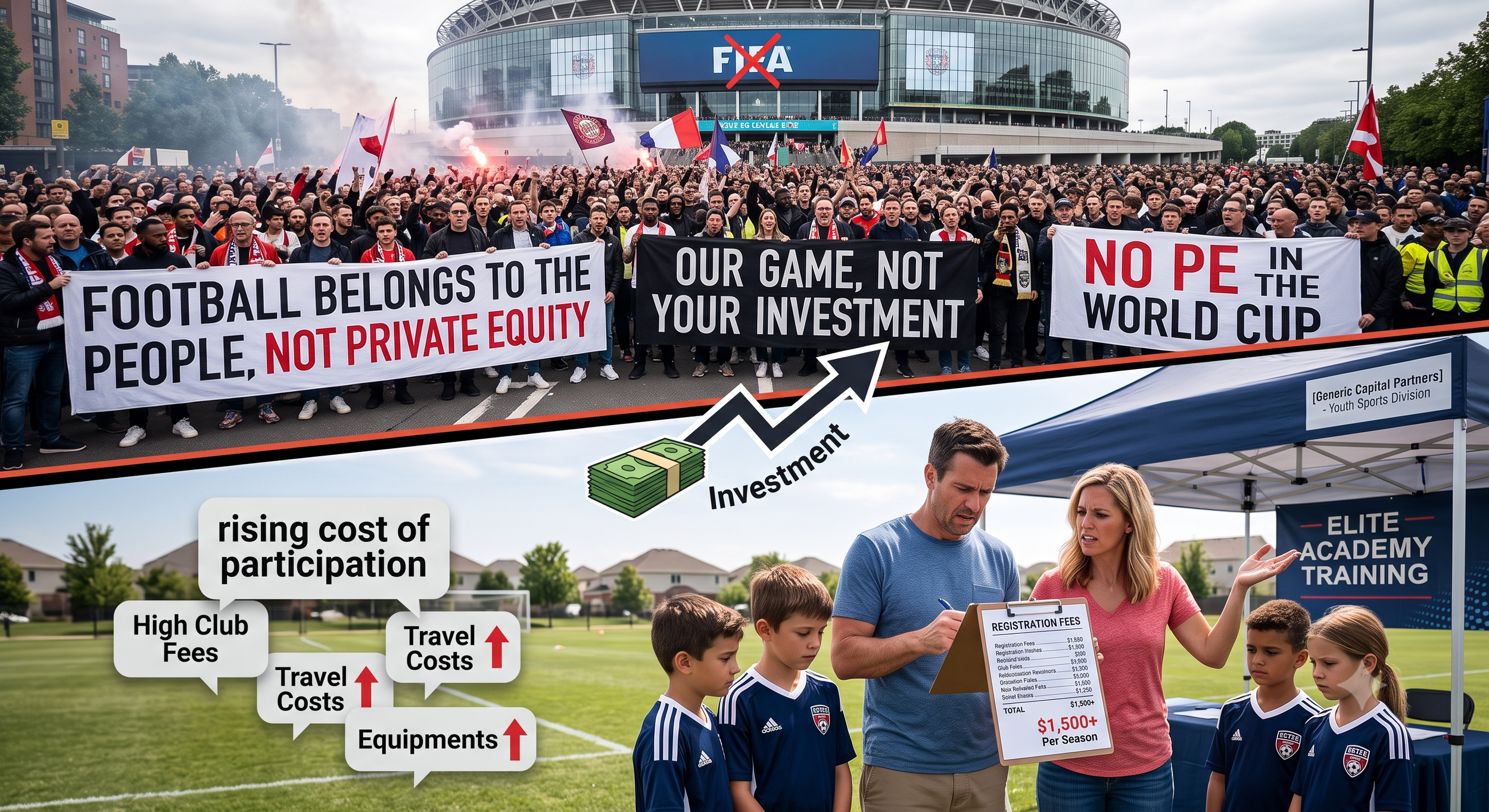
When the World Said No to Wall Street: Why Global Soccer Rejected Private Equity—and Why American Youth Sports Must Do the Same
When FIFA tried to sell off the World Cup to private equity, the global soccer community said NO. So why are we letting Wall Street take over American youth sports?
When a $20 billion proposal was introduced to spin off World Cup commercial rights to private investment firms, the backlash from UEFA, federations, and fans was immediate and uncompromising.
When FIFA President Gianni Infantino unveiled plans to spin off the commercial rights of the World Cup into a $20 billion venture backed by private equity, the reaction from the global soccer community was swift, unified, and uncompromising: The beautiful game is not for sale.
Across Europe, Asia, and North America, federations, clubs, and fans drew a hard line in the sand. Within days, the intense backlash forced FIFA to abandon the proposal entirely. Yet, while the international soccer community successfully protected its pinnacle tournament from shareholder intrusion, a very different story is unfolding in the United States.
Across America, private equity (PE) firms are quietly acquiring, consolidating, and commercializing the youth sports ecosystem. Without the regulatory guardrails or collective resistance seen on the global stage, Wall Street’s presence in U.S. youth athletics is pricing out families, eroding accessibility, and transforming what was once a community right into a profit-driven commodity.
"Not For Sale": How Global Soccer Defeated FIFA's Cash Grab
FIFA’s proposed project, dubbed FIFA Forward Enterprise (FFE), sought to sell a significant minority stake in the broadcasting and commercial rights of the men's and women's World Cups to private investment firms. The pitch was familiar: private capital would inject billions in immediate revenue, optimize commercial operations, and modernize the sport.
The global soccer ecosystem saw right through the corporate buzzwords. UEFA led a fierce resistance, warning that introducing private equity into the governance of international soccer would permanently warp the sport's priorities.
"Commercial return becomes a permanent obligation. Investor expectations become a daily pressure... From that moment onwards, every decision on the international calendar, every decision on competition formats and every decision shaping the future of football is no longer driven by what best serves the game, but by what best serves shareholders."
— UEFA Statement on Private Equity Involvement
The pushback was not just rhetorical. UEFA’s 55 member nations, joined by the Asian Football Confederation (AFC) and North America's CONCACAF, threatened to boycott FIFA competitions if the sale moved forward. Facing total institutional rebellion, Infantino scrapped the $20 billion plan, admitting that the proposal created divisions that were no longer in the interest of the sport.
America’s Pay-to-Play Crisis: Wall Street in the Neighborhood
While international soccer leaders successfully protected the World Cup from shareholder demands, American families are dealing with the exact consequences UEFA warned against—right in their own backyards.
Over the last decade, private equity firms have aggressively rolled up youth sports clubs, tournament operators, travel leagues, and sports facilities across the United States. The business model is simple:
Acquire and Consolidate: Buy up fragmented local clubs and regional tournament networks to create local monopolies.
Monetize the Pipeline: Require families to pay for expensive club memberships, mandatory travel tournaments, preferred-partner hotel bookings, and costly uniform packages.
Extract Value: Raise participation fees year after year to deliver the aggressive returns expected by fund managers.
The Toll on American Families
The financial burden on parents has skyrocketed. According to data from the Aspen Institute’s Project Play, the average American family spent $1,016 per child on their primary sport in 2024—a 46% increase over five years. For elite travel soccer, baseball, or volleyball teams, annual expenses now routinely hit $5,000 to $10,000 per child once travel, equipment, and private coaching are factored in.
When youth sports are treated as a commercial asset class, access becomes conditional on household income. Neighborhood leagues and community-focused development are replaced by an exclusionary "pay-to-play" system where children are evaluated not by their passion or potential, but by their parents' ability to cut a check.
Reclaiming the Game: Learning from the Global Resistance
The collapse of FIFA's private equity venture proves an essential truth: financialization is not inevitable. When a sports community recognizes the danger of shareholder pressure and stands together, it can draw a line that Wall Street cannot cross.
In the United States, awareness is finally beginning to build. Lawmakers have started investigating the consolidation of youth athletics, holding congressional hearings on how private equity’s fee structures are pricing kids out of the game. But legislative scrutiny alone is not enough.
To protect the future of American athletes, coaches, parents, and community organizations must adopt the same mindset that stopped FIFA's commercial buyout:
Demand Transparency: Require local clubs and tournament leagues to disclose ownership structures and financial interests.
Invest in Community Programs: Support and revitalize municipal parks-and-recreation leagues, school programs, and non-profit community clubs that prioritize participation over profit.
Reject the "Scholarship Myth": Push back against the predatory marketing that convinces parents they must spend thousands of dollars on private travel clubs for their children to succeed.
Youth sports should be a vehicle for mentorship, physical health, and community building—not a line item in an asset manager's portfolio. As the global soccer community just reminded the world, some things are simply too important to sell.
Sources
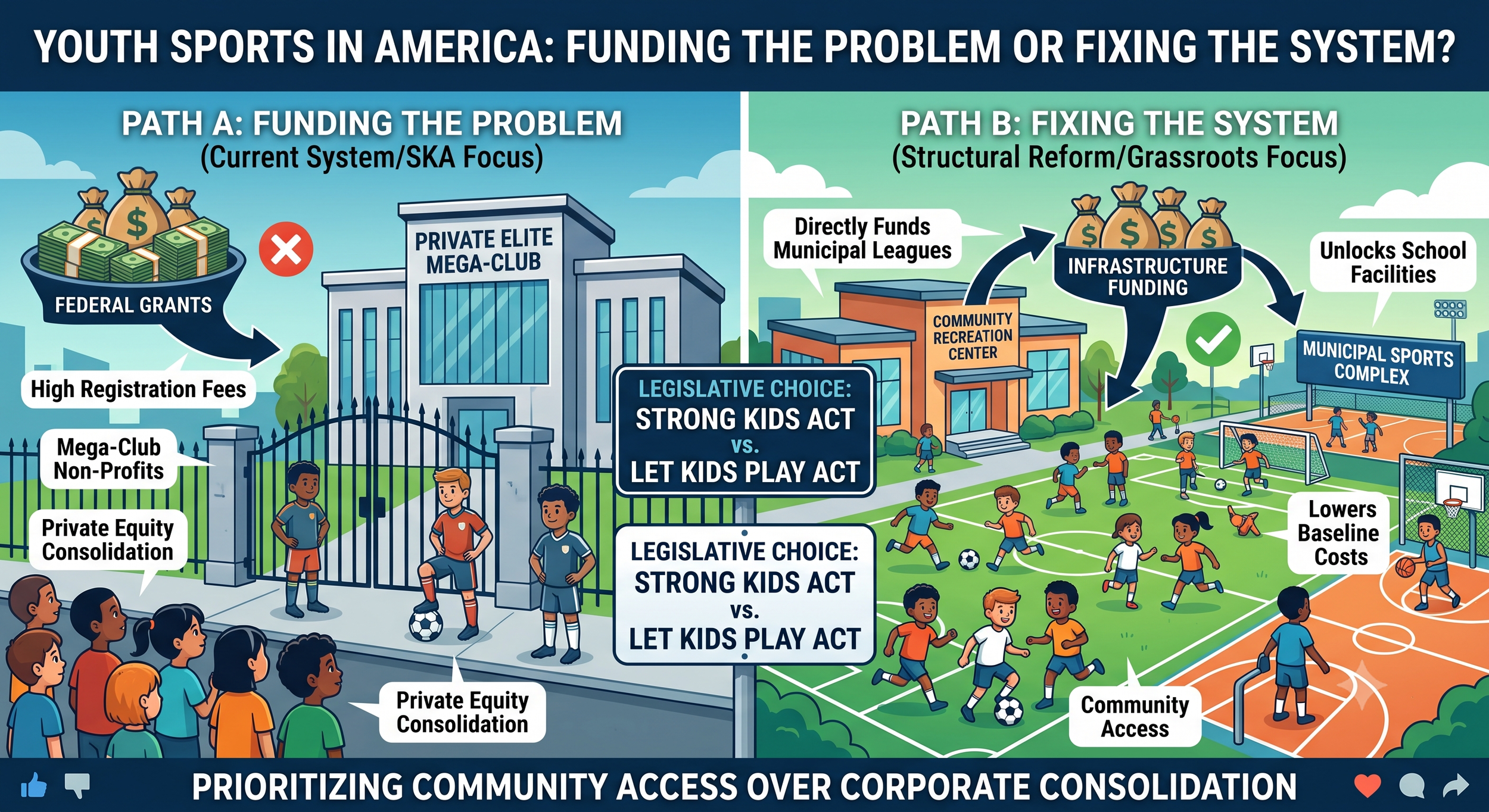
Funding the Problem vs. Fixing the System: Why SKA Misses the Mark on Youth Sports
We are at a defining moment for American youth sports—but simply throwing money at a broken system could make the affordability crisis worse.
Two major bills are currently in the arena: the STRONG Kids Act (SKA), which focuses on funding access, and the Let Kids Play Act (LKPA), which targets governance and market regulation.
We are at a defining moment for youth sports in America. With participation costs skyrocketing 46% over the past few years and families routinely spending over $5,000 a year per child, millions of kids are being priced out of the games they love. Lawmakers are finally stepping into the arena, but the debate has exposed a dangerous blind spot.
Two major pieces of legislation are now on the table: the STRONG Kids Act (SKA), which focuses on funding access, and the Let Kids Play Act (LKPA), which targets governance and industry regulation.
While both sound well-intentioned, simply injecting taxpayer grants into our current sports ecosystem without structural reform could actually make youth sports MORE expensive. Here’s why.
1. The Massive Loophole in the STRONG Kids Act
The core premise of the SKA is simple: get federal grant funding into the hands of local youth sports organizations as quickly as possible to lower cost barriers.
However, the bill suffers from a glaring structural flaw: its definition of eligible organizations.
As currently written, almost any registered "non-profit" that organizes youth sports programming can apply for funds. In the modern youth sports economy, "non-profit" is often just a tax filing status—not an operating philosophy.
The Mega-Club Paradox: Many of the country’s largest, most expensive "mega-clubs"—particularly in elite travel soccer and basketball—operate as 501(c)(3) non-profits. Yet, these same organizations charge families thousands of dollars per season, pay exorbitant executive salaries, and fuel the very affordability crisis this bill is trying to solve.
Manufactured Scarcity: Major league organizers and closed-circuit competitions often restrict access and territorial rights to protect the financial dominance of these elite non-profit clubs.
Subsidizing these entities without strict pricing caps or eligibility guardrails simply subsidizes the existing pay-to-play machine—and hands a government bailout to high-cost clubs.
2. Where Funding Actually Belongs: Grassroots Infrastructure
If Congress wants to use federal subsidies to increase participation, funds should bypass elite mega-clubs and target the infrastructure where everyday kids live and play:
Unlock School District (ISD) Facilities: One of the highest overhead costs for independent and neighborhood clubs is facility rental. Directing funds to ISDs could subsidize facility operations, allowing schools to open their fields, gyms, and tracks to community recreational teams free of charge.
Empower City & Municipal Leagues: Local city-run sports associations serve the broadest demographic. Funding them directly would allow municipalities to lower baseline registration fees across entire communities, making sports immediately more accessible to beginners and recreational athletes.
Key Takeaway: To move the needle on youth participation, funding must subsidize community access, not club overhead.
3. Why the Let Kids Play Act Hits the Root Cause
While the SKA attempts an accelerated funding patch, the Let Kids Play Act (LKPA) targets the underlying systemic force driving prices out of reach: the financialization and corporate consolidation of youth sports.
Youth sports has transformed into a $40 billion asset class. Over the past decade, institutional capital and private equity (PE) firms have flooded the space, deploying aggressive "roll-up strategies". They acquire independent local clubs, regional facilities, software platforms, and tournament circuits, bundling them into massive consolidated monopolies.
When PE firms enter an industry, their primary fiduciary duty is maximizing short-term yields for investors. In youth sports, this leads to predictable economic distortion: higher prices, reduced local competition, and structural exclusion.
How Restricting Private Equity Benefits the Entire Community
Passing the Let Kids Play Act—or implementing similar restrictions on PE "roll-ups" and predatory practices—isn't just about curbing Wall Street; it directly restores balance to local communities in five distinct ways:
Restores Local Competition & Prevents Price-Gouging: When a PE firm buys out three or four competing clubs in a single metro area, true competition dies. Families no longer have a low-cost local option if fees spike. Restricting roll-ups keeps independent operators in the market, forcing organizations to compete on quality and affordability.
Eliminates Mandatory "Ecosystem" Lock-Ins & Junk Fees: PE-backed sports networks rarely just charge a tuition fee. They build integrated ecosystems that require families to buy from their proprietary uniform lines, use their mandated scheduling apps, and stay at designated hotels through compulsory "stay-to-play" tournament schemes. The LKPA bans these coercive tie-ins and hidden junk fees.
Reclaims Field & Facility Access for Local Rec Leagues: When PE firms buy or manage local sports complexes, their goal is peak yield per square foot. They prioritize high-priced club teams and lucrative travel tournaments, effectively pricing out municipal, school, and volunteer-run recreational leagues. Curbing PE control ensures public and community facilities remain accessible to the majority of kids who want to play locally.
Shifts Focus from Capital Extraction to Community Retention: When a local club is community-owned or a true grassroots non-profit, registration fees stay in the neighborhood—funding local coach stipends, field maintenance, and financial aid. When PE owns the club, revenues leave the community to pay management fees and service leverage debt. Banning predatory financial practices keeps local dollars working for local families.
Preserves the True Role of Youth Sports—Social Health & Inclusion: Youth sports should be a public good that builds physical health, character, and social cohesion across socioeconomic backgrounds. When managed purely as a financial asset, sports become an exclusive luxury item. Restricting speculative capital allows youth sports to return to its core function: an accessible community foundation where every child gets a chance to play.
4. Complementary, Not Competing
We do not have to choose between getting kids on the field today and reforming the industry for tomorrow. These bills are complementary, not competing.
Solving the affordability crisis in American youth sports will take more than a single bill. It requires us to stop confusing "elite talent development" with "community youth sports"—and to ensure our policy solutions put everyday kids ahead of institutional incentives.
Sources
https://www.murphy.senate.gov/imo/media/doc/let_kids_play_act_one_pager.pdf#:~:text=Youth%20sports%20used%20to%20be%20a%20cornerstone,out%20of%20reach%20for%20millions%20of%20kids.
https://www.duanemorris.com/alerts/new_bill_seeks_let_kids_play_limiting_private_equity_youth_sports_0526.html#:~:text=The%20Let%20Kids%20Play%20Act%20is%20not,private%20equity%20from%20the%20youth%20sports%20industry.
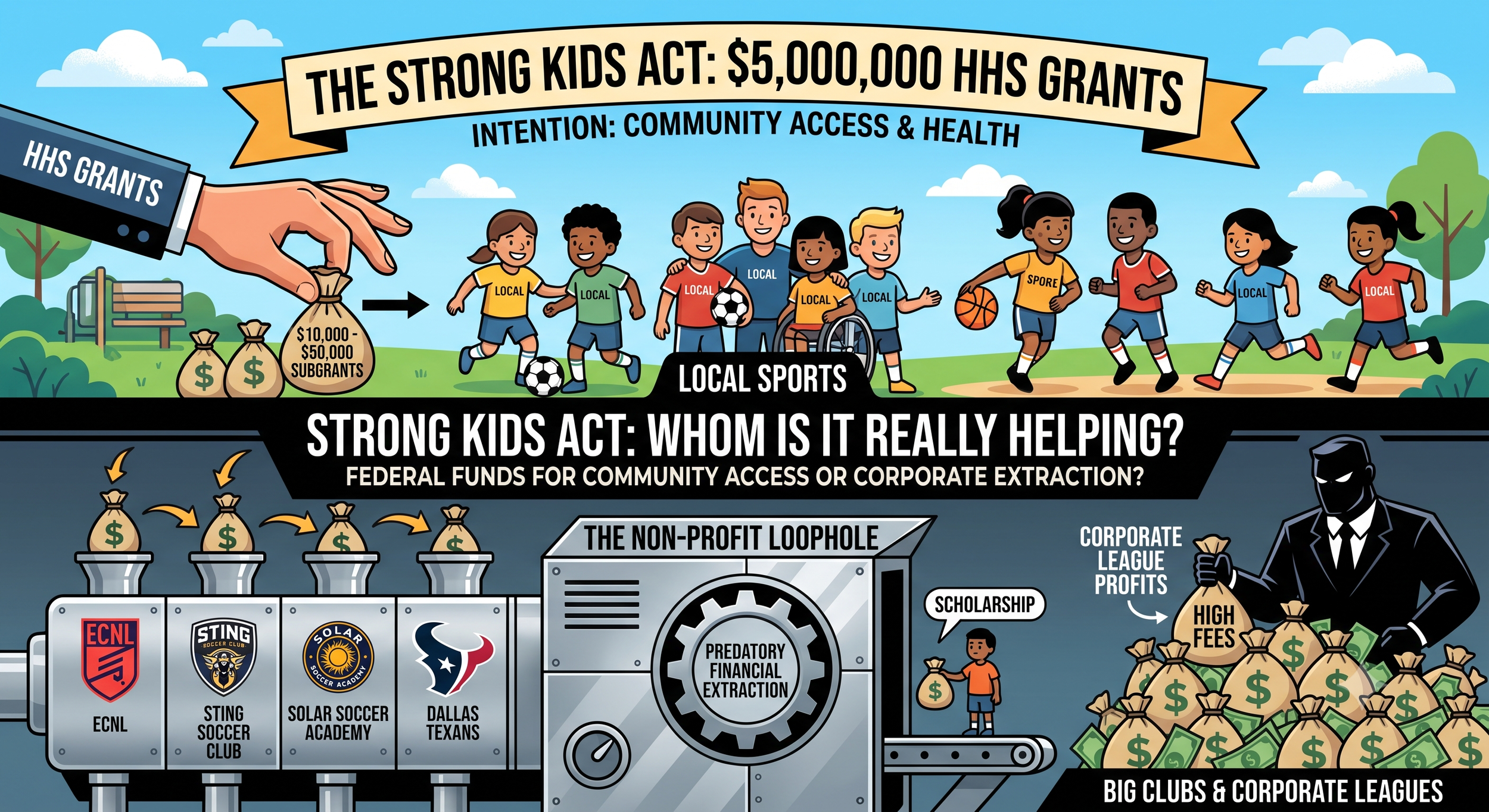
The Tax-Exempt Trojan Horse: How Mega-Clubs and Corporate Leagues Could Exploit the STRONG Kids Act
While the rest of the world views football as a localized, meritocratic ladder accessible to the working class, the United States has engineered something entirely different: a closed-loop wealth extraction machine.
Under the guise of "growing the game," the U.S. soccer establishment has built a structural oligopoly that systematically locks out working-class athletes, stifles community club growth, and rewards billionaire owners for sporting mediocrity. A forensic look at the numbers reveals a transatlantic divide not of athletic talent, but of systemic greed.
Europe invests in its youth to build capital. America taxes its youth to protect it.
On its surface, the newly proposed Sports Training, Recreation, and Opportunities for the Next Generation (STRONG) Kids Act reads like a lifeline for a broken youth sports ecosystem.
The bipartisan bill aims to deploy federal grant money to national and regional organizations, which are then mandated to distribute subgrants to local entities.
The stated goal is noble: to improve the health impacts of youth sports and increase access for children who have been priced out of the game.
However, a close reading of the bill’s language reveals a glaring loophole—one that could allow the very organizations and competitive leagues responsible for the youth sports affordability crisis to line their pockets with federal funds.
The issue lies in the legislation’s broad definition of who qualifies for the money. According to the bill, to be eligible for a subgrant ranging from $10,000 to $50,000, an entity simply needs to be a "local nonprofit or government organization" and have "experience organizing youth sports". Furthermore, national and regional organizations can access primary grants of up to $5,000,000 and $2,500,000, respectively.
In the highly lucrative world of youth soccer, the "nonprofit" label is often a legal technicality masking a ruthless, highly commercialized enterprise.
The Alphabet Soup of Corporate Leagues
It isn't just the local clubs poised to benefit; the legislation explicitly empowers the governing bodies of youth sports leagues. This opens the door for sprawling league organizers, such as the Elite Clubs National League (ECNL), to capture federal funds or dictate the compliance guidance that local clubs must follow to receive subgrants.
These alphabet-soup competitive league labels dictate the modern youth sports ecosystem. They enforce rigid corporate structures that mandate out-of-state travel, exclusive uniform deals, and hyper-competitive environments. By centralizing power within these leagues, the system systematically strangles human growth, character development, and unstructured free play. Empowering these exact league organizers with millions in federal grants inadvertently reinforces the top-down corporate structures that created the access crisis in the first place.
The North Texas Profit Paradox
At the local level, look no further than the Dallas-Fort Worth metroplex, a hotbed for elite youth soccer. Mega-clubs like Sting Soccer Club, Dallas Texans, and Solar Soccer Academy dominate the landscape. These organizations possess massive footprints, sophisticated corporate structures, and astronomical registration fees that regularly reach thousands of dollars per player, per year—before factoring in the mandatory travel imposed by leagues like the ECNL.
Yet, on paper, many of these sprawling youth sports empires operate under 501(c)(3) tax-exempt status. They are, technically and legally, "local nonprofits." Under the current language of the STRONG Kids Act, these mega-clubs perfectly fit the criteria of an eligible entity for subgrants.
Subsidizing the Problem
The legislation specifically authorizes subgrant funds to be used for "enabling a league or team to reduce, waive, or cover the full amount of any fee for participation, including through providing scholarships". It also mandates that organizations prioritize "youth with limited resources".
While this reads as a protective measure, in practice, it creates a perverse incentive. A high-cost mega-club competing in the ECNL could apply for a $50,000 subgrant to fund a handful of internal "scholarships," thereby satisfying the bill's requirement. In doing so, the federal government would effectively be subsidizing the club's exorbitant fee structure rather than challenging the pay-to-play model. The taxpayer money simply flows into the club's broader operating budget, sustaining the very financial barriers the bill was drafted to dismantle.
A Missing Safeguard
The IRS has historically struggled to police 501(c)(3) sports organizations that operate like commercial private businesses. Without stricter guardrails, the STRONG Kids Act risks relying on an IRS classification that fails to distinguish between a community-based recreational program running on a shoestring budget and a multimillion-dollar youth sports conglomerate prioritizing elite showcase pipelines.
If lawmakers want to genuinely protect youth from the commercialization of play and increase access for underserved communities, the eligibility requirements must be tightened. Funding needs to reach organizations fundamentally structured around community access and athlete well-being—not just any entity holding a tax-exempt sticker and a history of organizing sports.
Conclusion
Until the definition of an "eligible entity" is revised to exclude organizations and league organizers with predatory financial models, the STRONG Kids Act remains vulnerable to exploitation by the exact actors it should be regulating.
Source:
https://carey.house.gov/wp-content/uploads/2026/07/STRONG-Kids-Act.pdf
https://www.bottlenoses.com/podcast/v/k3zz89xlkby3deyaazcmt45anrf2n2
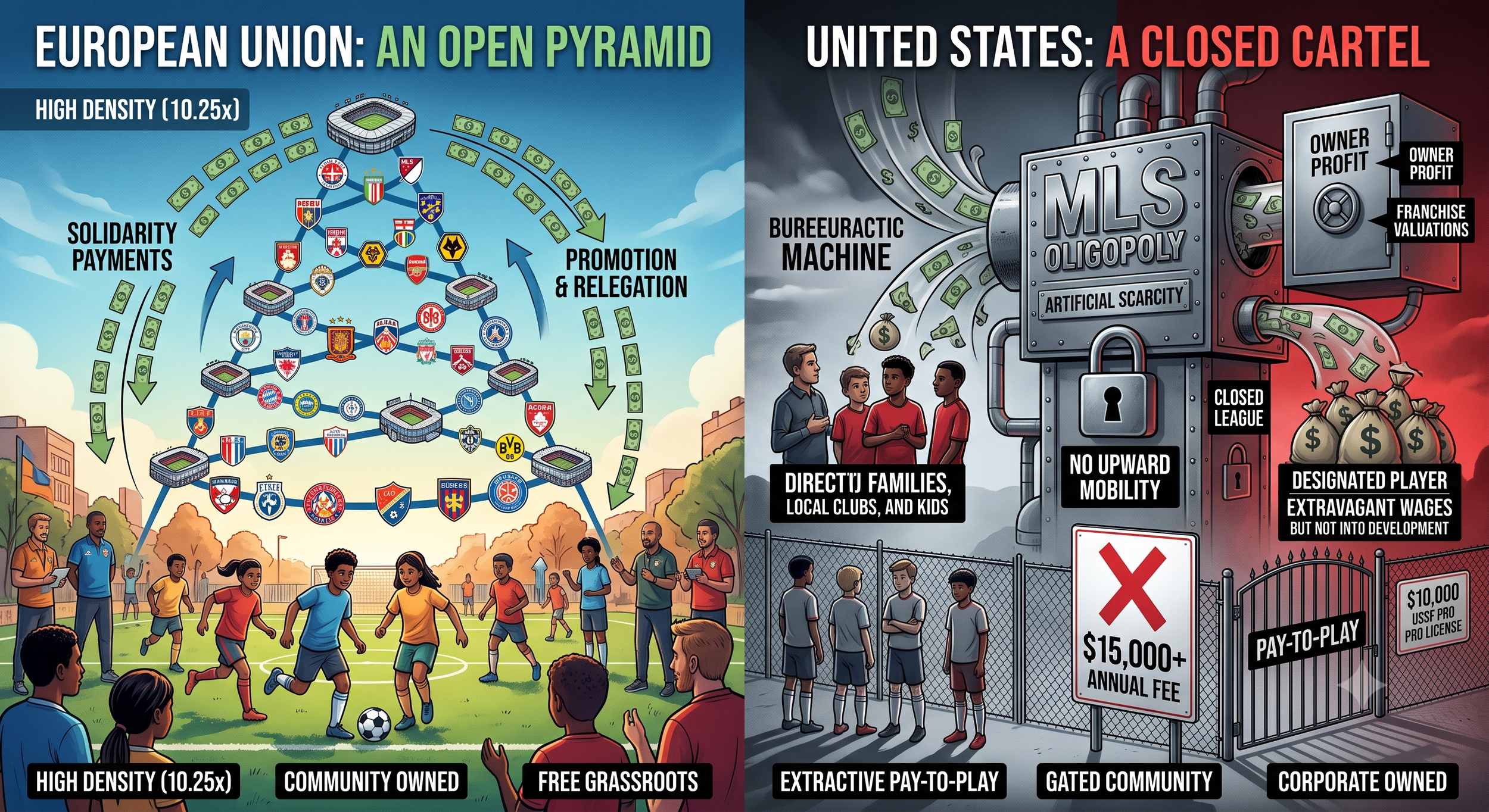
The Great American Soccer Extortion: How a Billionaire Cartel is Killing the Beautiful Game
While the rest of the world views football as a localized, meritocratic ladder accessible to the working class, the United States has engineered something entirely different: a closed-loop wealth extraction machine.
Under the guise of "growing the game," the U.S. soccer establishment has built a structural oligopoly that systematically locks out working-class athletes, stifles community club growth, and rewards billionaire owners for sporting mediocrity. A forensic look at the numbers reveals a transatlantic divide not of athletic talent, but of systemic greed.
Europe invests in its youth to build capital. America taxes its youth to protect it.
While the rest of the world views football as a localized, meritocratic ladder accessible to the working class, the United States has engineered something entirely different: a closed-loop wealth extraction machine.
Under the guise of "growing the game," the U.S. soccer establishment has built a structural oligopoly that systematically locks out working-class athletes, stifles community club growth, and rewards billionaire owners for sporting mediocrity. A forensic look at the numbers reveals a transatlantic divide not of athletic talent, but of systemic greed.
Europe invests in its youth to build capital. America taxes its youth to protect it.
The 10-Fold Desert: Geographic Isolation as a Weapon
The foundational failure of American soccer lies in its intentional, engineered scarcity. The efficiency of any sporting pipeline is dictated by its geographic saturation—how close the average child lives to a professional pathway.
In the European Union, a vibrant ecosystem of 1,328 fully professional clubs means almost every citizen is a short commute from a professional academy. Player discovery is exhaustive and localized. In the United States, an exclusionary franchise model has capped the professional landscape at roughly 100 clubs nationwide.
This catastrophic lack of density forces families in rural and mid-sized American markets to travel hundreds of miles just to be seen. The burden of discovery is entirely shifted from the professional club’s scouting budget directly onto the credit cards of American parents.
The "Non-Profit" Extortion Machine
Because professional clubs in the U.S. are too scarce to scout organically, player development is outsourced to an unregulated, pay-to-play industrial complex.
If a European child shows generational talent, professional clubs absorb their development costs entirely. It is an investment; discovering the next superstar funds an academy for a decade. In America, that same child’s family will be charged between $8,000 and $20,000 annually for access to elite platforms like ECNL or MLS NEXT, covering exorbitant travel, hotel stays, and coaching fees.
The hypocrisy is magnified by the tax code. Many premier American youth clubs operate as 501(c)(3) non-profits, yet function as ruthless commercial enterprises. Elite youth clubs in talent-rich regions report revenues in the millions—with over 94% coming from mandatory parent registration dues. Families pay with after-tax dollars, while the clubs shield their income.
The Coaching Bottleneck: Why are fees so high? Look at the United States Soccer Federation (USSF). A USSF Pro coaching license costs a staggering $10,000. In Spain, the equivalent UEFA Pro license costs roughly £1,070. By artificially restricting the supply of licensed coaches through exorbitant fees, the USSF forces youth clubs to pay premium coaching salaries—costs immediately passed down to parents.
The Solidarity Lifeline: How the Rest of the World Funds the Grassroots
While American parents are bleeding cash to fund local youth clubs, the rest of the global soccer economy is sustained by a built-in wealth redistribution engine: FIFA’s Training Compensation and Solidarity Payments.
Under FIFA regulations, whenever a professional player is transferred internationally for a fee, 5% of that transfer fee is carved out and distributed proportionally to the grassroots clubs that trained the player between the ages of 12 and 23. Additionally, training compensation mandates flat financial payments to youth clubs when a player signs their very first professional contract.
The positive impact of this system on youth development is staggering. It fundamentally shifts the economic model, transforming youth academies from fee-collecting businesses into heavily incentivized incubators of human capital.
Subsidizing the Working Class: A small, community-run club in France, Argentina, or Ghana can offer completely free development to hundreds of children because if just one of those players eventually reaches the elite level and is sold to a club like Chelsea or Real Madrid, the resulting solidarity payment can fund the local club's entire operation for a decade.
Automated Wealth Distribution: To enforce this, the newly established FIFA Clearing House automatically tracks transfers and collects the funds from elite clubs. In just its first 24 months of operation, the Clearing House distributed a massive $156.6 million in training rewards directly to thousands of grassroots clubs worldwide. It is a legally enforced trickle-down economy that actually works, directly supporting clubs that lack the financial power to retain top talent.
Yet, for decades, the U.S. soccer establishment and the MLS Players Association actively resisted participating in this system, framing it as an illegal "transactional tax" that restricted player movement. By blocking independent American youth clubs from collecting FIFA solidarity payments when their homegrown talents went to Europe, the system guaranteed that these youth clubs had only one remaining revenue stream to survive: extorting American parents.
Artificial Scarcity: Rewarding Mediocrity, Punishing Ambition
The American ecosystem is legally ring-fenced by the USSF's Professional League Standards (PLS)—a set of arbitrary financial benchmarks designed to protect the Major League Soccer (MLS) monopoly from free-market competition.
To sanction a Division I men's club, the PLS demands a principal owner with a net worth of $40 million and an enclosed 15,000-seat stadium. There is no promotion or relegation. A historic, community-backed club in a working-class neighborhood can win every match it plays for a decade, and it will never be allowed to enter the top flight unless a billionaire buys a franchise slot.
This closed market divorces financial success from sporting merit.
Real Madrid generates a record $1.27 billion in actual cash flow and carries a valuation multiple of 5.8x.
Los Angeles FC (LAFC) generates roughly $150 million in revenue but is valued at $1.4 billion—an absurd 9.3x multiple driven entirely by the artificial scarcity of MLS franchise slots and protection from relegation.
Lower down the pyramid, the economic suppression is devastating. While third-tier European players earn a livable €18,000 to €60,000 annually as full-time professionals, U.S. third-tier players scrape by on localized stipends of $12,000 to $30,000, forcing most into secondary employment just to survive.
A Glimmer of Hope: The NWSL's Labor Revolution
If there is a bright spot in the American landscape, it is the women’s game. Driven by relentless collective labor action, the National Women’s Soccer League (NWSL) is defying the restrictive financial models of its male counterparts.
Under their groundbreaking CBA, the NWSL is establishing true global financial benchmarks:
Salary Cap Growth: Rising to $5.1 million by 2030, augmented by shareable broadcast revenue.
Rising Floor: Minimum salaries scaling to $82,500 by 2030 (up from just $35k in 2022).
No Ceiling: The abolition of individual maximum salary limits allows top international stars to negotiate massive deals exceeding $500,000 annually.
By prioritizing player compensation over owner protectionism, the NWSL is demonstrating what a globally competitive American league can actually look like.
Blowing Up the Cartel
The U.S. Soccer Federation generated a massive $263.7 million in 2025, riding the commercial wave of the impending 2026 World Cup. Yet, this wealth remains trapped at the executive level while the grassroots system starves.
The American soccer pipeline inadvertently selects for household wealth rather than athletic potential. To fix it, the USSF cannot simply "tinker" with registration fees. The entire cartel must be dismantled.
Until the U.S. institutes an open pyramid with promotion and relegation, drops the billionaire-only PLS requirements, and enforces domestic FIFA solidarity payments—so that independent youth clubs are actually financially rewarded for producing pros rather than bleeding parents dry—American soccer will remain exactly what it is today: a gated community for the affluent, masquerading as a global sport.
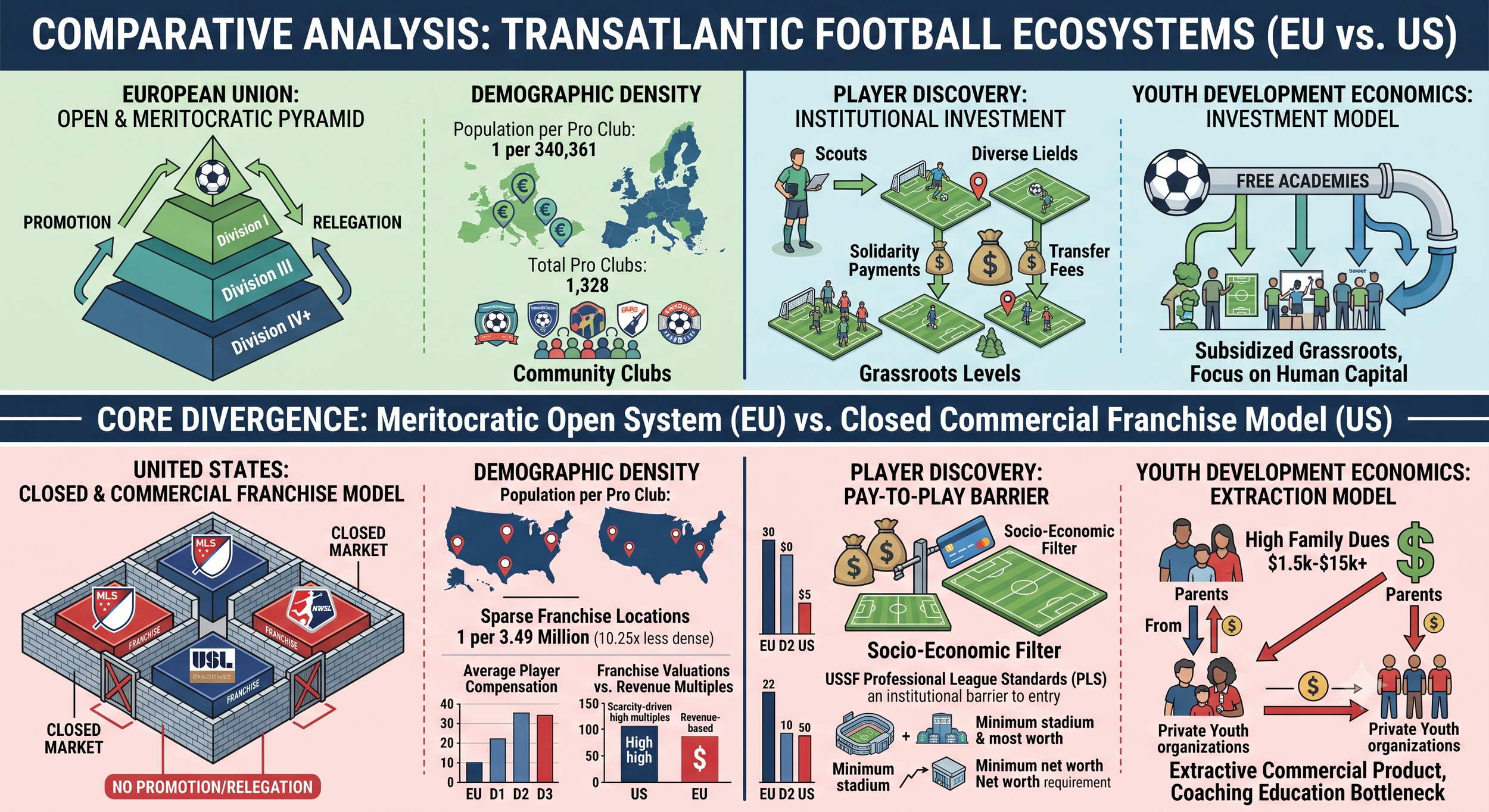
Structural and Economic Divergence in Transatlantic Football: A Comparative Analysis of Professional Soccer Ecosystems in the European Union and the United States
The report demonstrates how the exponentially larger number of professional soccer clubs in Europe facilitates granular, localized talent identification, whereas the highly commercialized "pay-to-play" model in the United States acts as a severe socio-economic barrier to entry.
1. Introduction
The global football (soccer) industry is characterized by distinct regional architectures that dictate how athletic talent is identified, developed, and monetized. At the forefront of this global market are two fundamentally divergent models: the European Union (EU) ecosystem, which relies on a decentralized, meritocratic, and community-integrated pyramid structure, and the United States (US) ecosystem, which is defined by a centralized, top-down franchise model governed by strict artificial scarcity.
This report provides an exhaustive, forensic comparative analysis of the financial compensation, structural incentives, and systemic frameworks across all professional soccer clubs at every division in the EU and the US.
The primary focus of this comparison is to highlight the stark contrast between the two populations and their respective sporting economies. This includes analyzing the number of professional clubs per capita, the financial compensation gaps at various professional tiers, and the overarching accessibility of player discovery.
The report demonstrates how the exponentially larger number of professional soccer clubs in Europe facilitates granular, localized talent identification, whereas the highly commercialized "pay-to-play" model in the United States acts as a severe socio-economic barrier to entry.
Furthermore, this analysis examines the differing approaches to youth development costs, the critical role of solidarity payments as an incentive for youth academies to develop and sell players, and the overarching incentives provided by regional soccer federations to support grassroots growth.
By dissecting collective bargaining agreements, franchise valuations, coaching education costs, and federation sanctioning standards, this report will trace how the structural oligopolies in the United States—maintained through stringent league standards and closed-market territorial rights—create artificial scarcity.
This scarcity inflates franchise valuations while simultaneously stifling organic, community-based club development, necessitating a comprehensive realignment of financial incentives from the grassroots to the professional ranks.
2. Demographic Foundations, Geographic Density, and the Accessibility Gap
To understand the economic disparities between the European and American soccer ecosystems, one must first analyze the fundamental demographic and geographic realities that dictate market density. The structural design of a nation's soccer pyramid directly correlates with its ability to discover, incubate, and elevate talent. A system's efficiency is largely determined by its geographic saturation.
2.1 Population Distribution and Professional Club Density
The European Union operates with a population of approximately 452 million people spread across 27 member states1. Within this bloc, there are 1,328 fully professional soccer clubs operating across multiple interconnected divisions1. This equates to approximately one professional team for every 340,361 EU residents1.
In contrast, the United States holds a population of 349 million people across 50 states and 5 territories1. However, the US soccer ecosystem supports only about 100 fully professional clubs1. This results in a staggering ratio of 3,490,000 people per professional team, representing a massive discrepancy in structural density1.
The implications of this 10.25-fold discrepancy in club density are profound and dictate the economic flow of the sport. In the European Union, the high density of professional clubs ensures that almost every citizen lives within a short commuting distance of a professional academy.
Major populations such as Germany (83.5 million, representing 18.5% of the EU), France (69.1 million, 15.3%), Italy (58.9 million, 13.0%), Spain (49.5 million, 11.0%), and Poland (36.1 million, 8.0%) sustain deep pyramids with fully professional third and fourth tiers1.
This geographic proximity drastically reduces the cost of participation, minimizes travel burdens on families, and creates a highly saturated scouting network where late developers or overlooked talents can easily transition to neighboring clubs.
In the United States, populations are heavily concentrated in massive geographic states such as California (39.3 million residents), Texas (31.7 million residents), Florida (23.4 million residents), and New York (20.0 million residents)1. Because there are only roughly 100 professional clubs nationwide, the geographic catchment areas for these clubs are vast.
A talented youth player in a rural or mid-sized American market may live hundreds of miles from the nearest professional academy. This geographic isolation shifts the burden of player discovery and development entirely onto the consumer—the player's family—who must fund extensive travel and elite club fees to access visibility.
2.2 The Mechanisms of Player Discovery
The exponential difference in club density fundamentally alters how talent is discovered and cultivated. In Europe, the presence of 1,328 professional clubs means there are over a thousand autonomous scouting networks actively competing to identify talent at the grassroots level.
Because European clubs benefit financially from developing and selling players through the global transfer market, they are highly incentivized to cast the widest possible net into working-class, immigrant, and rural communities.
Player discovery in this model is treated as an institutional investment; clubs absorb the cost of scouting and development because a single successful player sale can fund an academy's operations for a decade2.
In the United States, the scarcity of professional clubs severely limits organic scouting. Consequently, player discovery is largely outsourced to private, pay-to-play youth platforms such as the Elite Clubs National League (ECNL) and MLS NEXT3.
Because access to these elite platforms is contingent upon a family's ability to pay steep registration, coaching, and travel fees, the American talent pool is artificially restricted to upper-middle-class and affluent demographics5.
The working-class talent pool, which forms the bedrock of global football, is systematically priced out of the domestic discovery apparatus, forcing the US to rely on a significantly narrowed demographic subset for its national and professional pipelines6.
3. The Compensation Spectrum: From Superstars to the Grassroots
Financial compensation across professional soccer highlights the differing economic models of the two populations. While top-tier salaries in both regions reflect immense commercial and broadcast revenues, the distribution of wealth in the lower divisions reveals the depth, stability, and intent of the respective pyramids.
3.1 Division I: The Men's Top Flight
In the European Union's top leagues—specifically the massive domestic markets of the English Premier League, Spanish La Liga, Italian Serie A, French Ligue 1, and German Bundesliga—the average first-division player earns between €1.5 million and €2.5 million annually1.
However, the European open market creates a vast chasm in compensation even within a single 18-to-20-team division. Superstar clubs competing in the UEFA Champions League, such as Paris Saint-Germain or Real Madrid, feature average squad salaries exceeding €6 million to €8 million per player1.
Conversely, lower-table teams in those exact same divisions, battling annually to avoid relegation, may average closer to €400,000 to €500,000 per player1. This reflects a pure free-market approach where compensation is tied directly to a club's individual commercial power and sporting success.
In the United States, Major League Soccer (MLS) operates as a single-entity franchise structure with strict roster budgets and salary caps, yielding an average salary of approximately $594,000 per year1.
Due to the "Designated Player" (DP) rule, which allows clubs to sign up to three players outside the standard salary budget, standard averages are heavily skewed1. Elite DPs frequently earn between $2 million and $6 million, with global icons like Lionel Messi earning a base of $25 million and a guaranteed compensation package exceeding $28 million annually1. Conversely, the strict league minimum for senior roster players under the current collective bargaining agreement (CBA) sits between $88,025 and $98,000 per year, with reserve minimums resting around $71,401 to $80,6227.
This structure artificially suppresses middle-class domestic wages while allowing for exorbitant spending on top-tier international marketing assets.
3.2 Division I: The Women's Top Flight
The women's game in the United States represents a sector where the domestic ecosystem is aggressively setting global financial benchmarks, outpacing historical compensation models through collective labor action. The National Women's Soccer League (NWSL) has implemented landmark collective bargaining agreements that vastly restructure the financial reality for female athletes.
Under the new CBA terms, which extend to 2030, the NWSL has established a base salary cap of $3.3 million for the 2025 season, which is projected to rise incrementally to $5.1 million by 20309.
This cap is further augmented by a novel shareable revenue mechanism, ensuring that players directly benefit from increases in league broadcast and sponsorship income9. The minimum salary for an NWSL player is set at $48,500 in 2025 (up from just $35,000 in 2022) and will scale up to $82,500 by the conclusion of the agreement in 20307.
Furthermore, the NWSL features no maximum limit for individual player salaries, allowing top international and United States Women’s National Team (USWNT) stars to negotiate landmark deals worth $400,000 to $600,000+ annually1.
The average NWSL salary currently rests between $65,000 and $100,0001. These sweeping reforms include unrestricted free agency, guaranteed contracts, the abolition of the college draft, and the introduction of a "High Impact Player" rule10.
The High Impact Player mechanism allows teams to exceed the salary cap by up to $1,000,000 to sign players who meet elite global criteria, such as featuring in the Top 30 of Ballon d'Or voting, the Top 40 of the Guardian's global football rankings, or accumulating top minutes for the USWNT12.
This positions the American women's division as a highly competitive financial entity capable of retaining and attracting premier global talent.
3.3 Division II: The Secondary Professional Tier
The strength and sustainability of a nation's soccer infrastructure are often best judged by the economic viability of its second division.
In major EU nations such as Spain, Germany, and Italy, players in leagues like the Segunda División or Serie B earn robust wages between €150,000 and €350,000 annually1. In mid-sized EU nations, including Austria, Sweden, and Poland, second-division salaries adjust to regional economic realities, hovering between €40,000 and €80,0001.
This compensation is generally comparable to a stable local corporate salary, allowing players to focus entirely on their athletic development without the need for secondary employment.
In the United States, the men's second division is dominated by the USL Championship (USL-C). Following 547 days of exhaustive negotiations, federal mediation, and a near-strike authorization by 90% of the player pool, the USL Players Association (USLPA) secured a pivotal CBA lasting through 203013.
A primary victory for the players was transitioning standard contracts from 10-month playing-season agreements to standardized 12-month, year-round employment13.
The new CBA establishes a minimum compensation of $42,000 for the 2026 season, alongside an entry-level contract category set at $34,00014.
While top-tier USL veterans and proven goalscorers can earn upwards of $100,000 to $200,000, the average salary remains tightly clustered between $40,000 and $50,0001.
To offset these modest base salaries and address the high cost of living in American metropolitan areas, the CBA eliminated unilateral contract buyouts and mandated that clubs provide comprehensive health insurance matching front-office personnel plans14.
Furthermore, the CBA outlines future compensation minimums of $67,000 for the projected USL Premier league slated for 2028, signaling an ambition to close the gap with lower-tier MLS salaries15.
3.4 Divisions III, IV, and Below: The Grassroots Foundations
At the third and fourth tiers of soccer in major EU nations, clubs maintain fully professional legal status, meaning players hold full-time training and employment contracts1. These clubs are sustained by localized, community-driven commercial revenues, ticket sales, and minor broadcast distributions. Average earnings at this level range between €18,000 and €60,000 per year, or roughly €1,500 to €5,000 per month1.
Because these base wages are relatively low, European compensation packages at this tier are heavily reliant on club-provided housing, vehicles, and performance or win bonuses1.
By the fifth and sixth tiers, European clubs transition to semi-professional operations, where players hold separate day jobs, train in the evenings, and earn €350 to €1,500 per month supplemented by match-day stipends1.
In the US, the men's third tier comprises USL League One and the National Independent Soccer Association (NISA). In USL League One, average total compensation ranges from $25,000 to $30,000 per year, with star players earning up to $80,000 and entry-level minimums hovering around $2,350 monthly over the playing season1.
NISA operates on highly localized, austere budgets, where average player compensation is effectively a stipend of $1,000 to $2,000 per month during the active season, requiring most players to seek secondary employment to survive1.
4. Franchise Valuations and the Economics of Artificial Scarcity
The profound disparity in professional club density is not an accidental byproduct of disparate market interest; rather, it is the direct, intended result of divergent legal and economic frameworks governing the sport.
In Europe, clubs are traditionally community-founded entities that compete in an open pyramid. Valuations of European clubs are inextricably linked to their direct revenue generation, which is heavily dependent on sporting merit. If a club qualifies for the UEFA Champions League, its revenues soar; if it is relegated to a lower division, its broadcast and commercial revenues collapse.
For instance, elite European clubs like Real Madrid and Bayern Munich carry valuation-to-revenue multiples of roughly 5.8x and 6.3x, respectively16. Real Madrid's $9.5 billion valuation is justified by a staggering $1.27 billion in revenue generated during the 2024–25 season—a record total for a sports team17. The European valuation model is fundamentally a multiple of actual cash flow and global commercial power.
Conversely, Major League Soccer operates as a single-entity franchise system structurally immune to the threat of relegation19.
This closed-market structure establishes a legally protected monopoly over top-tier domestic professional soccer. Because supply is strictly capped (currently expanding to 30 franchises with the addition of San Diego FC), franchise valuations are driven by artificial scarcity, protected territorial rights, and expected future league growth rather than current revenue fundamentals8.
As a result, MLS franchises achieve valuation-to-revenue multiples that vastly exceed their European counterparts, despite generating a fraction of the income. Los Angeles FC (LAFC), for instance, has achieved a valuation of $1.4 billion against an estimated $150 million in revenue—a 9.3x multiple16.
The LA Galaxy are valued at $1.17 billion on $106 million in revenue (an 11x multiple), while Inter Miami CF, propelled by the acquisition of Lionel Messi, boasts a league-high valuation of $1.45 billion on $200 million in revenue21. The average MLS club is now valued at $767 million, with collective league valuations (including real estate assets like Miami Freedom Park) reaching $23 billion21.
This franchise model guarantees immense financial stability for investor-operators, shielding them from the catastrophic revenue drops associated with relegation in Europe20.
However, it completely severs the link between sporting merit and economic survival. Furthermore, it commodifies the local soccer market, preventing independent, community-based clubs in cities like McKinney, Texas, or Buffalo, New York, from ever aspiring to reach the top flight through on-field performance23.
A local club that wins consecutive lower-division championships is not promoted; it remains perpetually trapped beneath the franchise cartel.
5. The Professional League Standards (PLS) as an Institutional Barrier to Entry
The closed-system oligopoly in the United States is legally codified and enforced by the United States Soccer Federation (USSF) through its Professional League Standards (PLS)25. The PLS establishes stringent operational, financial, and facility requirements that entire leagues and their individual constituent clubs must meet to achieve and maintain Division I, Division II, or Division III sanctioning25.
Rather than allowing clubs to ascend divisions organically based on sporting merit (the bedrock of global promotion and relegation), the USSF mandates that clubs effectively buy their way into division classifications. If a club cannot meet arbitrary wealth and infrastructure metrics, it is barred from upper-tier competition, regardless of its talent or community support.
5.1 Analysis of PLS Financial and Infrastructure Requirements
To qualify as a Men's Division I league, the PLS mandates that 75% of a league's teams must be located in metropolitan markets with populations exceeding one million25. Geographically, the league must field teams across the Eastern, Central, and Pacific time zones to ensure a national footprint25.
Crucially, all league stadiums must be enclosed and have a minimum seating capacity of 15,00025. Furthermore, teams must secure stadium leases at least 180 days prior to the season26.
The financial barriers for ownership are uniquely prohibitive. For a Division I club, the principal owner must possess an individual net worth of at least $40 million (exclusive of primary residences and team value), and the total ownership group must hold a combined net worth of $70 million25. Additionally, each team must post a $1 million performance bond25.
Even at the Division II (USL Championship) and Division III (USL League One/NISA) levels, the financial barriers remain exceedingly high, locking out grassroots investors. Division II requires 5,000-seat stadiums, a principal owner with a $20 million net worth, and a $750,000 performance bond25. Division III requires a $10 million principal owner net worth, 1,000-seat stadiums, and a $250,000 bond25.
Women's divisions feature slightly adjusted but similarly rigid criteria, with Division I requiring a $15 million principal owner net worth and 5,000-seat stadiums25.
Recently, the USSF quietly updated the PLS to lower the required controlling equity stake of a principal owner from 35% to 15%27.
While this regulatory tweak theoretically eases the burden on individual billionaires, it primarily serves to facilitate the entry of private equity firms, multi-club ownership syndicates, and institutional capital into the sport, rather than empowering community or fan-owned models (such as Germany's 50+1 rule)27.
5.2 Antitrust Litigation and Stifled Ambitions
These standards are ostensibly designed to ensure financial viability and prevent lower-division leagues from collapsing mid-season. However, critics and subsequent antitrust lawsuits—most notably the litigation pursued by the former North American Soccer League (NASL)—argue that the PLS is an explicitly anticompetitive mechanism29.
The NASL alleged that the USSF acted in concert with MLS and Soccer United Marketing (SUM) to use the PLS to insulate the MLS monopoly from free-market competition30. T
he NASL argued that many historic European clubs operating successfully for decades would be considered ineligible for US Division I or II status due to the arbitrary nature of the market size and stadium capacity requirements30.
Today, ambitious independent clubs like Sacramento Republic FC, Detroit City FC, and Pittsburgh Riverhounds SC find themselves continually navigating these PLS constraints32.
While these clubs boast robust community support and are actively expanding their stadiums toward the 15,000-seat benchmark required for a potential USL Premier Division I launch, their progress is dictated by real estate development and capital fundraising rather than their ability to win football matches32.
The USSF effectively precludes European-style organic growth, wherein a neighborhood club with a 2,000-seat stadium could earn promotion to the top flight on sporting merit and sequentially build its infrastructure using the resulting top-tier broadcast revenue.
6. Youth Development Economics: Investment vs. Extraction
The structural and economic differences at the professional level cascade directly down to the youth ranks, resulting in diametrically opposed economic models for player development.
In Europe, youth development is treated as an investment subsidized by professional clubs to yield future assets. In the United States, youth development is treated as a product sold directly to families, operating as a commercial extraction model.
6.1 The US Pay-to-Play Crisis and the Non-Profit Paradox
Youth soccer in the United States is overwhelmingly defined by the "pay-to-play" model3. Families bear the brunt of the financial burden for coaching salaries, facility rentals, league administration fees, extensive travel, and tournament entries5.
At the local recreational level, costs are relatively modest, averaging $100 to $600 per year4. However, as players display talent and transition into competitive travel soccer, annual baseline costs immediately escalate to between $1,500 and $6,0004.
For players aspiring to elite pathways, such as ECNL or non-funded MLS NEXT academies, families routinely pay $8,000 to $15,000 annually in baseline fees4.
Highly competitive players pursuing collegiate recruitment or professional scouting often spend upwards of $20,000 annually when factoring in extensive interstate air travel, hotel accommodations, specialized summer camps, and private technical trainers4.
Structurally, many of the nation's premier youth clubs operate as 501(c)(3) non-profit organizations. However, the operational reality of elite clubs in talent-rich regions like North Texas (e.g., Solar Soccer Club or the Dallas Texans) more closely resembles a commercial enterprise37.
Forensic financial analysis reveals that these entities generate millions in revenue—Solar SC reporting approximately $6.88 million and the Dallas Texans reporting $4.5 million in recent periods37.
Crucially, over 94% of this revenue is categorized as "program service fees" (registration dues paid by parents) rather than charitable donations or grants37.
The families paying $3,000 to $5,000 in annual club dues are paying with after-tax dollars as consumers, receiving no charitable benefit, while the clubs enjoy tax-exempt status that serves as a direct operational subsidy for equipment and facility procurement37.
This economic framework creates a systemic socio-economic filter. The American pipeline inadvertently selects for wealth rather than raw athletic potential. The exorbitant costs force out low-income and working-class athletes, effectively sidelining a massive segment of the nation's premier athletic talent.
6.2 European Grassroots and Institutional Subsidies
Conversely, European soccer treats youth development as a vital pipeline for future professional talent and community cohesion. Top-tier professional academies in Europe are entirely free, funded by the parent clubs' operational budgets as a form of long-term research and development2.
Spanish professional clubs, for example, fund their academies not as revenue centers, but as an investment, constantly searching for the next generational talent2.
Even outside the elite professional academies, the European grassroots system remains highly accessible.
In Spain, grassroots participation typically costs €500 to €1,000 per year, and even paid elite pathways for non-academy players top out at €2,000 to €4,000 per year—roughly half the cost of standard American elite programs2.
In Germany and England, grassroots club memberships range from a mere €150 to £275 per year2. These localized systems are sustained by vast networks of volunteer coaches, local municipal subsidies, regional sponsorships, and deep community integration2.
In nations like Hungary, government-backed programs (such as TAO funding) fully subsidize elite academy pathways, ensuring that the financial burden never falls on the developing athlete2.
6.3 The High Cost of Coaching Education: A Systemic Bottleneck
A critical, often overlooked driver of the high cost of American youth soccer is the exorbitant expense of coaching education.
To justify high club fees to discerning parents, American youth clubs are pressured to hire highly licensed coaches; however, the USSF coaching pathway is highly restrictive and exceptionally expensive compared to its European counterparts.
While introductory USSF Grassroots modules cost roughly $25 per course, ascending the professional ladder requires significant capital38. A USSF D License costs between $300 and $55038. The USSF C License jumps to between $1,500 and $2,00038. The B License ranges from $1,300 to $3,000, and the A License costs up to $3,50038. The pinnacle USSF Pro License carries a staggering fee of $10,00038.
In stark contrast, European coaching licenses are generally far more accessible, reflecting a philosophy of mass education.
The Spanish UEFA A license costs approximately £960, and the Spanish UEFA Pro license costs £1,070—a fraction of the US equivalent40. In England, the FA charges around £1,200 for a UEFA B Diploma, £3,645 for an A license, and £9,890 for a Pro license40.
While prices vary by national association—Austria, for instance, charges up to €6,000 for an A license and €12,000 for a Pro license—the overall European structure features heavily subsidized lower-level licenses and a broader abundance of qualified educators41.
The high cost and limited availability of USSF licenses create a severe systemic bottleneck43. With only a few thousand coaches holding National A or B licenses in a country of 349 million people, these highly qualified individuals command premium salaries43.
Youth clubs absorb these high coaching salaries and pass the cost directly down to parents through inflated registration fees, perpetuating the pay-to-play cycle44.
7. Territorial Monopolies, Player Discovery, and Solidarity Payments
To protect the massive capital investments of their franchise owners, MLS implements strict "Homegrown Player" territorial rights. These rules actively shape—and in many ways, distort—the domestic player development landscape.
7.1 MLS Homegrown Territories and Artificial Boundaries
Currently, MLS defines a club's Homegrown Territory as a geographic radius—typically 75 to 100 miles—around the team's stadium or training facility8.
Certain clubs without regional rivals are granted entire states; for example, the Colorado Rapids claim all of Colorado and New Mexico, while Sporting Kansas City claims Kansas and Oklahoma47.
To avoid overlap in dense markets, exclusions apply: the New York Red Bulls and NYCFC share a 75-mile radius but are strictly excluded from the Philadelphia Union's 25-mile zone8.
Expansion club San Diego FC is granted a 75-mile US radius (excluding LAFC/Galaxy territory in Orange County) and uniquely holds a 62.1-mile (100-km) driving distance radius extending into Mexico for cross-border development8.
Within this massive geographic zone, an MLS club maintains exclusive "Homegrown Exclusivity" rights to sign and protect local academy talent without external interference from other MLS clubs47. Clubs can protect up to 35 registered academy players and an additional 5 non-academy players (the "Plus Five" rule) residing in their territory8.
While this territorial system encourages MLS franchises to invest in their immediate vicinities, it creates a localized monopoly that chokes independent development. Non-MLS youth clubs operating within a designated MLS territory function entirely independently.
Because there is no open-market mechanism for these independent youth clubs to monetize the players they develop, their only reliable revenue stream is to charge parents upfront.
7.2 The Battle Over Solidarity Payments
In the global FIFA transfer system, "solidarity payments" and "training compensation" are mandatory economic mechanisms designed specifically to financially reward grassroots clubs for developing professional players.
Under FIFA regulations, 5% of any international transfer fee is distributed proportionally among the clubs that trained the player between the ages of 12 and 2349.
Historically, the USSF and MLS actively resisted participating in the solidarity payment system50. The MLS Players Association vehemently argued against these fees, characterizing them as an illegal "transactional tax" that restricts player movement, suppresses wages, and primarily aids owners rather than players50.
The union argued that youth clubs already charge families tens of thousands of dollars in fees, negating the moral argument for backend compensation50.
However, because domestic US youth clubs were blocked from receiving solidarity payments for players they developed who eventually signed professional contracts, they had absolutely no financial incentive to offer free, subsidized development52.
A club that produced 20 professional players received the exact same financial reward from the professional ecosystem as a club that produced none: zero dollars50. This guaranteed the permanence of the pay-to-play model.
7.3 The MLS NEXT Development Grant Program: A Proprietary Compromise
Recognizing the immense friction this caused with independent youth clubs—and facing pressure as top American prospects like Weston McKennie bypassed MLS to sign for free in Europe—MLS recently introduced the "Development Grant Program" within its proprietary MLS NEXT youth platform51.
Under this program, if an independent "Elite Academy" develops a player who transfers to an MLS academy and subsequently signs a Homegrown professional contract, the independent youth club receives financial compensation (up to $30,000)52.
Additional financial payouts are triggered if the player hits specific MLS appearance milestones (their 1st, 17th, and 34th appearances) or if the player is eventually sold internationally to a non-MLS club53.
The program was made retroactive, paying out over $100,000 to clubs like Weston FC (for developing Benjamin Cremaschi), Real Colorado (Adam Beaudry), and Sacramento Republic (Chance Cowell)52.
While the Development Grant Program is a step toward aligning incentives, it remains a highly restricted, proprietary substitute for a true open-market solidarity system52.
Grants are strictly limited to clubs participating in MLS NEXT, effectively forcing independent clubs to bend to MLS's regulatory umbrella to see a return on investment49.
Crucially, it does not solve the broader macroeconomic issue: the thousands of youth clubs operating outside the closed MLS NEXT network still have zero financial incentive to subsidize player development, ensuring the extractive pay-to-play model remains dominant nationwide49.
8. Governing Body Finances, Institutional Alignment, and Legislative Pushback
The national governing body, the United States Soccer Federation (USSF), is uniquely positioned to dismantle the economic barriers stifling domestic growth. Financially, the USSF is thriving.
Driven by commercial momentum and sponsorships ahead of hosting the 2026 FIFA World Cup, the Federation generated $263.7 million in revenue during the 2025 fiscal year—a 121% increase from 2022—and projects a staggering $397 million in revenue for 202757.
The compensation for top executives reflects this vast commercial success, with CEO J.T. Batson earning $898,787 in 202557.
The Federation is beginning to deploy capital into infrastructure, opening its first centralized training facility in Fayetteville, Georgia, backed by a $50 million investment from Atlanta United owner Arthur Blank58.
However, this top-level commercial success has historically failed to trickle down into structural subsidies for the grassroots, leading to significant competitive stagnation on the international stage59.
Following recent competitive disappointments, USSF leadership has acknowledged the systemic flaws inherent in the American model. USSF Chief Operating Officer Dan Helfrich stated in 2026 that the Federation must "fundamentally restructure the youth side of the sport" to lower barriers to entry and increase access across the vast geography of the country6.
Helfrich expressly noted that the goal is not merely to tinker with current fees, stating, "We are not seeking to make the current system more affordable; we're trying to create a new system that then we make highly affordable"61.
This rhetoric of "blowing up" the current system is meeting political headwinds. The aggressive corporatization of youth sports has drawn legislative scrutiny, with Senator Chris Murphy introducing the bicameral "Let Kids Play Act" aimed at eliminating private equity from youth sports, arguing that corporate financial engineering drives up expenses for families6.
Despite the USSF's stated ambitions, creating a new, affordable system is impossible without dismantling the underlying economic structures that currently define US soccer.
If youth clubs cannot earn true solidarity payments in an open, non-proprietary market, and if ambitious local clubs are blocked from ascending to the top flight by PLS wealth mandates, independent investors will not deploy capital into community soccer.
Without the potential for return on investment through player sales or sporting promotion, the financial burden will always be passed down to the consumer.
9. Conclusion
The profound divergence between the European and American soccer ecosystems is ultimately a study in market incentives and structural philosophy.
In the European Union, the open pyramid, immense localized club density, and robust FIFA solidarity mechanisms naturally align the financial interests of grassroots community clubs with the development of elite professional talent.
In the United States, closed-market oligopolies, restrictive league sanctioning standards, vast territorial monopolies, and the historic absence of domestic training compensation transform youth development into an extractive, pay-to-play industry that systematically sidelines a vast majority of the population based on socio-economic status.
The financial incentives at all levels must be aligned to create a robust development platform, including: reforming pay-to-play by regulating local monopolies and costs in the USA, dismantling professional oligopolies like MLS, USL, and NWSL to open up promotion and relegation to any local team that can climb the ladder, enabling solidarity payments domestically, increasing domestic financial incentives to reduce costs of youth participation and professional participation from the top down (US Soccer Federation), aligning growth pathways from grassroots to pro, and aligning in a professional structure supporting true promotion and relegation (no rules in club or team size).
Only through the adoption of an open, merit-based market can the United States harness its full demographic and athletic potential, transitioning from a rigid franchise system that monetizes youth participation to a dynamic, community-integrated ecosystem that invests in human capital.
Sources
The Global Youth Soccer Cost Myth: What You Actually Get (and Don't Get) When "Government Funds Football", https://www.anytime-soccer.com/blog/the-global-youth-soccer-cost-myth-what-you-actually-get-and-dont-get-when-government-funds-football
U.S. Soccer's pay-to-play model draws fresh criticism after USMNT exit, https://www.sportsbusinessjournal.com/Articles/2026/07/10/us-soccers-pay-to-play-model-draws-fresh-criticism-after-usmnt-exit/
Costs of Youth Soccer: What Parents Should Know, https://ussoccerparent.com/costs-of-youth-soccer/
Youth Soccer FAQ for Parents: MLS NEXT, ECNL, Costs & College Recruiting, https://www.chasingthegame.us/youth-soccer-faq-parents
Soccer-'Crisis' in youth sports comes into focus after early US World Cup exit | Mix 92.9, https://mix929.com/2026/07/16/soccer-crisis-in-youth-sports-comes-into-focus-after-early-us-world-cup-exit/
The National Women's Soccer League reaches agreement to raise minimum salary to $82500 in 2030 - Fast Company, https://www.fastcompany.com/91177098/nwsl-and-players-union-new-cba-minimum-salary-cap
Homegrown Player Rule (MLS) - Grokipedia, https://grokipedia.com/page/Homegrown_Player_Rule_(MLS)
CBA | NWSLPA, https://www.nwslplayers.com/cba
NWSL and NWSLPA Agree to Historic Collective Bargaining Agreement Two Years Ahead of Expiration | News | NWSLsoccer.com, https://www.nwslsoccer.com/news/nwsl-and-nwslpa-agree-to-historic-collective-bargaining-agreement
How Much Money Do NWSL Players Make? - Girls Soccer Network, https://girlssoccernetwork.com/how-much-money-do-nwsl-players-make/
NWSL RELEASES COMPETITION RULES, UPDATES FOR 2026 SEASON | News | NWSLsoccer.com, https://www.nwslsoccer.com/news/nwsl-releases-competition-rules-updates-for-2026-season
USLPA Authorizes Potential Strike in CBA Negotiations - The Blazing Musket, https://www.theblazingmusket.com/uslpa-authorizes-potential-strike-in-cba-negotiations/
USL & USLPA Tentative CBA Deal Breakdown: Salaries Up, Health Care for All, USL Premier 2028 Numbers | Full Interview w/ John Morrissey - YouTube : r/USLPRO - Reddit, https://www.reddit.com/r/USLPRO/comments/1t3tq3d/usl_uslpa_tentative_cba_deal_breakdown_salaries/
USL New CBA details finally released!! : r/USLPRO - Reddit, https://www.reddit.com/r/USLPRO/comments/1t1t7ku/usl_new_cba_details_finally_released/
Valuation vs. Revenue in Global Soccer: Comparing Major League Soccer and European Clubs, https://sites.lsa.umich.edu/mje/2025/11/06/valuation-vs-revenue-in-global-soccer-comparing-major-league-soccer-and-european-clubs/
Deloitte Football Money League 2026, https://www.deloitte.com/uk/en/services/consulting-financial/analysis/deloitte-football-money-league.html
The 30 Most Valuable Soccer Teams in 2026—Ranked, https://www.si.com/soccer/30-most-valuable-soccer-teams-2026-ranked
Soccer in America vs. Europe: A Comparison - Plus31 Sports, https://www.plus31sports.com/blog/soccer-in-america-vs-europe
Major League Soccer - Grokipedia, https://grokipedia.com/page/Major_League_Soccer
Sportico: MLS team values continue to climb | MLSSoccer.com, https://www.mlssoccer.com/news/sportico-mls-team-values-continue-to-climb
Forbes Soccer Valuations 2026 List: Most Valuable World Football Teams : r/MLS - Reddit, https://www.reddit.com/r/MLS/comments/1trawz8/forbes_soccer_valuations_2026_list_most_valuable/
Find youth soccer teams near McKinney, Texas - TeamPlayr, https://www.teamplayr.us/soccer-teams/city/mckinney-texas
On a decade in American soccer - FC Buffalo, https://www.fcbuffalo.org/on-a-decade-in-american-soccer/
United States soccer league system - Grokipedia, https://grokipedia.com/page/United_States_soccer_league_system
United States soccer league system - Wikipedia, https://en.wikipedia.org/wiki/United_States_soccer_league_system
What the New USSF Ownership Rule Signals for Pro Soccer - Midfield Press, https://midfieldpress.com/2026/05/03/what-the-new-ussf-ownership-rule-signals-for-pro-soccer/
PLS Change- Principal owner decreased from 35% to 15% : r/USLPRO - Reddit, https://www.reddit.com/r/USLPRO/comments/1syj057/pls_change_principal_owner_decreased_from_35_to_15/
Home-Field Disadvantage: How the Organization of Soccer in the United States Affects Athletic and Economic Competitiveness, https://repository.law.umich.edu/cgi/viewcontent.cgi?article=2514&context=mlr
US Soccer Federation Scores Big Win In Antitrust Lawsuit, https://fgcclaw.com/599-2/
Differentiate, Or Die: NASL Must Evolve Dramatically If It Survives Its Latest Challenge, https://midfieldpress.com/2017/09/27/differentiate-or-die-nasl-must-evolve-dramatically-if-it-survives-its-latest-challenge/
USL Premier 2028: Tiering Every 2026 USL Championship Club by Launch Readiness - Midfield Press, https://midfieldpress.com/2026/02/15/usl-premier-2028-tiering-every-2026-usl-championship-club-by-launch-readiness/
USL Premier - Wikipedia, https://en.wikipedia.org/wiki/USL_Premier
'Set their own course' - USL's new top flight presents opportunity, uncertainty for owners after landmark announcement - Goal.com, https://www.goal.com/en-in/lists/set-their-own-course-of-destiny-usl-s-plans-to-launch-a-division-one-league-presents-both-opportunity-uncertainty-for-club-owners/bltaa79ec4ff3af69f2
I just read a post about how much it costs to play youth soccer in the US and I'm hoping I've misunderstood. - Reddit, https://www.reddit.com/r/usmnt/comments/1upzh01/i_just_read_a_post_about_how_much_it_costs_to/
Let's be honest about cost of US Youth Soccer! : r/youthsoccer - Reddit, https://www.reddit.com/r/youthsoccer/comments/1t874s2/lets_be_honest_about_cost_of_us_youth_soccer/
The Structural Paradox of Non-Profit Youth Athletics: An Economic and Forensic Analysis of the North Texas Soccer Ecosystem (Full Report) - Bottlenoses, https://www.bottlenoses.com/article-blog/the-structural-paradox-of-non-profit-youth-athletics-an-economic-and-forensic-analysis-of-the-north-texas-soccer-ecosystem
How to get a soccer coaching license, https://ussoccerplayers.com/soccer-training-tips/coaching-licenses
U.S. Soccer Coaching Licenses: Grassroots to Pro (D, C, B, A, Pro), https://www.soccercoachlab.com/blog/what-training-to-become-a-soccer-coach
Until the FA reduce the exorbitant costs to get involved in coaching in this country, England will struggle to produce top level managers : r/ThreeLions - Reddit, https://www.reddit.com/r/ThreeLions/comments/1e3qbec/until_the_fa_reduce_the_exorbitant_costs_to_get/
What are the CHEAPEST UEFA Pathways in Europe? : r/SoccerCoachResources - Reddit, https://www.reddit.com/r/SoccerCoachResources/comments/1loxsdx/what_are_the_cheapest_uefa_pathways_in_europe/
Licenses in Football Coach Education: 2026 Guide - zone14, https://zone14.ai/en/blog/coaching/licences-in-football-coach-education/
The High Cost of American Coaching | Club Soccer, https://www.topdrawersoccer.com/club-soccer-articles/the-high-cost-of-american-coaching_aid43981
US Soccer - Where the US excels in soccer compared to Europe : r/TheSoccerNetwork, https://www.reddit.com/r/TheSoccerNetwork/comments/1s17y8m/us_soccer_where_the_us_excels_in_soccer_compared/
The Homegrown Player Rule - A Visual Guide : r/MLS - Reddit, https://www.reddit.com/r/MLS/comments/264hwn/the_homegrown_player_rule_a_visual_guide/
Homegrown Player Rule (MLS) - Wikipedia, https://en.wikipedia.org/wiki/Homegrown_Player_Rule_(MLS)
2025 MLS Player Development Guidelines | MLSSoccer.com - Major League Soccer, https://www.mlssoccer.com/news/2025-mls-player-development-guidelines
Major League Soccer Announces Player Development Guidelines - Sporting Kansas City, https://www.sportingkc.com/news/major-league-soccer-announces-player-development-guidelines
Training Compensation By MLS? - Mag Mile Sport, https://www.magmilesport.com/blog/2024/02/training-compensation-by-mls.html
Q&A: Training Compensation and Solidarity Payments - MLS Players Association, https://mlsplayers.org/news/training-compensation-and-solidarity-payments
Notes on Training Compensation and Solidarity: The Impact on MLS - Terence D. Brennan, https://terryblaw.medium.com/notes-on-training-compensation-and-solidarity-the-impact-on-mls-f892995da8a6
MLS NEXT Development Grant Program: How Does It Impact Youth Soccer? - SoccerWire, https://www.soccerwire.com/soccer-blog/mls-next-development-grant-program-what-does-it-mean-and-how-does-it-impact-youth-soccer/
MLS NEXT Development Grant Program - Major League Soccer, https://www.mlssoccer.com/news/mls-next-development-grant-program
MLS Announces MLS NEXT Development Grant Program, Continuing Commitment to Pro Player Pathway | MLSSoccer.com, https://www.mlssoccer.com/news/mls-announces-mls-next-development-grant-program-continuing-commitment-to-pro-pl
Adam Beaudry signing benefits Rapids, Real Colorado, as part of new program, https://www.coloradorapids.com/news/adam-beaudry-signing-benefits-rapids-real-colorado-as-part-of-new-program
MLS NEXT Development Grant Program: What to know & how it works | MLSSoccer.com, https://www.mlssoccer.com/mlsnext/news/mls-next-development-grant-program-what-to-know-how-it-works
SBJ Unpacks: U.S. Soccer gives J.T. Batson 'long term' extension, https://www.sportsbusinessjournal.com/sb-blogs/sbj-unpacks/2026/06/10/
Soccer-'Crisis' in youth sports comes into focus after early US World Cup exit - WTAQ, https://wtaq.com/2026/07/16/soccer-crisis-in-youth-sports-comes-into-focus-after-early-us-world-cup-exit/
Soccer-‘Crisis’ in youth sports comes into focus after early US World Cup exit, https://wdez.com/2026/07/16/soccer-crisis-in-youth-sports-comes-into-focus-after-early-us-world-cup-exit/
Soccer-A place called home: US Soccer's hope for the future | WTVB, https://wtvbam.com/2026/07/16/soccer-a-place-called-home-us-soccers-hope-for-the-future/
Arsène Wenger: US soccer development will depend on ‘consistency’ and ‘education’, https://www.theguardian.com/football/2026/jul/16/arsene-wenger-us-soccer-development
FBI Calls Foul On Proposed Mega-Complex - Buying Sandlot, https://www.buyingsandlot.com/p/fbi-calls-foul-on-proposed-mega-complex
US looks at eliminating pay-to-play after World Cup that 'fundamentally changed' its soccer outlook : r/usmnt - Reddit, https://www.reddit.com/r/usmnt/comments/1uyq9lk/us_looks_at_eliminating_paytoplay_after_world_cup/
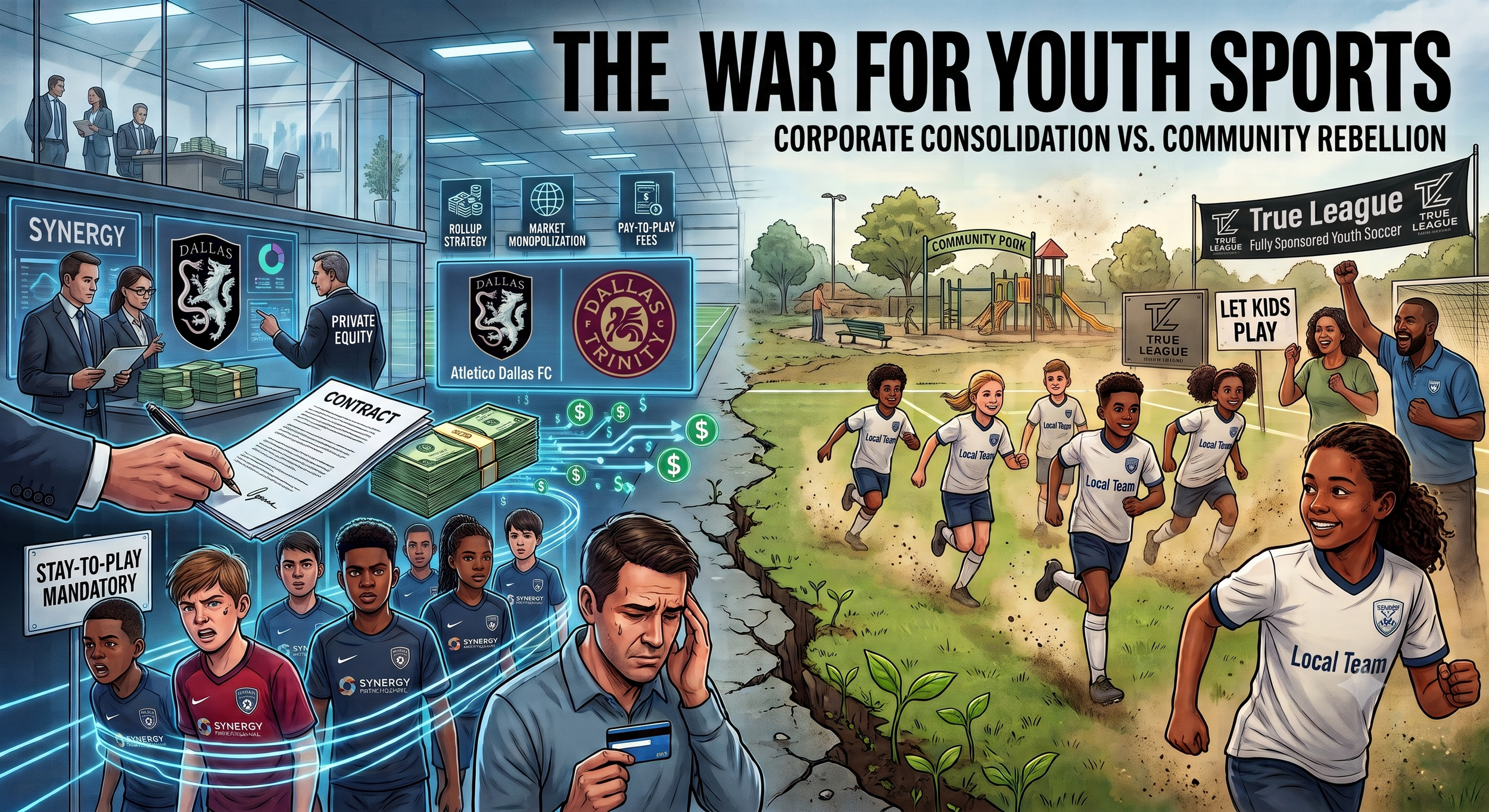
Game Over: How Wall Street is Hijacking Youth Sports and Pricing Out the Working Class
The youth sports ecosystem in the United States generates an estimated $40 billion annually—dwarfing the $20 billion hauled in by the NFL. For decades, this ecosystem was run by non-profit community boards, municipal park districts, and volunteer coaches. Today, it is being systematically devoured by private equity.
Institutional capital, priced out of the mature "Big 4" North American sports leagues, has aggressively pivoted toward amateur athletics. Through sophisticated financial engineering—specifically the "rollup" strategy—private equity firms are monopolizing local markets, eliminating civic competition, and transforming a foundational pillar of childhood development into a highly sterilized, profit-maximizing luxury commodity.
Here is how Wall Street views your child's weekend soccer game: as a heavily subsidized data mine and an exploitable lifetime revenue unit.
The youth sports ecosystem in the United States generates an estimated $40 billion annually—dwarfing the $20 billion hauled in by the NFL. For decades, this ecosystem was run by non-profit community boards, municipal park districts, and volunteer coaches. Today, it is being systematically devoured by private equity.
Institutional capital, priced out of the mature "Big 4" North American sports leagues, has aggressively pivoted toward amateur athletics. Through sophisticated financial engineering—specifically the "rollup" strategy—private equity firms are monopolizing local markets, eliminating civic competition, and transforming a foundational pillar of childhood development into a highly sterilized, profit-maximizing luxury commodity.
Here is how Wall Street views your child's weekend soccer game: as a heavily subsidized data mine and an exploitable lifetime revenue unit.
The Private Equity "Rollup" Playbook
To understand the corporatization of community athletics, you have to look at the mechanics of the "rollup." A financial sponsor systematically acquires multiple independent local clubs, proprietary tournament circuits, and sports-adjacent tech platforms, merging them into a single corporate behemoth.
As competing local clubs are either bought out or driven into insolvency by the conglomerate's massive resource advantage, families are left with zero alternatives. Once the monopoly is set, the extraction begins.
These predatory strategies have artificially inflated the cost of athletic participation far beyond the rate of inflation. Over the past five years, the average cost of youth sports has skyrocketed by an astonishing 46%, with many families routinely forced to spend over $5,000 annually per child.
The Illusion of the Pipeline: League One Volleyball (LOVB)
League One Volleyball (LOVB), heavily backed by a consortium of massive institutional investors including Synergy Sports Capital, Ares Management, and Atwater Capital, provides the most striking example of the vulture business model.
LOVB markets itself as a revolutionary "youth-to-pro" pathway, leaning heavily on the rhetoric of female empowerment and celebrity investors. But a look at its financial architecture reveals a ruthless extraction machine.
Before its professional league even launched, LOVB's private equity backers executed a massive, quiet horizontal rollup, acquiring more than 75 prominent youth volleyball clubs across 28 states. By intentionally keeping the original names of these local clubs, LOVB successfully obscured the corporate takeover from local communities.
Today, the LOVB corporate umbrella controls roughly 21,000 young athletes. The professional division features only about 84 jobs across the entire league. Statistically, 99.6% of the girls playing in LOVB-owned youth clubs will never reach the professional tier.
Yet, 100% of their families are forced to pay exorbitant club fees—routinely between $2,100 and $3,750—to subsidize the high-overhead professional league and generate yields for private equity investors.
LOVB monetizes pure aspiration, turning a recreational public good into a highly sterilized corporate pipeline.
Monopolizing the Pitch: The Dallas Soccer Takeover
The methodology isn't confined to volleyball. Synergy Sports Capital is actively deploying it in the domestic soccer market via Atlético Dallas, an expansion franchise joining the men's USL Championship in 2027.
In June 2026, USL Dallas, LLC (Atlético Dallas's corporate entity) executed a massive horizontal rollup by acquiring Dallas Trinity F.C., the city's independent professional women's soccer club. This wasn't just about expanding; it was about total market elimination.
By absorbing their competitor, USL Dallas LLC became the absolute gatekeeper for lower-division professional soccer in the region, gaining asymmetrical leverage to negotiate municipal subsidies with the City of Dallas.
Simultaneously, the group launched a "completely free" high-performance youth academy. While billed as a community benefit, the true corporate purpose is a vertical rollup: drain the elite talent from competing local clubs, weaken independent community competitors, and build a proprietary pipeline of athletes who can eventually be sold in the lucrative global transfer market.
The Real Estate Extraction Play
The strategy is heavily dependent on municipal extraction. In 2024 and 2025, Atlético Dallas attempted to secure $70.87 million in public funding from the City of Garland for a public-private training facility, which was to be surrounded by a $100 million private commercial development owned by the team's investors.
The deal collapsed when civic leaders realized the city was receiving essentially zero return on investment. The failure highlighted the true nature of these investments: rapid extraction of public tax dollars and prime real estate.
The Human Cost: Data Harvesting and Paywalled Memories
The entry of private equity has fundamentally altered the relationship between children and the sports they play.
The Commoditization of Childhood:
Firms actively harvest biometric data, injury histories, physical metrics, and precise parental financial information through proprietary digital registration software. Families demonstrating high "price elasticity" are targeted for automated fee increases, while those seeking payment plans are tracked for "poverty indicators" and gradually priced out.
Paywalling Public Spectacle:
Firms like Black Bear Sports Group have implemented draconian policies banning parents from filming their own children's ice hockey games. By controlling the physical arenas, they force extended families to purchase mandatory subscriptions to exclusive, AI-powered streaming services, costing up to $36.99 per month. Parents attempting to film on smartphones face aggressive intervention by rink staff under the cynical guise of "privacy and safety risks."
The Community Strikes Back: The Merit-Based Rebellion
While private equity titans orchestrate billion-dollar rollups from their high-rises, a grassroots rebellion is taking shape on the local pitches. Independent organizations are actively subverting the corporate monopoly by returning to a radical, antiquated concept in modern youth sports: pure merit.
Local initiatives like Canteraz Soccer Academy are aggressively evolving the youth soccer ecosystem in direct defiance of the pay-to-play model. By offering fully-sponsored youth soccer teams to exceptionally talented local players, Canteraz short-circuits the predatory financial machinery of the corporate megaclubs.
Rather than viewing parents as bottomless revenue units to be extracted for $5,000 to $10,000 annually, academies operating under this community-first model rely on localized sponsorships, civic partnerships, and targeted grassroots funding to cover operational costs.
This localized evolution effectively democratizes athletic development. It ensures that a child's trajectory is dictated by their skill on the ball and their dedication to the game, rather than the credit limit on their parents' Visa.
By deliberately insulating players from baseline participation fees, mandatory junk fees, and proprietary apparel grifts, programs like Canteraz represent a tangible, functioning blueprint for returning the sport to the community that built it.
The Legislative Backlash: The "Let Kids Play Act"
The unfettered financialization of youth sports has finally triggered an existential threat to the private equity playbook. In May 2026, a bipartisan coalition introduced the "Let Kids Play Act," representing the most aggressive federal challenge to Wall Street's expansion into amateur sports in U.S. history.
The legislation explicitly categorizes private equity firms operating in youth sports as "vulture investors." To avoid mandatory divestiture—which would require firms to completely sell their stakes within two years—firms must prove under penalty of perjury that they do not engage in:
Horizontal/Vertical Consolidation: Outlawing the core rollup strategy.
"Stay-to-Play" Schemes: Banning mandatory hotel/travel monopolies.
Junk Fees & Predatory Contracts: Eradicating hidden surcharges and geographic non-competes.
Data and IP Capture: Banning the paywalling of game broadcasts and the harvesting of minors' biometric data.
The survival of community-based sports relies entirely on dismantling these monopolistic structures. As lawmakers, municipalities, and local academies like Canteraz wake up to the grift and fight back, Wall Street's ruthless optimization of the youth sports market is finally facing the whistle.
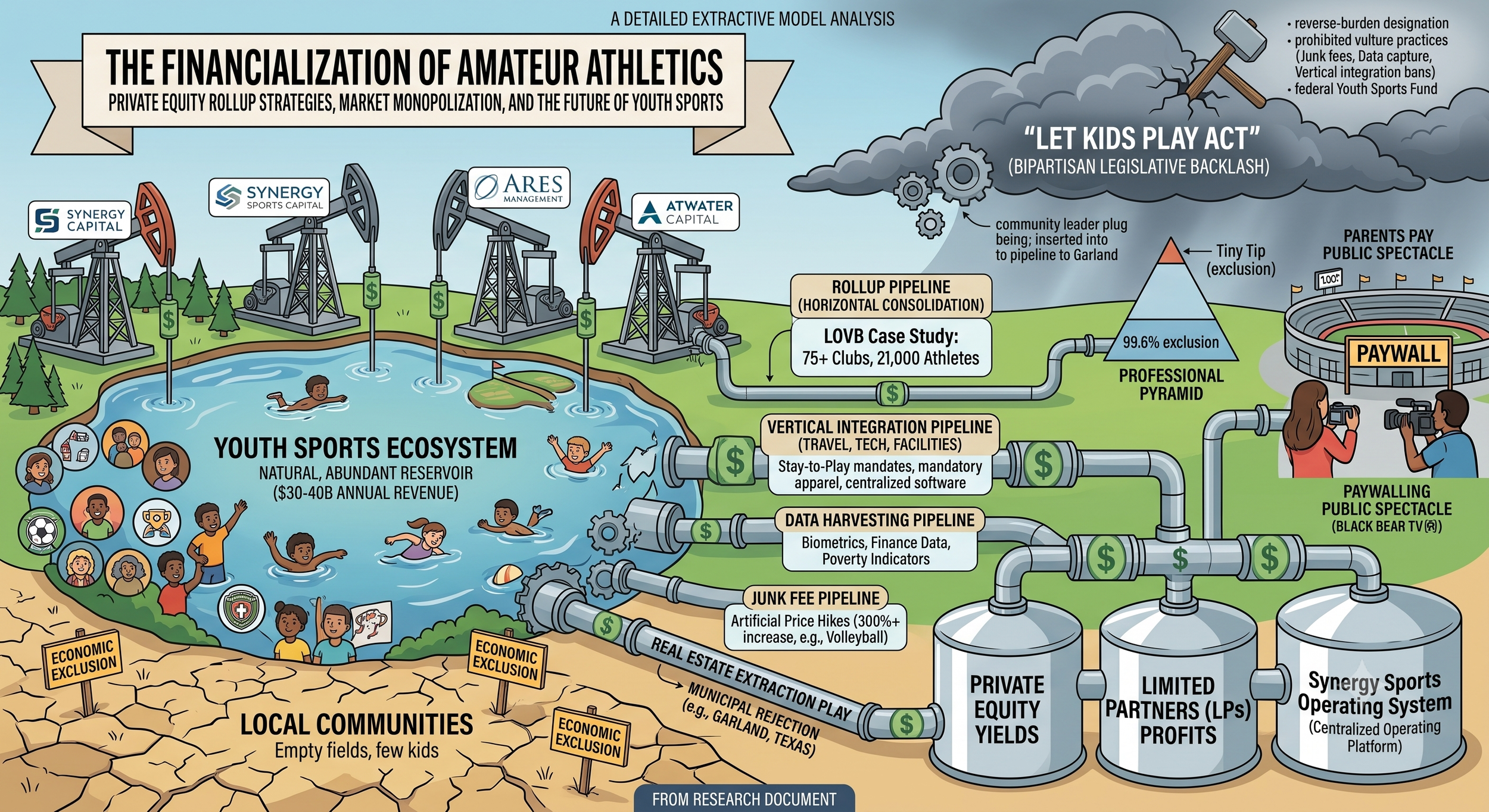
The Financialization of Amateur Athletics: Private Equity Rollup Strategies, Market Monopolization, and the Future of Youth Sports
Priced out of major league franchises, private equity is aggressively targeting the $40 billion youth and emerging sports market. Using financial "rollup" strategies, these firms are consolidating independent, community-based leagues into monopolized national platforms.
This report examines the mechanics and socioeconomic fallout of this trend, specifically focusing on:
The Playbook: How funds like Synergy Sports Capital use strategic acquisitions—such as League One Volleyball (LOVB), USL’s Atlético Dallas, and Dallas Trinity F.C.—to eliminate local competition and artificially increase pricing power.
The Fallout: The severe impact on communities, including skyrocketing participation costs, data exploitation, and the paywalling of public arenas.
The Backlash: The resulting bipartisan federal pushback against this business model, most notably the proposed "Let Kids Play Act."
Executive Summary
The intersection of institutional capital and professional sports has historically been characterized by private equity firms taking minority, passive stakes in mature, blue-chip franchises operating within the "Big 4" North American sports leagues.
However, as the entry valuations in these top-tier leagues have become increasingly prohibitive, institutional capital has aggressively pivoted toward a significantly more expansive, underpenetrated, and fragmented sector: the $40 billion youth and emerging sports market1.
Through sophisticated financial engineering, specifically the deployment of the "rollup" strategy, private equity firms are systematically consolidating independent, community-based youth sports organizations into vertically integrated national platforms3.
This comprehensive industry report examines the mechanics and devastating socioeconomic consequences of the private equity rollup strategy within the amateur and emerging sports sectors.
By analyzing the strategic acquisitions of Synergy Sports Capital—a newly launched $150 million private equity fund that holds prominent, controlling investments in League One Volleyball (LOVB) and the United Soccer League's (USL) Atlético Dallas—this analysis traces the precise operational blueprints utilized to monopolize local markets6.
Furthermore, the report explores the recent acquisition of Dallas Trinity F.C. by Atlético Dallas's ownership group, demonstrating how horizontal and vertical consolidation eliminates civic competition and artificially increases pricing power9.
Finally, the analysis evaluates the severe negative externalities of this vulture business model on local communities, including skyrocketing participation costs, data exploitation, the paywalling of public arenas, and the subsequent bipartisan federal legislative backlash manifested in the proposed "Let Kids Play Act"12.
The Macroeconomic Shift: Private Equity's Pivot to Youth Sports
To understand the rapid corporatization of community athletics, one must first examine the structural tailwinds driving institutional capital downmarket. The youth sports ecosystem in the United States generates an estimated $30 billion to $40 billion annually, dwarfing the $20 billion in annual revenue generated by the National Football League1. The industry boasts a compound annual growth rate of 8% to 10%, driven largely by year-round athletic specialization and the accelerating parental investment in structured competitive pathways2.
Historically, this massive addressable market has been highly fragmented. For decades, youth sports were operated largely by localized, non-profit community boards, municipal park districts, volunteer coaches, and independent club directors5.
For a private equity investor, extreme high fragmentation in a market characterized by robust, recession-resistant demand presents an optimal environment for institutional consolidation3. The normalization of private capital in sports, which began with Major League Baseball in 2019 and was followed by the NBA, NHL, and eventually the NFL, paved the way for institutional investors to seek out the next frontier of growth3.
The landmark transaction that signaled the viability of the youth sports sector was BPEA EQT's $1.25 billion acquisition of IMG Academy from Endeavor Group Holdings3. This transaction demonstrated that integrated platforms blending elite athletic training, proprietary facilities, and academic infrastructure could command premium valuation multiples in the private capital markets3.
Consequently, firms have poured billions into the sector; in the first five months of 2026 alone, private equity investments in amateur sports reached $2.11 billion, more than four times the $550 million recorded for all of 20252.
The Mechanics of the Private Equity "Rollup" Strategy
The mechanism through which private equity dominates these fragmented markets is the "rollup" strategy. A rollup involves a financial sponsor acquiring multiple small, independent companies within the same sector and merging them into a single, scaled corporate entity3.
In the context of youth sports, a private equity firm systematically acquires regional travel clubs, proprietary tournament circuits, local training facilities, and sports-adjacent technology platforms.
Once these independent entities are absorbed into the corporate umbrella, the parent company centralizes back-office operations, standardizes pricing across regions, and leverages economies of scale to drastically reduce administrative costs4.
Monopolization and the Elimination of Market Alternatives
The primary benefit of the rollup strategy for the private equity firm is the rapid accumulation of localized market share, which inevitably leads to absolute monopsonistic and monopolistic pricing power. As competing local clubs are either acquired by the conglomerate or driven into insolvency by the scaled entity's massive resource advantage, families are left with fewer, or frequently zero, alternatives for athletic participation18.
This market capture allows private equity operators to extract maximum lifetime value from families through a sequence of calculated operational changes.
First, operators utilize sophisticated data analytics to test price elasticity among affluent suburban demographics. Because parents view youth sports as a prerequisite for their children's social development, physical health, and potential collegiate athletic scholarships, consumer demand remains highly inelastic12.
Private equity operators recognize that parents will sacrifice significant portions of their discretionary income before pulling a child from a team13. Consequently, baseline participation fees can be increased exponentially without triggering a proportional drop in enrollment15.
Second, rollups frequently involve aggressive vertical integration. Firms do not merely buy the clubs; they acquire the tournament management software, the hotel booking agencies, and the exclusive apparel providers utilized by those clubs3.
Firms then implement mandatory "stay-to-play" schemes, forcing families to book travel exclusively through the private equity-owned or partnered portals, allowing the firm to capture exorbitant kickbacks and commissions on hotel rooms and flights14.
Third, upon consolidating a market, private equity-backed clubs routinely introduce mandatory "junk fees" that were previously optional or entirely non-existent. These include mandatory facility surcharges, non-negotiable uniform packages refreshed annually, and exclusive streaming network subscriptions13.
These predatory strategies combine to artificially inflate the cost of athletic participation far beyond the rate of inflation. In the past five years, the average cost of youth sports has increased by an astonishing 46%, with many families routinely spending over $5,000 annually per child13.
Synergy Sports Capital: Engineering the Modern Sports Ecosystem
Synergy Sports Capital, which officially launched in March 2026, represents the next iteration of the sports-focused private equity firm. Founded by former NFL players Terrence C. Murphy Sr. and Reggie Bush, the firm introduced a $150 million target fund specifically focused on acquiring controlling stakes in emerging sports leagues, lower-middle-market teams, and related ecosystem assets outside the traditional Big 4 North American sports leagues7.
Synergy’s core investment thesis deliberately avoids taking minority, passive stakes in mature franchises. According to Murphy, established teams are already priced at the top of the market, offering limited upside for new capital7. Instead, the firm seeks absolute control, operating on what it formally terms the "Synergy Sports Operating System"7.
This centralized operating platform is designed to generate diversified, compounding revenue streams and create early liquidity opportunities for their Limited Partners (LPs), a stark contrast to traditional sports funds that rely primarily on long-term franchise appreciation over decades7.
The Synergy Sports Operating System integrates four distinct, highly synchronized pillars to extract maximum enterprise value. The foundation is direct team ownership in high-growth, emerging sports formats, particularly in women's sports and next-generation leagues7.
This is immediately paired with aggressive real estate development, anchoring the acquired teams in mixed-use, stadium-centric commercial real estate projects that generate continuous, year-round cash flow regardless of the team's on-field performance7.
To ensure a captive audience and minimize operational costs, the firm establishes proprietary youth academy pipelines, controlling the grassroots development systems that feed into the professional teams5.
Finally, the system leverages sports-adjacent technology, deploying deep data analytics and owning the media strategies that distribute the content7. By deploying this multi-pronged approach, Synergy insulates its investments against the inherent volatility of professional sports performance.
Case Study 1: League One Volleyball (LOVB) and the Vulture Business Model
League One Volleyball (LOVB), heavily backed by a consortium of massive institutional investors including Synergy Sports Capital, Ares Management, and Atwater Capital, provides the most striking and controversial example of the private equity rollup strategy currently operating in the United States6.
In March 2026, Synergy Sports Capital executed a strategic investment to acquire the operating rights to LOVB's Salt Lake franchise, integrating the team into Synergy's broader, interconnected portfolio6.
The Blueprint of the LOVB Pipeline
LOVB markets itself to the public as a revolutionary "youth-to-pro" pathway and heavily utilizes the rhetoric of female empowerment, highlighting celebrity investors such as Lindsey Vonn, Kevin Durant, and Amy Schumer, alongside a stated commitment to elevating women's sports8.
However, a thorough analysis of the underlying financial architecture reveals a ruthless, vertically integrated extraction machine designed to capitalize on the aspirations of young female athletes.
Before the professional league even launched its inaugural matches, LOVB's private equity backers executed a massive, quiet horizontal rollup, acquiring more than 75 prominent youth volleyball clubs across 28 states5.
By intentionally maintaining the original, trusted names of these local clubs, LOVB successfully obscured the corporate takeover from parents and local communities29. Today, the LOVB corporate umbrella controls an astonishing 21,000 young athletes17.
The integration of these clubs follows a predatory financial logic that relies on the subsidization of professional ambition through exorbitant youth fees. The professional division of LOVB features only six teams with rosters of approximately 14 players each, totaling roughly 84 professional jobs across the entire league17.
Statistically, 99.6% of the 21,000 girls playing in LOVB-owned youth clubs will never reach the professional tier17. Yet, 100% of these families are forced to pay exorbitant club fees, which act as the primary funding mechanism for the high-overhead professional league and generate the requisite yields for the private equity investors17.
The historical context of these costs is staggering. In the late 2000s, an average youth volleyball club season cost approximately $500 to $60015. Adjusted for inflation, that figure should currently reside near $90015. Instead, following aggressive private equity consolidation, top club teams now routinely charge between $2,100 and $3,750 for grade-school and high-school levels, representing an artificial price hike of over 300%15.
The Illusion of the Pipeline and Corporate Sterilization
LOVB monetizes pure aspiration. By telling parents that their 12-year-old daughter is enrolled in the official development system of a professional league broadcast on ESPN, LOVB manufactures a psychological justification for elite pricing8.
The marketing framing suggests that spending thousands of dollars is not merely a recreational expense, but an investment in female empowerment and a direct pathway to collegiate and professional success.
The centralization required to execute the LOVB rollup fundamentally destroys the localized, community-centric nature of youth sports17. As local club directors are forced to cede operational control to corporate boards, decisions are no longer made based on community welfare, but rather on maximizing investor yields17.
Mandatory participation in internal LOVB-branded tournaments, forced purchases of proprietary apparel from approved vendors, and rigid corporate accounts receivable departments replace the flexibility and empathy that independent clubs once offered to families undergoing financial hardship17.
Critics of the centralized model argue that it strips autonomy from local communities, transforming a recreational public good into a highly sterilized, profit-maximizing corporate pipeline13.
Case Study 2: Atlético Dallas, Dallas Trinity F.C., and Regional Monopolization
The rollup methodology is not confined to the volleyball landscape; it is actively and aggressively being deployed in the domestic soccer market by Synergy Sports Capital and its partners. Atlético Dallas, an expansion franchise set to join the men's USL Championship in 2027, is co-founded by Matt Valentine and Sam Morton, with Synergy Sports Capital holding an active, controlling ownership stake7.
A detailed analysis of Atlético Dallas’s corporate maneuvers over the past several years reveals a textbook execution of both horizontal market consolidation and vertical integration designed to capture the entire North Texas soccer ecosystem.
The Horizontal Rollup: Acquiring Dallas Trinity F.C.
In June 2026, USL Dallas, LLC—the overarching corporate entity overseeing Atlético Dallas—announced the acquisition of Dallas Trinity F.C., the city's professional women's soccer club competing in the Gainbridge Super League9. Dallas Trinity F.C. had been independently financed and built by the Neil family since its inception in 2023, successfully establishing a foothold in the local sports market11.
By absorbing Dallas Trinity F.C., USL Dallas LLC executed a massive horizontal rollup within the Dallas professional soccer market. The acquisition yields several distinct monopolistic advantages for the private equity backers. First, it enables total facility consolidation.
Both the men's USL team and the women's Super League team will now share a single, high-capacity venue—the historic Cotton Bowl at Fair Park11. Consolidating tenancy under one corporate entity gives USL Dallas LLC immense, asymmetrical leverage in negotiating favorable leases, concession splits, and municipal subsidies with the City of Dallas11.
Second, the acquisition ensures the total elimination of market competition. Rather than competing against the Neil family for local corporate sponsorships, premium ticket sales, media coverage, and the finite loyalty of local soccer fans, USL Dallas LLC simply absorbed its competitor9.
This maneuver establishes USL Dallas LLC as the absolute, singular gatekeeper for lower-division professional soccer in the region9. Furthermore, the dual ownership structure enables the parent company to execute aggressive cross-selling strategies, bundling season tickets, corporate sponsorships, and merchandise to extract higher aggregate revenues from the local consumer base while simultaneously lowering customer acquisition costs9.
The Vertical Rollup: Predatory Talent Drains via the Academy
Simultaneous to its horizontal expansion, Atlético Dallas initiated a calculated vertical rollup through the launch of the Atlético Dallas Academy28. Billed as a high-performance youth development program targeting U9 and U10 boys—with explicit plans to expand into girls' pathways following the Trinity F.C. acquisition—the Academy is strategically positioned to capture the elite talent pool across North Texas11.
While Atlético Dallas prominently highlights in its marketing materials that its academy is "completely free for selected players," this structure serves a highly calculated corporate purpose28.
By offering free elite training led by European coaches such as Iván Cifuentes and Carlos Indiano, the club effectively drains the highest-tier talent from competing local clubs, critically weakening independent community competitors28.
In the long term, this establishes a centralized, proprietary pipeline of athletes who can be developed within the Synergy ecosystem, signed to professional contracts at below-market rates, and potentially sold in the lucrative global transfer market, representing a massive, highly scalable return on investment for the private equity backers36.
The Real Estate Extraction Play: The Garland Facility Collapse
The most revealing aspect of the Synergy and Atlético Dallas investment strategy is the explicit interplay between sports ownership and municipal real estate extraction.
In 2024 and 2025, Atlético Dallas engaged in intense, protracted negotiations with the suburban City of Garland to construct a sprawling, $70 million-plus public-private training facility and soccer complex37. This public infrastructure was to be surrounded by a $100 million-plus private mixed-use commercial development controlled by the team's ownership37.
This proposal perfectly embodied the Synergy Sports Operating System: utilizing the cultural allure and civic pride associated with a professional sports team to secure heavily subsidized municipal real estate, which would then be surrounded by private equity-owned, cash-flowing commercial properties7.
However, the strategy faced a critical failure. In September 2025, the City of Garland abruptly terminated the negotiations, calling off the $70 million project entirely38. The municipality explicitly cited that the proposed deal structure failed to provide a sufficient return on investment (ROI) for the city's $70.87 million public commitment39.
When civic leaders pushed back against the egregious public funding of a privately held enterprise, the deal inevitably collapsed37. This highly public failure highlights the true vulture nature of private equity sports investments: the primary objective is frequently not the sustainable growth of the sport itself, but rather the rapid extraction of public tax dollars and the acquisition of prime real estate19.
Following the collapse in Garland, Atlético Dallas quickly pivoted to securing the management rights to the existing MoneyGram Soccer Park in Dallas, continuing their relentless quest to control local infrastructure without bearing the full capital expenditure35.
The Negative Externalities of Private Equity in Local Markets
The financial engineering deployed by firms like Synergy Sports Capital, Ares Management, and Atwater Capital has triggered profound, deeply damaging negative externalities across the youth and community sports landscape. The transition from community-driven recreation to profit-driven corporate consolidation has fundamentally altered the American sports experience.
1. The Commoditization of Childhood and Data Harvesting
The entry of private equity has fundamentally altered the relationship between children and the sports they play. Youth athletes are no longer viewed as community members engaging in healthy recreation; they are viewed by corporate boards as lifetime revenue units12.
Through the systematic acquisition of digital registration software, scheduling applications, and advanced performance tracking tools, private equity firms now harvest staggering amounts of proprietary data on minors12.
This data collection extends far beyond basic contact information. Firms actively harvest biometric data, injury histories, physical metrics, and precise parental financial information14. This massive data apparatus is subsequently utilized to feed sophisticated algorithmic marketing engines designed to psychologically manipulate parents.
According to industry investigations, families demonstrating high "price elasticity" are targeted for subsequent, automated fee increases, while those seeking payment plans are tracked for "poverty indicators" and gradually priced out of the system12. The objective is the optimization of financial extraction based on mapped psychological vulnerabilities, treating childhood athletic development purely as an exploitable market sector12.
2. The Paywalling of Public Spectacle
A deeply controversial and increasingly common tactic emerging from private equity consolidation is the aggressive monetization of game viewing. Firms such as Black Bear Sports Group, which has successfully rolled up significant portions of the youth ice hockey market across the East Coast and Midwest, have implemented strict, draconian policies banning parents from filming or live-streaming their own children's games22.
By controlling the physical arenas, Black Bear forces parents, grandparents, and extended families to purchase mandatory subscriptions to "Black Bear TV," an exclusive, AI-powered streaming service installed in their facilities via a partnership with Spiideo42.
Subscriptions are priced exorbitantly, costing between $25.99 and $36.99 per month for access43. Parents who attempt to film games on their smartphones face aggressive intervention from rink staff under the guise of mitigating "privacy and safety risks"43.
This justification serves as a cynical obfuscation designed entirely to protect the private equity firm's artificial broadcasting monopoly and force captive consumers behind a lucrative digital paywall43.
3. Economic Exclusion and the Erasure of the Working Class
The most devastating and widespread impact of the rollup strategy is the systemic economic exclusion of lower-income and working-class families. As private equity firms consolidate leagues and initiate aggressive price hikes to satisfy their Limited Partners' yield requirements, sports are transformed from an accessible public good into a luxury commodity reserved solely for the affluent21.
The 46% rise in participation costs over the last five years has resulted in lower-income families participating in youth sports at less than half the rate of wealthier families13.
Furthermore, the "take-it-or-leave-it" predatory contracts and non-compete clauses instituted by private equity-backed organizations trap families in escalating cycles of debt14. Parents routinely drain retirement savings and take on crippling credit card debt to finance the $5,000 to $10,000 annual club fees13.
This financial sacrifice is driven by the false hope—heavily and deceptively marketed by the clubs themselves—that these investments will yield lucrative collegiate athletic scholarships4. In reality, only 12% of high school baseball players go on to play college ball, and the NCAA's recent reduction of Division 1 roster sizes has made this path even narrower, meaning private equity firms are essentially selling an expensive lottery ticket with virtually impossible odds to 100% of their customer base4.
The Legislative Backlash: The "Let Kids Play Act"
The aggressive and unchecked extraction of wealth from American families by private equity has finally triggered intense, bipartisan legislative scrutiny at the federal level2. In May 2026, a bicameral coalition of lawmakers, including Senator Chris Murphy (D-CT), Senator Cory Booker (D-NJ), Representative Chris Deluzio (D-PA), and Representative Pat Ryan (D-NY), introduced the "Let Kids Play Act"13. This legislation represents the most aggressive, sweeping federal challenge to private equity's expansion into the amateur sports sector in U.S. history23.
The Let Kids Play Act explicitly categorizes private equity firms operating in youth sports as "vulture investors" and targets the exact rollup mechanisms utilized by firms like LOVB, Synergy Sports Capital, and Black Bear Sports Group13. Supported by the Monopoly Busters Caucus and endorsed by the American Economic Liberties Project, the bill seeks to completely sever institutional capital from amateur athletics14
.
Key Provisions and Regulatory Mechanisms
The legislation relies on an unprecedented "reverse-burden designation system," wherein any private equity fund invested in youth sports is automatically presumed to be a vulture investor 91 days after the bill's enactment14. To avoid this devastating designation, firms must legally attest under penalty of perjury that they have never engaged in a specifically defined set of "vulture practices"14.
The prohibited practices systematically dismantle every facet of the private equity rollup playbook:
Banning Horizontal and Vertical Consolidation: The act explicitly prohibits acquiring, managing, or investing in multiple entities that supply essential products or services to participation, effectively outlawing the core rollup strategy that eliminates market competition14.
Outlawing "Stay-to-Play" Schemes: Firms can no longer condition a child's eligibility to play in a tournament on the mandatory use of designated, private equity-partnered hotels, travel agents, or transportation entities14.
Eradicating Junk Fees and Predatory Contracts: The legislation bans hidden fees, mandatory multi-year uncancelable commitments, and geographic non-compete clauses that prevent young athletes from playing in unaffiliated local tournaments14.
Prohibiting Data and IP Capture: Private equity firms are barred from claiming intellectual property rights over game broadcasts, parental recordings, and the biometric data of minors, directly neutralizing the exploitative paywall models seen in youth hockey and volleyball14.
If a firm fails to prove absolute compliance, it is subject to mandatory divestiture, requiring the firm to completely sell its ownership stakes and management rights in youth sports within two years21.
During the divestiture period, non-compliant firms are subjected to a punitive 10% monthly revenue escrow23. Furthermore, the legislation establishes severe personal liability, piercing the corporate veil to hold private equity control persons personally and financially responsible for the youth entity's debt obligations, legal judgments, and safety violations14.
False certifications carry a $1 million civil penalty per submission and up to one year of federal imprisonment14.
Finally, the Act mandates that any designated vulture investor must provide full financial refunds to families for collected junk fees and wipe out outstanding predatory debts13.
The financial penalties levied against these firms are to be deposited into a newly created federal "Youth Sports Fund," which is specifically earmarked to provide scholarships, lower costs for working-class families, and ensure that public fields remain free for community use21.
The bill also grants parens patriae authority to state attorneys general and creates a private right of action, allowing families to sue for treble damages14.
Conclusion
The aggressive infiltration of private equity into youth and emerging sports represents a fundamental paradigm shift in how athletic development is structured, financed, and consumed in the United States.
Firms like Synergy Sports Capital have recognized that the passion, civic pride, and parental devotion inherent in sports provide an incredibly inelastic demand curve—one that is highly susceptible to financial exploitation through the rollup strategy.
By utilizing horizontal acquisitions to eliminate local competitors and vertical integration to capture every ancillary dollar—from youth academy fees and proprietary tournament travel to massive municipal real estate developments—private equity firms have engineered closed, monopolistic ecosystems.
As demonstrated by LOVB's aggressive acquisition of over 75 youth clubs to financially subsidize a minuscule professional tier, and USL Dallas LLC's dual acquisition of Dallas Trinity F.C. to consolidate regional market power and extract public infrastructure funds, the ultimate objective of these ventures is maximum capital extraction, not community enrichment or athletic development.
This corporate colonization has yielded severe societal consequences. It has transformed a foundational pillar of childhood development into a luxury commodity, systematically pricing out working-class families, harvesting the proprietary data of minors, and placing family memories behind artificial subscription paywalls.
The introduction of the "Let Kids Play Act" signals a critical legislative inflection point. Lawmakers have recognized that the unfettered financialization of youth sports constitutes a profound market failure requiring aggressive federal intervention.
Whether through sweeping legislative bans, mandatory divestiture, or increasing municipal resistance to subsidized real estate deals (as witnessed in Garland, Texas), the private equity playbook is facing unprecedented, existential friction.
Ultimately, the survival of community-based sports relies entirely on dismantling these monopolistic structures and returning the focus of the industry to athletic development, universal accessibility, and the inherent public good of play, rather than the ruthless optimization of private investor yields.
Sources
How Private Equity Destroyed Youth Sports, https://www.youtube.com/watch?v=zEOeQQ019aA&vl=en-US
Private Equity's Expansion Into Youth Sports Draws Bipartisan Concern - Benzinga, https://www.benzinga.com/markets/private-markets/26/06/60201892/private-equitys-expansion-into-youth-sports-draws-bipartisan-concern
Private equity's expanding role in youth sports | White & Case LLP, https://www.whitecase.com/insight-alert/private-equitys-expanding-role-youth-sports
Private Equity in Baseball & Youth Sports : r/Homeplate - Reddit, https://www.reddit.com/r/Homeplate/comments/1t2nz35/private_equity_in_baseball_youth_sports/
Private equity firms are consolidating the fragmented youth sports spaces through M&A, while revenue estimates range from $20 billiont to $40 billion annually., https://leadersgroup-sbj-prod.web.arc-cdn.net/Articles/2025/03/17/the-youth-sports-buy-in/
Synergy Sports Capital, Led by Former NFL Players Terrence C. Murphy Senior and Reggie Bush, Acquires LOVB Salt Lake, https://www.lovb.com/news/synergy-sprots-capital-terrence-c-murphy-sr-reggie-bush-acquires-lovb-salt-lake
NEWS: Synergy Sports Capital Launches With $150M Target Fund for Emerging Leagues, https://www.atleticodallas.com/news/2026/03/05/synergy-sports-capital-launches-with-150m-target-fund-for-emerging-leagues/
Reggie Bush, Terrence Murphy Waste No Time With Deal for LOVB Team, https://frontofficesports.com/reggie-bush-terrence-murphy-waste-no-time-with-deal-for-lovb-team/
Atlético Dallas Acquires Dallas Trinity FC, Strengthening Commitment to Professional Soccer in North Texas, https://www.dallastrinityfc.com/news/2026/06/30/atletico-dallas-acquires-dallas-trinity-fc-strengthening-commitment-to-professional-soccer-in-north-texas/
Atlético Dallas buys women's pro soccer club Dallas Trinity FC, https://www.fox4news.com/news/atletico-dallas-buys-womens-pro-soccer-club-dallas-trinity-fc
Atlético Dallas purchases Dallas Trinity FC - 3rd Degree, https://3rddegree.net/atletico-dallas-purchases-dallas-trinity-fc
After the Sign-Up: How Private Equity Turns Your Child's Data Into Marketing Gold, https://nomoredrills.substack.com/p/after-the-sign-up-how-private-equity
CONGRESSMAN PAT RYAN INTRODUCES “LET KIDS PLAY ACT” TO KICK PRIVATE EQUITY OUT OF YOUTH SPORTS AND STOP THE RIPOFFS OF HUDSON VALLEY FAMILIES, https://patryan.house.gov/media/press-releases/congressman-pat-ryan-introduces-let-kids-play-act-kick-private-equity-out
YOUTH SPORTS BUSINESS REPORT: Let Kids Play Act Targets Private Equity Ownership of Youth Sports Teams, Leagues, and Facilities | Congresswoman Angie Craig, https://craig.house.gov/media/in-the-news/youth-sports-business-report-let-kids-play-act-targets-private-equity-ownership
Thoughts on this proposed bill? : r/volleyball - Reddit, https://www.reddit.com/r/volleyball/comments/1ti8v3i/thoughts_on_this_proposed_bill/
The NFL Let the Private Equity 'Barbarians' Through the Gate - Front Office Sports, https://frontofficesports.com/nfl-private-equity-barbarians-through-the-gate/
The LOVB Playbook - How Private Equity is Building a Volleyball Empire on the Dreams of 12-Year-Old Girls, https://bayareavolleyballclub.com/the-lovb-playbook-how-private-equity-is-building-a-volleyball-empire-on-the-dreams-of-12-year-old-girls/
[CNBC] Private equity in youth sports draws bipartisan scrutiny in Congress: consolidation is driving up costs for families while limiting access to more affordable options. Too many children are being priced out, not lacking talent or determination their families simply cannot afford rising costs" : r/baseball - Reddit, https://www.reddit.com/r/baseball/comments/1ujxg49/cnbc_private_equity_in_youth_sports_draws/
THE FAIR PLAY FACADE: - American Economic Liberties Project, http://www.economicliberties.us/wp-content/uploads/2026/04/20260211-aelp-sports-fin.pdf
How Private Equity Is Reshaping Youth Sports in America - YouTube, https://www.youtube.com/watch?v=fxcQfoqaABM
Booker, Murphy, Deluzio Introduce Bicameral Bill to Kick Private Equity Out of Kids' Sports and Stop the Ripoffs, https://www.booker.senate.gov/news/press/booker-murphy-deluzio-introduce-bicameral-bill-to-kick-private-equity-out-of-kids-sports-and-stop-the-ripoffs
Federal Bill to ban Private Equity from buying youth clubs and facilities - potentially ban stay to play rules, https://www.reddit.com/r/youthsoccer/comments/1tcb0mf/federal_bill_to_ban_private_equity_from_buying/
New Bill Seeks to "Let Kids Play" by Limiting Private Equity in Youth Sports - Duane Morris, https://www.duanemorris.com/alerts/new_bill_seeks_let_kids_play_limiting_private_equity_youth_sports_0526.html
Let Kids Play Act One Pager, https://www.murphy.senate.gov/imo/media/doc/let_kids_play_act_one_pager.pdf
Synergy Sports Capital, Led by Former NFL Players Terrence C. Murphy Senior and Reggie Bush, Acquires LOVB Salt Lake, https://www.lovb.com/press-releases/synergy-sprots-capital-terrence-c-murphy-sr-reggie-bush-acquires-lovb-salt-lake
Synergy Sports Capital Launches to Acquire Controlling Stakes in High-Growth Leagues, Teams and Sports-Driven Ventures - Business Wire, https://www.businesswire.com/news/home/20260305526870/en/Synergy-Sports-Capital-Launches-to-Acquire-Controlling-Stakes-in-High-Growth-Leagues-Teams-and-Sports-Driven-Ventures
Synergy Sports Capital | Sports Private Equity Firm, https://www.synergysportscapital.com/
Atlético Dallas Academy | Training, Teams & Tryouts, https://www.atleticodallas.com/academy/
The LOVB Playbook - by Loren Anderson - Beyond the Drill, https://nomoredrills.substack.com/p/the-lovb-playbook
Proskauer Advises League One Volleyball on Investment from Synergy Sports Capital, https://www.proskauer.com/release/proskauer-advises-league-one-volleyball-on-investment-from-synergy-sports-capital
So If LOVB Pro Doesn't Make Money, the Clubs Will Keep It Afloat!? - Reddit, https://www.reddit.com/r/PVF/comments/1daplav/so_if_lovb_pro_doesnt_make_money_the_clubs_will/
The Battle For Professional Volleyball Has Officially Begun - Defector, https://defector.com/the-battle-for-professional-volleyball-has-officially-begun
Atlético Dallas : r/USLPRO - Reddit, https://www.reddit.com/r/USLPRO/comments/1s3u3t8/atl%C3%A9tico_dallas/
Atlético Dallas Acquires Dallas Trinity FC, Strengthening Commitment to Professional Soccer in North Texas, https://www.atleticodallas.com/news/2026/06/30/atletico-dallas-acquires-dallas-trinity-fc-strengthening-commitment-to-professional-soccer-in-north-texas/
Jan 13, 2026 Ad Hoc Committee on Professional Sports Recruitment and Retention - Dallas, TX, https://dallastx.new.swagit.com/videos/371886
NEWS: Atlético Dallas Launches Free Elite Youth Academy, Creating Professional Development Pathway for North Texas Players, https://www.atleticodallas.com/news/2026/03/23/atletico-dallas-launches-free-elite-youth-academy/
Atlético Dallas ends training complex deal with City of Garland - 3rd Degree, https://3rddegree.net/atletico-dallas-ends-training-complex-deal-with-city-of-garland
NEWS: City of Garland Ends Facility Project Discussions with Atlético Dallas, https://www.atleticodallas.com/news/2025/09/25/news-city-of-garland-ends-facility-project-discussions-with-atletico-dallas/
City of Garland Ends Negotiations with Atlético Dallas, https://www.garlandtx.gov/CivicAlerts.aspx?AID=3646
City of Garland calls off $70 million soccer stadium - CultureMap Dallas, https://dallas.culturemap.com/news/entertainment/garland-soccer-stadium-atletico/
City of Garland Cuts ends training ground deal with Atlético Dallas - Big D Soccer, https://www.bigdsoccer.com/city-of-garland-cuts-ends-training-ground-deal-with-atletico-dallas/
Black Bear TV, https://blackbearsportsgroup.com/blackbeartv/
Frequently Asked Questions - Black Bear Sports Group, https://blackbearsportsgroup.com/faqs/
Black Bear Sports Group Sets Record Straight Amid Media Frenzy - Buying Sandlot, https://www.buyingsandlot.com/p/black-bear-sports-group-sets-record-straight-amid-media-frenzy
Who Owns the Moment? Rights in Sports Photos and Videos - McBrayer PLLC, https://www.mcbrayerfirm.com/blogs-intellectual-property-blog,who-owns-the-moment-rights-in-sports-photos-and-videos
Black Bear Sports Group : r/hockeyplayers - Reddit, https://www.reddit.com/r/hockeyplayers/comments/1regodw/black_bear_sports_group/
Deluzio, Murphy Introduce Bill to Kick Private Equity Out of Kids' Sports and Stop the Ripoffs, https://deluzio.house.gov/media/press-releases/deluzio-murphy-introduce-bill-kick-private-equity-out-kids-sports-and-stop
House committee looks into private equity’s role in youth sports, https://www.sportsbusinessjournal.com/Articles/2026/07/01/house-committee-looks-into-private-equitys-role-in-youth-sports/
Lawmakers Want Private Equity Out of Youth Sports, https://frontofficesports.com/lawmakers-want-private-equity-out-of-youth-sports/
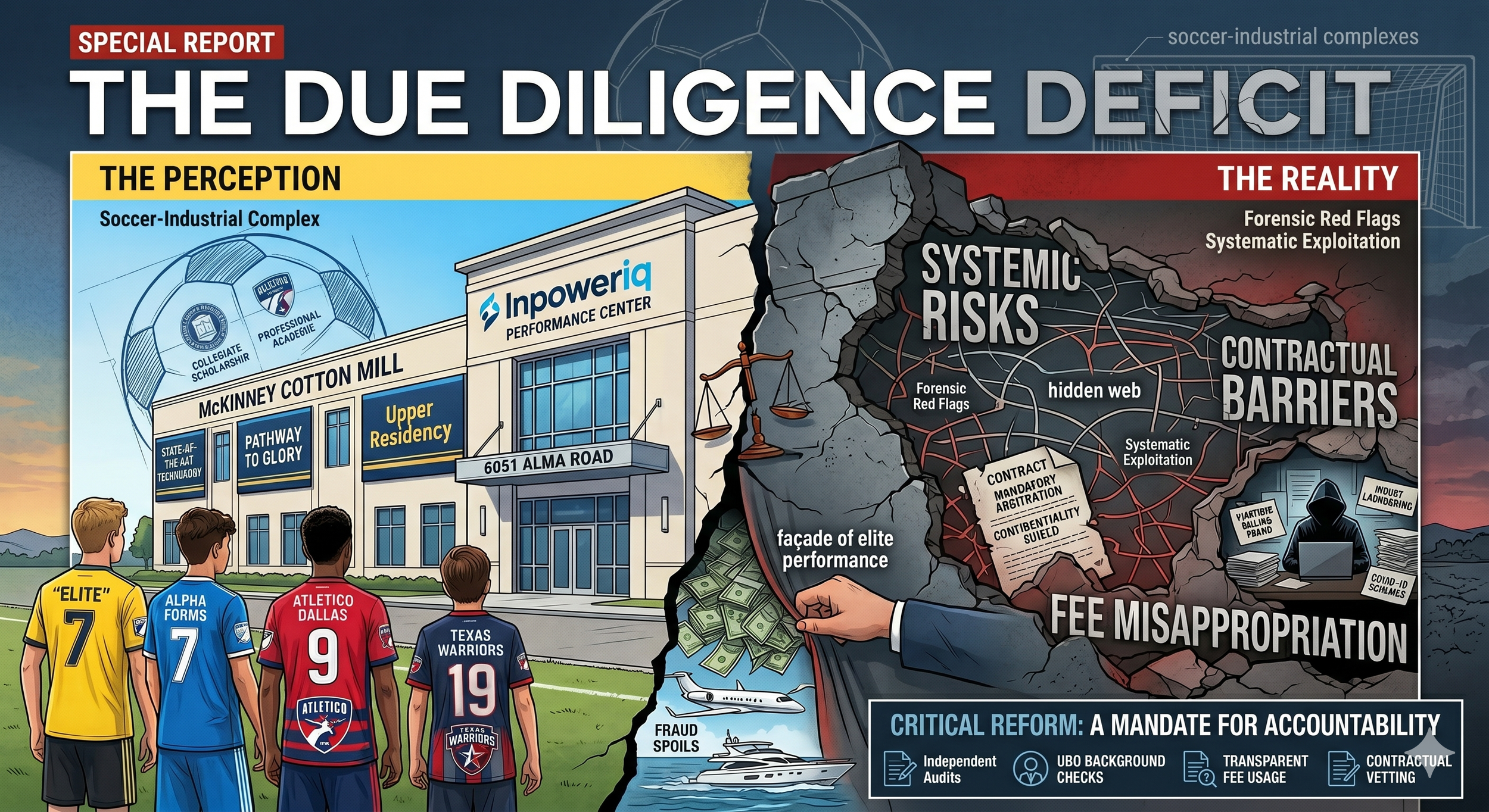
The Due Diligence Deficit: InpowerIQ and the Vulnerability of the North Texas Soccer Club
The federal conviction of Mouzon Bass III and Lance Wilson has exposed a critical "blind spot" in the multi-billion dollar DFW youth sports economy. While the Inpoweriq Performance Center was marketed as a premier development hub, forensic evidence suggests it functioned as a capital sink—a "trophy asset" purchased to park funds derived from a massive healthcare fraud scheme orchestrated through Vivature.
However, the most alarming revelation isn't the fraud itself, but the systemic failure of youth soccer clubs to perform even the most basic corporate due diligence. By failing to vet their commercial partners, club leadership tethered their families and players to a tainted facility, leaving them vulnerable to financial and reputational fallout.
Investigative Analysis: Corporate Governance in Youth Sports
McKinney, TX | May 13, 2026
The federal conviction of Mouzon Bass III and Lance Wilson has exposed a critical "blind spot" in the multi-billion dollar DFW youth sports economy.
While the Inpoweriq Performance Center was marketed as a premier development hub, forensic evidence suggests it functioned as a capital sink—a "trophy asset" purchased to park funds derived from a massive healthcare fraud scheme orchestrated through Vivature.
However, the most alarming revelation isn't the fraud itself, but the systemic failure of youth soccer clubs to perform even the most basic corporate due diligence.
By failing to vet their commercial partners, club leadership tethered their families and players to a tainted facility, leaving them vulnerable to financial and reputational fallout.
The "Turf-First" Fallacy: A Crisis of Oversight
In the competitive landscape of North Texas soccer, club directors often prioritize "turf and tech" over "titles and transparency."
Most clubs operating as tenants at 6051 Alma Road entered into long-term commercial agreements based on the physical quality of the weight rooms and the prestige of the McKinney Cotton Mill location.
This "turf-first" mentality has created a dangerous due diligence deficit. Most youth organizations lack the internal financial controls or legal expertise to investigate the Ultimate Beneficial Owner (UBO) of their training grounds.
Consequently, they unknowingly walked their players—and their players' private data—into a facility purchased with the proceeds of a federal conspiracy.
Tenant Risk Matrix: The Cost of Commercial Negligence
The fallout leaves clubs like Alpha Forms, Atletico Dallas, and the Texas Warriors in a state of operational and ethical paralysis. Because these clubs failed to vet the financial origin of their "home field," they now face a matrix of risks that directly impact their membership.
Risk Category
Brand Contamination
Club brands are now inextricably linked to a federal wire fraud and money laundering case. The "Elite" branding they sought via Inpoweriq has become a reputational liability that may deter future recruits and sponsors.
Fee Misappropriation
Families might be paying for "technology" and "facility fees" with the expectation of athletic development. Without transparent oversight, there is no way to verify if these funds were used for training or diverted to support the owners' legal defenses and yachts.
Operational Displacement
As the facility at 6051 Alma Road is listed as a "business acquisition opportunity," clubs risk losing their primary training asset. A sudden sale or seizure would leave hundreds of players without a home mid-season.
Ethical Breach
By failing to perform due diligence, club leadership effectively funneled parent money into a corporate structure managed by individuals who admitted to systematic financial deception.
Forensic Red Flags vs. Club Negligence
The Inpoweriq case provided several clear indicators of instability that went ignored by club leadership:
The Vivature Connection: A simple audit would have revealed the facility's parent entity was a healthcare billing firm under federal scrutiny.
The DPR Group Anomaly: The use of an international Data Protection Representative for a local McKinney business is a classic hallmark of funds-hiding.
Legal "Poison Pills": Clubs signed leases with mandatory arbitration and one-year statutes of limitations, effectively signing away the legal rights of their families to seek recourse.
Conclusion: A Mandate for Accountability
The Inpoweriq Performance Center was a world-class facility built on a foundation of illicit capital. While the owners await federal sentencing, the youth soccer community is left to reckon with its own lack of vigilance.
One of the biggest threats to a young athlete's pathway in North Texas is the absence of a comprehensive due diligence protocol at the club level. Moving forward, "transparency" must be more than a buzzword; it must be a contractual requirement.
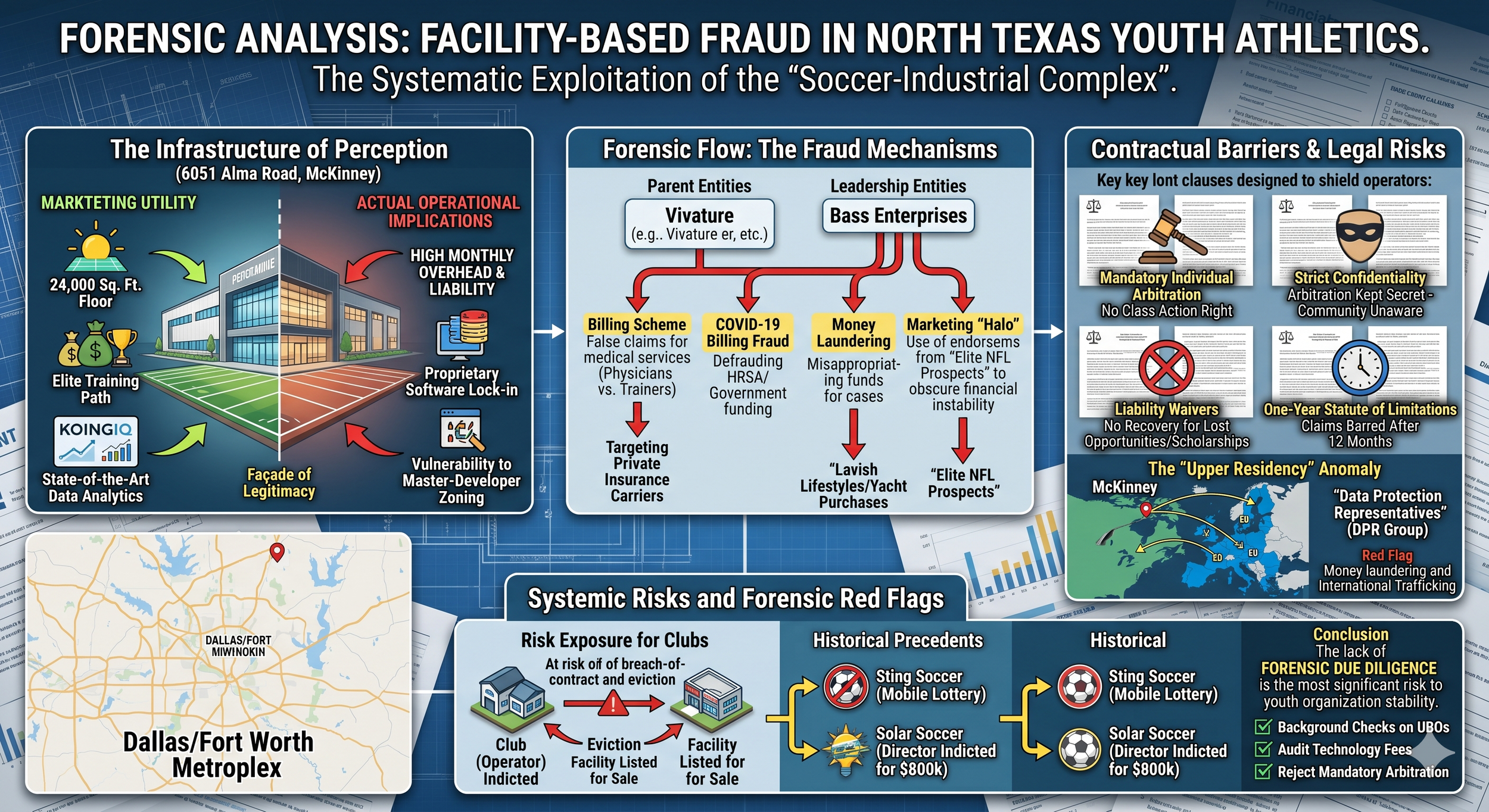
Forensic Analysis of Facility-Based Fraud in North Texas Youth Athletics: The Inpoweriq Performance Center and the Systematic Exploitation of the Soccer-Industrial Complex
The youth soccer landscape in the Dallas/Fort Worth (DFW) Metroplex has undergone a radical transformation over the last decade, transitioning from a community-based recreational model to a multibillion-dollar "soccer-industrial complex." This evolution is characterized by the rise of elite, technology-driven performance centers that promise collegiate and professional pathways to young athletes.
However, this high-growth environment has also attracted fraudulent operators who utilize sophisticated corporate structures and high-profile marketing to obscure financial instability and criminal activity.
Listen to this article → HERE
The youth soccer landscape in the Dallas/Fort Worth (DFW) Metroplex has undergone a radical transformation over the last decade, transitioning from a community-based recreational model to a multibillion-dollar "soccer-industrial complex."
This evolution is characterized by the rise of elite, technology-driven performance centers that promise collegiate and professional pathways to young athletes.
However, this high-growth environment has also attracted fraudulent operators who utilize sophisticated corporate structures and high-profile marketing to obscure financial instability and criminal activity.
The Inpoweriq Performance Center in McKinney, Texas, and the subsequent indictments and guilty pleas of its owner, Mouzon Bass III, and its leadership, including Lance Wilson, serve as a critical case study in the systemic risks that youth soccer clubs, athletes, and families face when entering into commercial agreements with facility operators.
This report provides an exhaustive forensic examination of these risks, the legal precedents in North Texas, and the contractual mechanisms used to shield fraudulent actors from accountability.
The Economic Drivers of Athletic Facility Proliferation in North Texas
The DFW Metroplex is currently experiencing an unprecedented surge in sports-related commercial activity, fueled in part by the region’s selection as a primary host for the 2026 World Cup.
With nine matches scheduled at the AT&T Stadium in Arlington and the establishment of major fan zones in Fair Park, the region has become a magnet for athletic investment.
This international spotlight has created a "halo effect" for local training facilities, allowing operators to market themselves as part of a global elite performance network.
The demand for high-end training space is further amplified by the regional hospitality and real-estate boom. Hotels in the Dallas area have seen significant increases in pricing, and short-term rental bookings on platforms like Airbnb and Vrbo are trending upward as the tournament nears.
In this climate, facilities like the Inpoweriq Performance Center at 6051 Alma Road in McKinney are positioned not merely as gyms, but as essential infrastructure for the "future of college athletics".
The 24,000-square-foot facility, integrated into larger redevelopment projects like the McKinney Cotton Mill, represents a trend where athletic training is bundled with high-density multifamily and commercial developments.
The Infrastructure of Perception: 6051 Alma Road
The physical attributes of a facility often serve as the primary mechanism for establishing legitimacy in the eyes of youth club directors and parents.
The Inpoweriq Performance Center was marketed as a "state-of-the-art" environment featuring advanced data analytics, personalized coaching, and specialized areas for professional athletes.
The facility’s layout included a weight room, gym flooring, an indoor track, batting cages, and six dedicated office spaces. For a youth soccer club, such an environment suggests a level of permanence and professional rigor that is difficult to find in municipal parks or smaller private facilities.
This infrastructure can be a "façade of elite performance" when the underlying business model is fraudulent. The Inpoweriq facility was eventually listed for sale as a "business acquisition opportunity," indicating that the "existing business" was available for purchase alongside the real estate.
This transition from a premier training center to a listed asset often occurs when an operator has over-leveraged the facility’s prestige to secure investment or when legal pressures, such as federal indictments, make continued operation impossible.
Case Study: The Vivature/Inpoweriq Indictments and Leadership Failure
The central example of this phenomenon in North Texas is the Inpoweriq Performance Center, owned by Bass Enterprises and Mouzon Bass III, with Lance Wilson serving as president. Bass and Wilson represent a sophisticated class of fraudulent operators who utilized the prestige of athletic training to facilitate massive financial crimes.
The Federal Fraud Conspiracy
In February 2026, Mouzon Bass III, 60, of Highland Park, and Lance Wilson, 57, of Allen, pleaded guilty to federal charges related to a multimillion-dollar fraud conspiracy in the Eastern District of Texas.
The indictment and subsequent pleas revealed a "hidden web" of criminal activity involving their company, Vivature, and a variety of schemes including:
Athletic Training Billing Scheme: Submitting false claims to private insurance carriers representing that physicians provided medical services for injured student athletes at various universities. In reality, physicians did not see or treat these patients; services were performed by athletic trainers who were ineligible for reimbursement.
COVID-19 Billing Fraud: Defrauding Health Resources and Services Administration (HRSA) funding by billing for travelers who were privately insured and ineligible for government-funded testing.
Money Laundering: Prosecutors noted that the proceeds from these schemes were used to fund lavish lifestyles, including the purchase of a yacht.
Both men now face up to 20 years in federal prison, along with potential fines and mandatory restitution.
The "Upper Residency" and Educational Veneer
To further entice families, Inpoweriq implemented an "Upper Residency" program, which moved into the McKinney facility for the 2026-2027 season.
This program integrated athletic training with academic components led by directors like Betsy Strawn and Meghan Payne.
By positioning the facility as an educational and residential hub, the operators increased the financial stakes for families. This integration makes the fallout of a fraudulent closure even more severe, as it disrupts the athlete's education and housing, not just their training schedule.
Contractual Barriers to Recourse: A Forensic Legal Review
The risk to families and clubs is codified in the "Terms and Conditions" and "Privacy Policies" designed by Inpoweriq's leadership to provide the operator with near-total immunity from civil litigation.
The Arbitration and Confidentiality Shield
A hallmark of the Inpoweriq legal strategy was the use of mandatory binding individual arbitration. This clause explicitly prevents families from filing class-action lawsuits. The terms stated that "the arbitrator shall have the exclusive power to rule on his or her own jurisdiction," further insulating the process from the public court system.
Furthermore, the Inpoweriq terms required that "all documents and information disclosed in the course of the arbitration shall be kept strictly confidential". This secrecy ensures that if one family successfully proves fraud, other families training at the facility will never know, allowing the operator to continue the behavior with new victims.
The Statute of Limitations and Liability Waivers
Inpoweriq’s contracts significantly shortened the window for filing a claim. Under standard Texas law, a party might have several years to act upon fraud; however, the Inpoweriq agreement mandated that any claim be commenced "within one (1) year after the date the party... first knows or reasonably should know of the act, omission, or default".
The "Data Protection Representative" Anomaly and Money Laundering Risks
A highly irregular aspect of Inpoweriq’s corporate structure was the appointment of the "DPR Group" as a Data Protection Representative in the European Union, claiming locations in all 28 EU countries.
In the context of international sports crime, complex "hidden webs" of ownership and international data representation are often used to facilitate money laundering and the trafficking of young players.
Given Bass and Wilson's guilty pleas to conspiracy to commit money laundering and wire fraud, this international data footprint serves as a significant forensic red flag.
Historical Legal Precedents of Soccer Fraud in DFW
The Inpoweriq situation is part of a long-standing pattern of litigation involving youth soccer in the North Texas region, where "foundations" are often used to shield for-profit activities from scrutiny.
Purser v. Coralli and Sting Soccer: In Purser v. Coralli (2011-2013), an investor sued the owner of the Sting Soccer Foundation, alleging he was defrauded of over $200,000 for a "mobile lottery" business connected to his soccer interest.
G. David Ringer (Solar Soccer Club): The former director of Solar Youth Soccer Club was indicted for allegedly stealing more than $800,000 from parents, treating the non-profit bank account as a "personal piggy bank".
Texas Soccer Foundation v. Sting Soccer Foundation (2021): Involved a protracted dispute over financial separation between facility operators and the non-profit entities that use them.
Risk Exposure for Youth Soccer Clubs as Commercial Tenants
Youth soccer clubs that enter into lease agreements with operators like Bass Enterprises face existential risks. When an operator is indicted or a facility is listed for sale as a "business acquisition," the club’s primary asset—access to high-quality training space—is compromised.
Clubs are often forced to guarantee their membership that training will occur at a specific location. If the facility at 6051 Alma Road is sold due to Bass and Wilson's legal fallout, the club faces its own breach-of-contract lawsuits from parents.
Furthermore, youth sports leagues are "ripe for fraud" because they often lack internal financial controls, allowing operators to misappropriate "technology fees" before they ever reach the club's official accounts.
Forensic Red Flags for Facility Operators
A forensic review of the Inpoweriq case reveals several "red flags" for clubs and families:
Prior Healthcare/Billing Violations: Owners with a history of billing fraud (Vivature) use similar tactics to overcharge athletic families.
Layers of Foreign Representation: Unnecessary international compliance structures (DPR Group) for a local McKinney operation.
Shortened Claims Periods: Contracts limiting fraud claims to one year to prevent discovery of long-term embezzlement.
Ownership-Leadership Disconnect: Ambiguous property ownership where the "business" and "real estate" are separated to isolate assets from liability.
Use of "Halo" Athletes: Reliance on NFL Draft picks (Jeanty) to establish legitimacy while leadership is under federal indictment.
Conclusion and Tenant Vulnerability
The research into the Inpoweriq Performance Center indicates that facility-based fraud in North Texas is a systemic byproduct of the region's athletic commercialization.
The guilty pleas of Mouzon Bass III and Lance Wilson in early 2026 highlight the danger of "soccer-industrial" complexes managed by individuals with a history of sophisticated financial crime.
Current youth soccer tenants at the 6051 Alma Road facility—including Alpha Forms (Forms Residency), Atletico Dallas, and the Texas Warriors—now face significant operational and reputational risk.
These organizations, alongside others in the DFW Metroplex, must adopt more rigorous partnership due diligence before entering into commercial agreements. Standard vetting should include:
Full background checks on "ultimate beneficial owners" (UBOs) and parent corporate entities.
Independent audits of facility technology fees and data-privacy contracts.
Rejection of mandatory arbitration and shortened statutes of limitations in lease and service agreements.
The lessons from Inpoweriq, Sting Soccer, and the Texas Soccer Foundation highlight a fundamental truth: one of the most significant risks to a youth organization's stability is the lack of forensic scrutiny applied to its commercial partners.
As the 2026 World Cup approaches, the vigilance of the soccer community—backed by comprehensive due diligence—is the only effective defense against systematic exploitation.
Sources
U.S. Department of Justice (Eastern District of Texas): Healthcare executives guilty in multimillion-dollar healthcare fraud conspiracy (February 13, 2026) .
Becker's Hospital Review: Healthcare billing company owner, executive plead guilty in fraud scheme (Andrew Cass, February 18, 2026).
WFAA News:(https://www.wfaa.com/article/news/crime/north-texas-healthcare-executives-plead-guilty-multimillion-dollar-fraud-conspiracy/287-b56ce102-b1e1-4071-a93a-02a1ba889138) (February 13, 2026) .
Inpoweriq, Inc.:(https://www.inpoweriq.com/terms) (Effective July 1, 2019) .
DuWest Realty:(https://duwestrealty.com/wp-content/uploads/2025/08/6051-Alma-OM-APRIL-26.pdf) (April 2026) .
Newswire:(https://www.newswire.com/news/inpoweriq-announces-new-nil-opportunity-for-more-than-300-000-student-21799100) (2024) .
Community Impact:(https://editions.communityimpact.com/view/617900558) (August 2024) .
WFAA News:(https://www.wfaa.com/article/news/local/ashton-jeanty-las-vegas-raiders-interview/287-08dbc343-f085-4359-832f-b1bf5d9327e1) (May 8, 2025) .
Forms Academy/Residency:(https://formsresidency.org/) .
Bottlenoses (Forensic Analysis):(https://www.bottlenoses.com/article-blog/the-structural-paradox-of-non-profit-youth-athletics-an-economic-and-forensic-analysis-of-the-north-texas-soccer-ecosystem) .
Justia Case Law:(https://law.justia.com/cases/texas/fifth-court-of-appeals/2021/05-19-01228-cv.html) .
AP News:(https://apnews.com/article/mundial-dallas-a96ab1b955b0b766bf00d7c2d3ee2210).
CBS Texas:(https://www.cbsnews.com/texas/news/head-of-dallas-soccer-club-accused-of-stealing-800000/) (June 9, 2011) .
Texas Warriors FC:(https://texaswarriorsfc.com/our-fields/) .
Atletico Dallas: Little Lobos Open Play Venue Information at Inpoweriq .
EFPR Advisory:(https://efpradvisory.com/news/article-publication/auditing-assurance/protecting-youth-sports-leagues-from-fraud/)
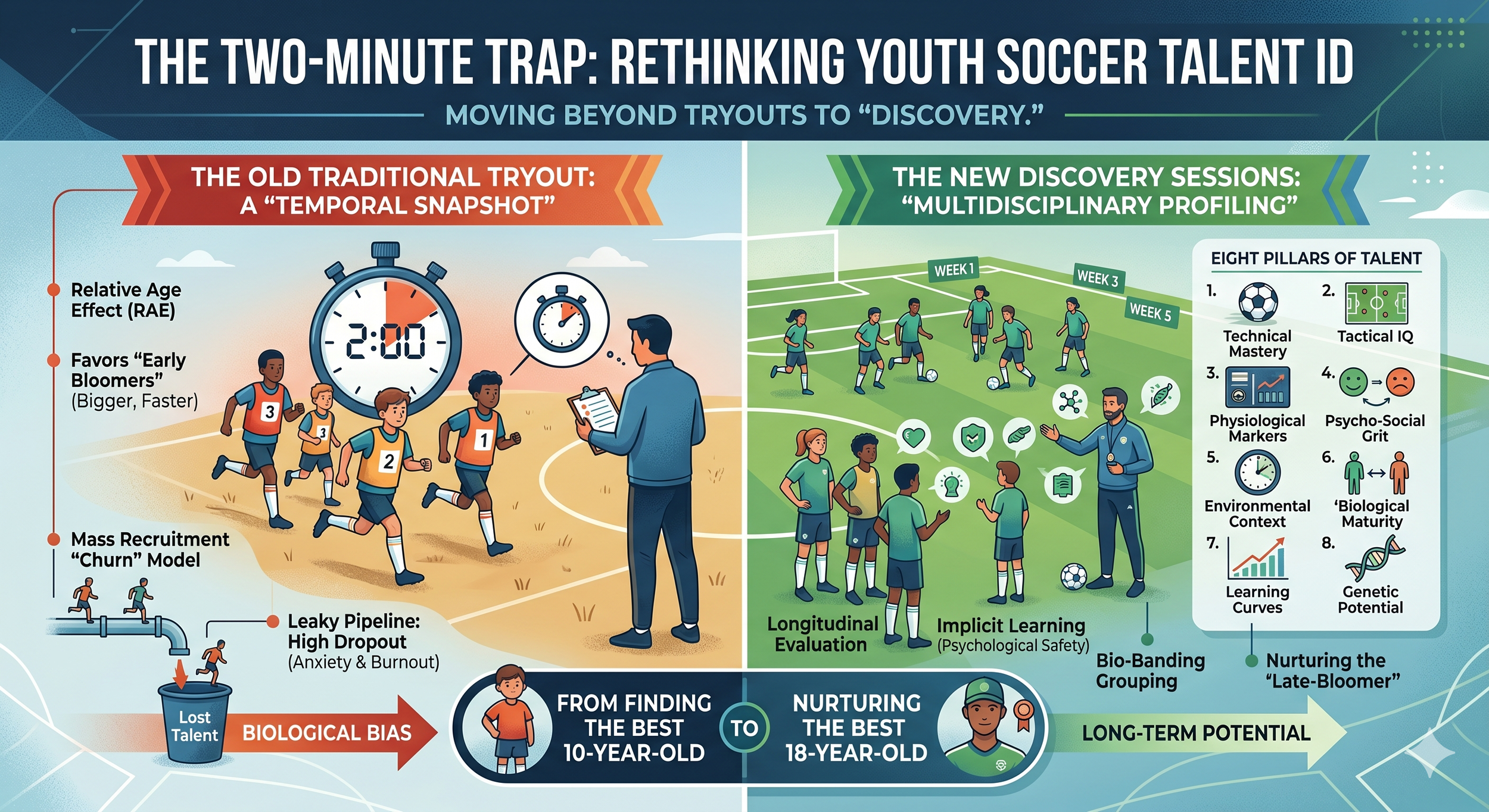
The Two-Minute Trap: Why Youth Soccer is Trading Tryouts for “Discovery”.
For decades, the ritual was the same: hundreds of nervous children gathered on parched summer fields, wearing numbered bibs and chasing a roster spot over a frantic 48-hour window.
But the "traditional tryout"—a staple of the American youth sports machine—is under fire.
Emerging research suggests these high-pressure events are scientifically flawed, favoring early-maturing "physical specimens" while discarding the very "game intelligence" required for elite success.
As clubs across the country look to modernize, a new paradigm is taking hold: "Discovery Sessions".
Listen to this article → HERE
For decades, the ritual was the same: hundreds of nervous children gathered on parched summer fields, wearing numbered bibs and chasing a roster spot over a frantic 48-hour window.
But the "traditional tryout"—a staple of the American youth sports machine—is under fire.
Emerging research suggests these high-pressure events are scientifically flawed, favoring early-maturing "physical specimens" while discarding the very "game intelligence" required for elite success.
As clubs across the country look to modernize, a new paradigm is taking hold: "Discovery Sessions".
The Flaw of the "Temporal Snapshot".
The traditional tryout is often less about talent and more about administrative efficiency.
In large clubs, coaches may only observe a specific player for "one to two minutes per drill".
This "snapshot" creates a massive biological bias. Because coaches are forced to make rapid judgments, they often fall victim to the "Relative Age Effect (RAE)".
Statistics show a staggering over-representation of players born in the first quarter of the year (January–March).
These "Q1" players are often bigger and faster simply because they are older, not because they are better soccer players.
"We mistake a temporary physical advantage for genuine technical superiority," the research notes. "Meanwhile, the 'late-bloomers'—players with high football IQ but smaller frames—are often cut before they hit their growth spurt.
The Eight Pillars of Talent.
In contrast, Discovery Sessions move away from the "all-or-nothing" weekend. They are longitudinal, often spanning several weeks. This extended window allows coaches to evaluate what scientists call "Multidisciplinary Profiling".
Instead of just looking at who can kick the ball hardest, evaluators look at eight distinct pillars:
Technical Mastery: Performance under pressure, not just in isolation.
Tactical IQ: Decision-making and "field vision."
Physiological Markers: Using sport science to measure true acceleration and agility.
Psycho-Social Grit: Resilience, coachability, and "joy for the game."
Environmental Context: Support systems and hours of deliberate practice.
Biological Maturity: Using "bio-banding" to group kids by physical stage rather than birthday.
Learning Curves: How quickly a player absorbs new information.
Genetic Potential: Emerging indicators of muscle composition and endurance.
The Hidden Cost of the "Factory" Model.
The shift isn't just about science; it’s about business. The traditional tryout serves a "churn" model, where clubs use mass recruitment to fill "B" and "C" teams to cover overhead costs.
However, this leads to a "leaky pipeline". When players feel undervalued or misidentified, they quit.
Currently, 70-80% of youth athletes drop out of organized sports by age 15, citing anxiety and burnout.
Discovery Sessions offer a "psychological safety net," allowing for "implicit learning"—the kind of unconscious growth that happens when a child isn't terrified of making a mistake.
A New Strategic Outlook.
Governing bodies like U.S. Soccer and UEFA are leading the charge, promoting Talent Identification Centers that prioritize long-term retention over seasonal roster-filling.
For clubs, the transition requires more coaching hours and better data, but the payoff is clear: higher player retention, a stronger brand reputation, and a much lower chance of "cutting" the next superstar.
As the "Play Revolution" grows, the goal is shifting from finding the best 10-year-old to nurturing the best 18-year-old.
By trading the stopwatch for a microscope, youth soccer is finally giving "late-bloomers" the temporal space they need to realize their full potential.
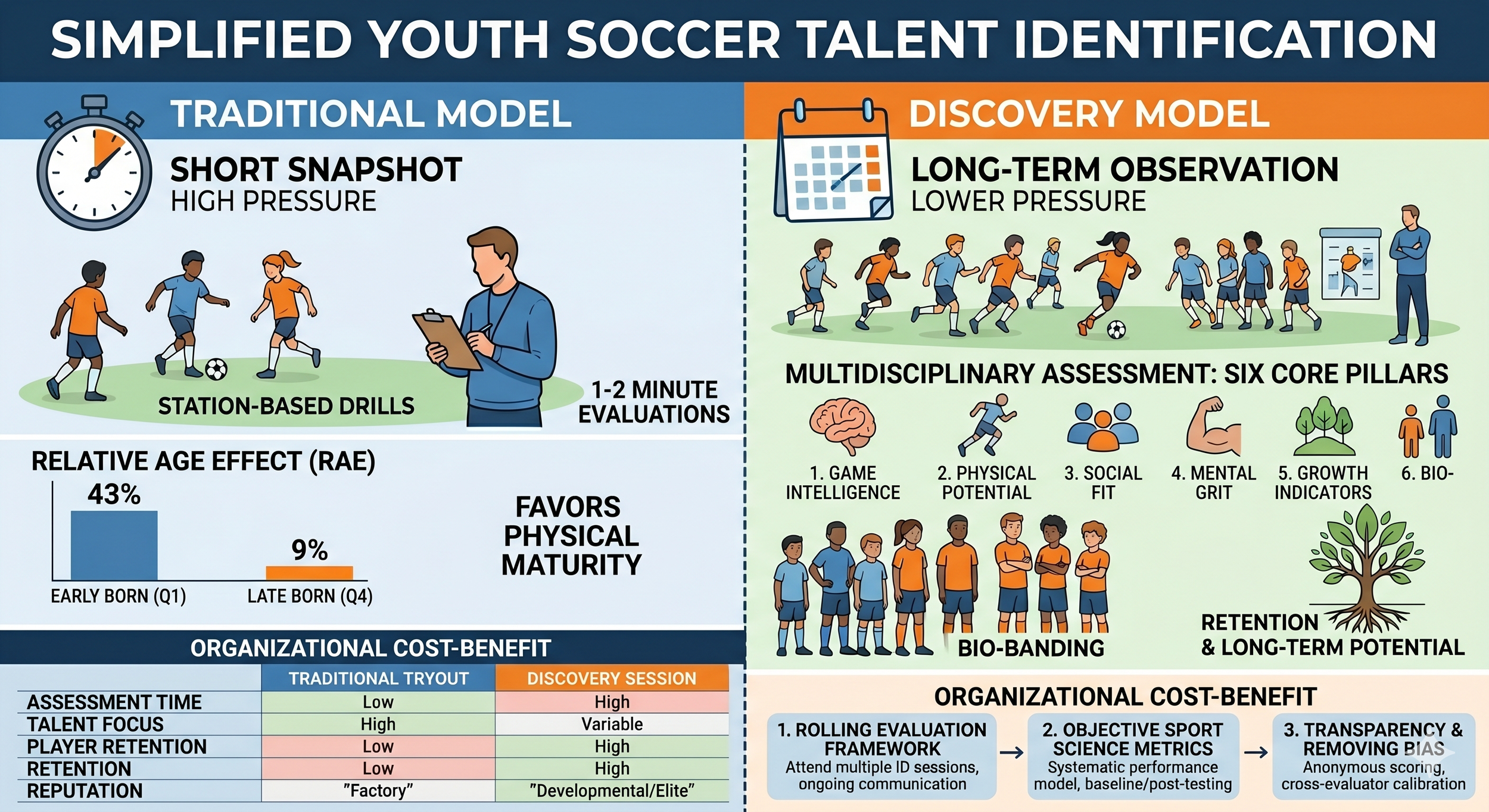
Multidisciplinary Paradigms in Youth Soccer Talent Identification: From Traditional Tryouts to Discovery-Based Assessment Models
The landscape of youth soccer talent identification is undergoing a significant transition from historically rigid, performance-based selection mechanisms to more fluid, longitudinal discovery models.
Traditionally, the youth soccer ecosystem has relied upon "tryouts"—short-duration, high-pressure events designed to categorize players based on immediate performance snapshots.
However, emerging research in sport science and talent development suggests that these traditional methods are often confounded by biological maturation variables, relative age effects, and a lack of holistic profiling.
In contrast, discovery sessions and identification clinics offer an extended window for assessment, prioritizing a player’s long-term potential over transient physical advantages.
This analysis explores the scientific foundations of these competing models, evaluates the multidisciplinary domains of talent, and provides a comprehensive cost-benefit analysis of their implementation in competitive youth soccer.
Listen to this article → HERE
The landscape of youth soccer talent identification is undergoing a significant transition from historically rigid, performance-based selection mechanisms to more fluid, longitudinal discovery models. Traditionally, the youth soccer ecosystem has relied upon "tryouts"—short-duration, high-pressure events designed to categorize players based on immediate performance snapshots. However, emerging research in sport science and talent development suggests that these traditional methods are often confounded by biological maturation variables, relative age effects, and a lack of holistic profiling. In contrast, discovery sessions and identification clinics offer an extended window for assessment, prioritizing a player’s long-term potential over transient physical advantages. This analysis explores the scientific foundations of these competing models, evaluates the multidisciplinary domains of talent, and provides a comprehensive cost-benefit analysis of their implementation in competitive youth soccer.
The Traditional Tryout: Mechanics, Biases, and the Logic of Selection
Traditional youth soccer tryouts have long served as the gatekeeper for entry into competitive sports environments. These events are typically structured as high-intensity, short-duration assessment windows, often lasting between two and five days.1 The primary objective of these tryouts is to help soccer organizations determine which players best fit their immediate needs for the upcoming competitive season.2 While ostensibly designed to identify talent, the mechanics of the traditional tryout frequently prioritize administrative efficiency and immediate physical performance over the long-term developmental potential of the athlete.
The Problem of the Temporal Snapshot: The Two-Minute Assessment
A central critique of the traditional tryout model is the extreme compression of the evaluation window. In many large-scale club environments, the sheer volume of participants necessitates a "station-based" or "drill-centric" approach. Research and practitioner observations indicate that in such settings, the actual time spent observing a specific individual’s decision-making or technical execution under pressure can be as low as one to two minutes per drill.3 This brevity is a significant limitation because talent identification is a complex, dynamic process that requires observing how a player's skills interact with various environmental and match-specific conditions.3
From a scientific perspective, a 120-second observation window is insufficient to capture "implicit learning" or "game intelligence"—qualities that are often obscured by the high-anxiety environment of a high-stakes tryout.7 Instead, these short windows favor players who exhibit high-visibility, physical traits—such as top-end speed or size—which are easier to identify quickly but are poor predictors of elite-level success in later years.3 Coaches, acting on what has been described as "subjective expert opinion" (SEO), often rely on intuition or an "inner standard" to make rapid judgments.6 While experienced coaches develop a "practical sense" for recognizing movement patterns, this intuition is highly susceptible to cognitive biases, leading to inconsistent and potentially inaccurate deselection decisions.6
The Recruitment-First Business Model and "Filling the Field"
Traditional tryouts frequently serve a dual purpose: they are both a talent filter and a recruitment engine for the club's broader business model. By hosting "open" tryouts, clubs can identify a small percentage of elite talent for top-tier teams while simultaneously recruiting a larger volume of players to populate "B," "C," and "D" teams.7 This "churn" model is often driven by a pay-for-play revenue structure where organizational overhead is covered by the sheer volume of registered players.7
In this context, the tryout is less about finding the developmentally appropriate fit for every player and more about "filling the field" to ensure financial sustainability. Players who do not make the "top" teams are often placed in lower tiers with less experienced coaching, despite paying similar registration fees. This practice highlights a fundamental conflict between a club's competitive goals and its developmental responsibilities. The result is often a "leaky pipeline" where players in lower tiers, feeling undervalued or misidentified, drop out of the sport entirely.11
The Science of Discovery Sessions: A Holistic Paradigm for Growth
Discovery sessions and identification (ID) clinics represent a fundamental shift toward a more scientific, longitudinal approach to talent identification. Unlike the "one-off" nature of traditional tryouts, these sessions are often integrated into a club's year-round calendar or involve multiple attendance dates, allowing coaches to observe players over an extended period.9 This structure mitigates the impact of a single "bad day" and reduces the performance-inhibiting effects of tryout-related anxiety.
Multidisciplinary Profiling: The Eight Pillars of Talent
The core advantage of the discovery model is the ability to assess a holistic player profile. Scientific literature suggests that talent identification must move beyond isolated technical drills and incorporate a multidisciplinary approach.15 Research highlights eight primary indicators that must be taken into consideration for a comprehensive talent assessment: maturity, physiological abilities, technical skills, tactical skills, psycho-social attributes, deliberate practice, genetic factors, and environmental context.6
1. Technical Skills and Mastery Under Pressure
Beyond simple ball control, recruiters in discovery models prioritize "technique under pressure" and "first touch" as high-tier indicators of potential.3 Technical skills such as passing and first touch constitute over half of all individual actions in a game.3 A discovery session allows coaches to see these skills in varying contexts—different game speeds, varying levels of opposition, and diverse tactical roles—providing a much more accurate picture of a player's technical competence than a 15-minute isolated drill.
2. Tactical Skills and Game Intelligence
Tactical skills include game understanding, decision-making, positioning, and "field vision." These traits are often "implicit" and require repeated observation in various game scenarios to identify accurately.7 Players who progress to elite levels are often those who possess superior domain-specific information processing abilities, such as anticipation and pattern recognition.3 Discovery sessions provide the temporal space to see if a player can adapt their tactical approach over the course of a week as they learn a team's style of play.
3. Physiological and Anthropometric Attributes
These include acceleration, maximal speed, agility, and power.18 While traditional tryouts often overvalue these traits because they are easy to see, discovery models use objective sport-science protocols to measure them accurately and place them in the context of a player's biological maturity.18 For instance, a player might have low top-end speed but exceptional 5-meter acceleration, a nuance that might be missed in a crowded tryout but captured in a structured ID clinic.
4. Psycho-Social and Mental Attributes
Evaluators in discovery models look for "coachability," "resilience," "inner drive," and "joy for the game".3 Psychological attributes such as self-confidence, motivation, and the ability to seek social support have been shown to predict elite-level career success.3 A discovery session allows coaches to see how a player responds to feedback, how they interact with potential teammates, and how they recover from a mistake over several days, rather than just several minutes.
5. Social and Sociocultural Factors
Holistic models also consider the player's environment, including parental support, cultural background, and total hours of practice.3 These factors are critical because they influence a player's access to resources and their long-term commitment to development. Discovery sessions often involve more parent-coach interaction, allowing for a better understanding of the support system surrounding the athlete.
6. Maturity and Biological Age
As discussed extensively in the literature, maturation status significantly influences physical performance assessments.19 Discovery sessions allow for the use of assessment tools like the Pubertal Developmental Scale (PDS) or "bio-banding" to differentiate between current physical dominance and actual soccer potential.19
7. Deliberate Practice and Trajectories
Discovery sessions can identify a player's "learning curve"—how quickly they absorb and apply new information. This is a far better predictor of future success than their current skill level at age 10 or 11.
8. Genetic Factors and Environmental Context
While still an emerging field, understanding the influence of genetics on physical traits like muscle composition is becoming a part of the professional scouting conversation.6 Discovery models allow for a deeper dive into these background factors during the recruitment process.
Biological Maturation and the Selection Fallacy
One of the most profound scientific arguments for discovery sessions is the need to account for biological maturation and the Relative Age Effect (RAE). Traditional tryouts are notorious for exhibiting a bias toward selecting the oldest and most physically mature children in an age group—typically those born in the first quarter (Q1) of the selection year.7
The Relative Age Effect (RAE) and Institutional Bias
RAE describes the phenomenon where an athlete's likelihood of selection is influenced by their birthdate relative to age-group cutoff dates.20 In youth soccer, players are typically grouped by chronological age cohorts, resulting in age differences of up to 12 months between players born in January versus December.20 Due to this disparity, Q1 players often exhibit superior physical fitness and are perceived as more talented, while late-born (Q4) players are often excluded, leading to a "wasted" talent pool.3
Research across European academies shows a stark over-representation of Q1 births: approximately 43.4% of elite youth players are born in Q1, compared to only 9.3% in Q4.21 This bias persists across major leagues and youth academies globally.22 The "snapshot" nature of traditional tryouts reinforces this, as coaches mistake the temporary, maturity-related physical advantage of an older child for genuine technical or tactical superiority.7
Maturation Bias vs. Talent Potential
Biological maturation and RAE are distinct constructs that operate independently.20 While RAE is primarily an institutional artifact of age-grouping, maturation bias refers to the tempo of an individual's growth. Early-maturing players experience advanced skeletal age and muscle hypertrophy, which translates into superior endurance, power, and speed capacities during puberty.20
In a 1-2 minute assessment, a coach might be dazzled by a player's explosive sprint but fail to see that a smaller, late-maturing teammate has superior "football IQ" and technical skills. When the smaller player is deselecting, the club loses a "late-bloomer" who might have eventually surpassed the early-maturer once physical growth evened out. Discovery sessions allow for the application of "bio-banding"—grouping players by biological maturity rather than chronological age—to create a fairer assessment environment and prevent the premature exclusion of talented late-developers.19
The "Underdog Hypothesis" and Exceptionalism
Interestingly, some research suggests that the few late-born (Q4) or late-maturing players who do manage to stay in the elite system often become superior professional players later in life. This is known as the "underdog hypothesis"—the idea that having to compete against larger, stronger peers forces these players to develop superior technical workarounds, tactical resilience, and game awareness to survive.7 By using discovery sessions to keep more of these late-developers in the system, clubs can significantly increase the quality of their top-end talent pool.
Psychological Impact: Pressure, Anxiety, and Burnout
The structure of the assessment significantly influences the psychological welfare and development of the young athlete. Traditional tryouts, characterized by their "all-or-nothing" nature, create a high-stress environment that can trigger performance anxiety and long-term mental health challenges.
The Mental Health Cost of High-Pressure Selection
Participation in high-stakes competition from a young age is linked to a variety of mental health issues. Statistics show that 70-80% of young players quit organized sports by age 15, frequently citing anxiety, burnout, and a loss of enjoyment.11 Clinical evaluations have found that nearly 17% of youth elite athletes experience at least one mental disorder, with lifetime prevalence reaching 25%.11
Traditional tryouts exacerbate these risks. The fear of failure—specifically the fear of being "cut" or "deselected"—can lead to an identity crisis, as many young players tie their self-worth to their athletic status.12 This "deselection" process, often handled via a generic email after a brief tryout, can be emotionally devastating and lead to an abrupt end to a child's athletic journey.12
Implicit vs. Explicit Learning and the "Safety" of Discovery
Psychologically, the "safety" provided by a discovery session allows for "implicit learning." This is learning that occurs unconsciously through play, making it more resilient under pressure and more adaptable to changing game situations.7 In contrast, high-pressure tryouts force "explicit" learning—coaching that is conscious, ego-based, and reflective.7 This makes players more susceptible to "choking" under pressure and less likely to take the tactical risks necessary for elite growth.
Environments that prioritize "FreePlay" and longitudinal assessment allow players to focus on the "driver" (decision-making and perception) rather than just the "execution" (physical outcome).7 When a player knows they have multiple sessions to demonstrate their ability, their cortisol levels remain lower, allowing for better cognitive function and a more accurate display of their actual potential.
Cost-Benefit Analysis: Traditional Tryouts vs. Discovery Sessions
Implementing a discovery session model requires a significant shift in organizational strategy and resource allocation. While traditional tryouts are often seen as more "efficient" from a time-management perspective, a deeper analysis reveals substantial hidden costs related to talent waste and player churn.
Economic Costs and Revenue Models of Traditional Systems
Tryout Fee Revenue: Traditional models often generate immediate cash flow through registration fees (e.g., $5 to $10 per player).24 With hundreds of players participating, this can represent a significant seasonal windfall for a club.
Facility and Staffing Efficiency: Traditional tryouts pack the assessment into 2-3 days, minimizing facility rental costs and coaching hours per player.
The Cost of "Talent Waste": The primary hidden cost is the misidentification of talent. When a club cuts a player who later develops into a star for a rival, they have lost a valuable asset.
The Cost of Churn: Roster turnover in European academies is estimated at 25-30% annually.12 High turnover requires constant spending on marketing and recruitment to fill vacancies, a cycle that discovery models aim to break.
Economic and Strategic Benefits of Discovery-Based Models
Higher Retention and Lifetime Value: Discovery models emphasize placement and retention. The UEFA Grassroots Charter identifies retention as a "KEY criterion" because long-term participation builds the "adult volunteers of tomorrow" and maintains commercial value within the sport's ecosystem.14
Personalized Recruitment of "Impact" Players: For elite programs, the discovery model (often involving individual trials) is a more effective way to attract high-profile talent who might be hesitant to attend a crowded "open" tryout.9
Data-Informed Decision Making: While discovery sessions require more coaching hours, the "rolling evaluation" process allows for better alignment across coaching staff and reduces the risk of expensive "wrong" deselection decisions.8
Revenue through Quality: Clubs that can point to a track record of player growth move up levels and attract more talented athletes, eventually leading to higher program fees and sponsorship opportunities.25
Institutional Frameworks and Professional Best Practices
Professional governing bodies like U.S. Soccer and UEFA have recognized the limitations of traditional tryouts and are actively promoting alternative identification pathways.
U.S. Soccer Talent Identification Centers (IDCs)
U.S. Soccer describes its IDCs as a critical component of the national team pathway.26 These centers move away from the "open registration" model, instead utilizing invitation-only sessions for top talents discovered through direct scouting at games and club recommendations.26 This model replicates the elite environment of a national team camp and is strictly closed to parents and spectators to encourage player autonomy and focus.26
UEFA Grassroots Charter and Elite Scouting
The UEFA Grassroots Charter places a heavy emphasis on "registered player" data and retention rates.14 To achieve "Gold" status, national associations must have systems that track player growth and ensure that adult participation remains at least 90% of youth participation levels.14 This reflects a strategic understanding that the health of the game depends on keeping players involved for life, rather than cycling through them in a high-pressure tryout environment.
UEFA also offers an Elite Scout Programme (UEFA ESP) to train professionals in "modern-day" scouting, which involves moving away from "gut feelings" toward the use of statistics, new technologies, and holistic observation.27 This professionalization of scouting is designed to counteract the subconscious biases that plague traditional assessments.
Implementation: Transitioning to the Discovery Model
For youth clubs looking to adopt a more scientific approach to talent identification, the implementation of "Discovery ID Sessions" offers a clear path forward. This transition involves shifting from a "selection day" mentality to a "developmental assessment" mindset.
The "Rolling Evaluation" Framework
Clubs like the Reign Academy and Brit-Am All Stars have adopted flexible schedules where players attend multiple ID sessions.13 This provides flexibility for families and ensures that players are seen in multiple states of readiness. Communication in these programs is ongoing; feedback and team invitations are sent throughout the period, rather than concentrated at the end of a stressful week.13
Utilizing Objective Sport Science Metrics
A modern discovery clinic should integrate objective physical profiling. Following a systematic performance model—baseline testing, supplemental training, and post-testing—allows coaches to measure "training responsiveness".18 This is a critical indicator of talent: it's not just about how fast a player is today, but how quickly they improve when given professional instruction.
Metrics such as 10-meter acceleration, maximal sprinting velocity, change-of-direction efficiency (agility), and explosive power (broad jump) provide a clear, objective insight into an athlete's physical profile.18 When these are measured alongside technical and tactical skills, the club can build a truly holistic player profile.
Transparency and Removing Bias
A key challenge in moving to a more longitudinal, often subjective, discovery model is maintaining transparency for parents and players. Organizations can adopt specific steps to ensure fairness:
Communicate Criteria: Provide evaluation rubrics to players before sessions.29
Anonymous Scoring: Use bib numbers instead of names to prevent evaluator bias.29
Cross-Evaluator Calibration: Have different coaches "spot-check" and compare scores in real-time using player evaluation software.29
Formal Feedback: Share results after the evaluation period to help the player understand their developmental path, whether or not they were selected for a top team.29
Synthesis and Strategic Outlook
The transition from traditional tryouts to discovery sessions is more than just a change in scheduling; it is a fundamental rejection of the "commodity" view of youth players in favor of a "human-centered" developmental model. The science is clear: the traditional "two-minute" assessment in a high-pressure tryout is a poor predictor of elite potential and is fundamentally biased by biological maturation and the Relative Age Effect.
Discovery sessions, by providing more time for assessment across eight multidisciplinary domains, allow for a much more accurate identification of the "driver"—the perceptual-cognitive and tactical intelligence that ultimately separates elite professionals from sub-elite amateurs. Furthermore, these sessions provide a "safety net" for psychological health, reducing burnout and keeping more "late-bloomers" in the sport's ecosystem.
While the organizational costs of discovery models are higher in the short term, the long-term benefits of increased player retention, improved talent accuracy, and enhanced brand reputation for development provide a superior strategic path for youth soccer clubs. As professional governing bodies like US Soccer and UEFA continue to push for data-informed, longitudinal identification pathways, the traditional tryout model will likely be relegated to recreational contexts, with competitive development focusing on the patient, holistic "discovery" of talent. The "Play Revolution" and the move toward implicit learning through discovery represent the future of the game, ensuring that every child is given the temporal and psychological space to realize their full athletic potential.
Sources
How long do soccer tryouts last? - Quora, accessed on April 22, 2026, https://www.quora.com/How-long-do-soccer-tryouts-last
How Do Youth Soccer Tryouts Work?, accessed on April 22, 2026, https://www.soccerstars.com/how-do-youth-soccer-tryouts-work/
Talent identification and recruitment in youth soccer: Recruiter's ..., accessed on April 22, 2026, https://pmc.ncbi.nlm.nih.gov/articles/PMC5395184/
How to Run Effective Baseball Tryouts | SkillShark Athlete Evaluations, accessed on April 22, 2026, https://skillshark.com/blog/how-to-run-baseball-tryouts
Soccer Development by Age: The Role of LTPD in BC Soccer, accessed on April 22, 2026, https://sefasoccer.com/the-role-of-ltpd-in-bc-soccer/
The Identification of Talent in Soccer – a Brief Review - LUMEN Publishing, accessed on April 22, 2026, https://lumenpublishing.com/journals/index.php/rrem/article/download/910/pdf/3571
VIVA LA REVOLUTION - Joy of the People, accessed on April 22, 2026, https://www.joyofthepeople.org/post/viva-la-revolution
Challenges and solutions to talent (de)selection and ... - Frontiers, accessed on April 22, 2026, https://www.frontiersin.org/journals/psychology/articles/10.3389/fpsyg.2025.1636386/full
Elite Player Identification & Events | RISE Soccer Club, accessed on April 22, 2026, https://www.risesc.org/elite-player-identification-events
Examining Equity, Diversity, and Inclusion in Talent Identification and Talent Development in Youth Soccer in Canada: Coaches' - MSpace, accessed on April 22, 2026, https://mspace.lib.umanitoba.ca/bitstreams/b3e13903-b885-48c4-9c6c-6f9f74f2fb73/download
Youth Sports Psychology: What Competition Actually Does to Your Child's Mental Health, accessed on April 22, 2026, https://www.drpaulmccarthy.com/post/youth-sports-psychology-what-competition-actually-does-to-your-child-s-mental-health
(PDF) Dealing with de-selection from youth international football: A case study of English Premier League academies - ResearchGate, accessed on April 22, 2026, https://www.researchgate.net/publication/375981920_Dealing_with_de-selection_from_youth_international_football_A_case_study_of_English_Premier_League_academies
ID Sessions/Tryouts - Seattle Reign Academy, accessed on April 22, 2026, https://www.reignacademy.com/tryouts
Charter Guidelines, accessed on April 22, 2026, https://assets01.sdd1.ch/assets/lbwp-cdn/mobilesport/files/1601441336/uefa-grassroots-programme-charter-guidelines.pdf
VARIABLES USED FOR TALENT IDENTIFICATION AND DEVELOPMENT IN SOCCER: A SCOPING REVIEW, accessed on April 22, 2026, https://ojs.srce.hr/kinesiology/article/view/29293/16971
TALENT IDENTIFICATION AND DEVELOPMENT IN YOUTH SOCCER; A Guide for Researchers and Practitioners, accessed on April 22, 2026, https://api.pageplace.de/preview/DT0400.9781000918748_A46514687/preview-9781000918748_A46514687.pdf
Coaches' Criteria for Talent Identification of Youth Male Soccer Players, accessed on April 22, 2026, https://www.mdpi.com/2075-4663/10/2/14
Advancing Youth Soccer Development Through Applied Sport Science: Insights From Synergy Athletic Solutions' In-Season Performance Program, accessed on April 22, 2026, https://synergyathleticsolutions.com/blog/in-season-soccer-sport-science-performance-program/
Assessment of Performance in Youth Soccer Players: Should We ..., accessed on April 22, 2026, https://pmc.ncbi.nlm.nih.gov/articles/PMC11307186/
Interactive Effects of Biological Maturation and Relative Age Effect on Talent Identification for U16 Elite Soccer Players | bioRxiv, accessed on April 22, 2026, https://www.biorxiv.org/content/10.64898/2026.04.02.716019v1.full-text
Maturity Status Strongly Influences the Relative Age Effect in International Elite Under-9 Soccer - PMC, accessed on April 22, 2026, https://pmc.ncbi.nlm.nih.gov/articles/PMC5950738/
Leveling the Playing Field: A New Proposed Method to Address Relative Age- and Maturity-Related Bias in UK Male Academy Soccer Players - Frontiers, accessed on April 22, 2026, https://www.frontiersin.org/journals/sports-and-active-living/articles/10.3389/fspor.2022.847438/full
Youth Sport Specialization: Pros, Cons and Age Guidelines - Johns Hopkins Medicine, accessed on April 22, 2026, https://www.hopkinsmedicine.org/health/conditions-and-diseases/sports-injuries/youth-sport-specialization
Social Media Posts for George Mason University - College Raptor, accessed on April 22, 2026, https://www.collegeraptor.com/colleges/social-media/George-Mason-University-VA--232186
How To Navigate the Club Tryout Process - Beast Mode Soccer, accessed on April 22, 2026, https://beastmodesoccer.com/how-to-navigate-the-club-tryout-process/
Talent Identification Centers | U.S. Soccer Official Website, accessed on April 22, 2026, https://www.ussoccer.com/talent-identification/talent-identification-centers
UEFA Elite Scout Programme (UEFA ESP) - UEFA Academy, accessed on April 22, 2026, https://uefaacademy.com/courses/esp/
2026 – 2027 All Stars Academy ID Sessions - Brit-Am Soccer Academy, accessed on April 22, 2026, https://brit-am.com/team-tryouts/
Say Good-bye to Youth Soccer Tryout Bias with these 7 Steps, accessed on April 22, 2026, https://www.soccercommand.com/blogs/soccer-command-blog/say-good-bye-to-youth-soccer-tryout-bias-with-these-7-steps

Canteraz Soccer Academy and Fever United Forge Strategic Alliance Prioritizing Holistic Player Growth
MCKINNEY, TX – Canteraz Soccer Academy today announced a strategic alliance with Fever United, specifically for its U15 Girls team competing in the ECNL-RL-NTX. While the move marks a competitive transition—with the team now officially becoming Fever United—the heart of this collaboration is a shared commitment to the long-term human growth and athletic maturity of the players involved.
MCKINNEY, TX – Canteraz Soccer Academy today announced a strategic alliance with Fever United, specifically for its U15 Girls team competing in the ECNL-RL-NTX. While the move marks a competitive transition—with the team now officially becoming Fever United—the heart of this collaboration is a shared commitment to the long-term human growth and athletic maturity of the players involved.
In an era where youth sports often prioritize rankings over development, this alliance is designed to shield athletes from the volatility of changing league formats and rules, providing them with a stable, high-performance environment where they can thrive as both players and individuals.
A Mission Rooted in Long-Term Development
At the core of this decision is the belief that elite competition should serve the player’s personal growth. By joining forces with Fever United, Canteraz ensures that these young women have access to the resources necessary to navigate the rigorous ECNL-RL-NTX landscape without sacrificing the holistic approach to coaching they have come to expect.
"Our focus has always been on the human behind the athlete," said Daniel Yactayo, Co-Founder of Canteraz Soccer Academy. "As we look at the changes occurring in the ECNL-RL-NTX format, this alliance with Fever United allows us to provide a more robust development path. We aren't just preparing them for the next match; we are preparing them for the next stage of their lives."
Strategic Integration for the U15 Girls
This partnership is precision-targeted to address the unique needs of the U15 Girls age group. By integrating into the Fever United system, the team gains:
Stability Amidst Change: A clear, guided path through the new ECNL-RL-NTX rules and structural shifts.
Comprehensive Support: Access to expanded technical resources and a deeper competitive pool to challenge their growth.
Community-Centric Values: A shared philosophy that prioritizes player well-being, mental readiness, and the long-term development arc over short-term results.
About Canteraz Soccer Academy
Founded on the principles of holistic development, Canteraz Soccer Academy is dedicated to providing high-level training that focuses on the "whole" athlete. Through community-oriented models and innovative programs like the "Let’s Grow" initiative, the academy continues to break down barriers to elite soccer.
About Fever United
Fever United is a premier North Texas soccer organization known for its competitive excellence and its ability to foster an environment where athletes can reach their peak potential through disciplined training and elite league play.

The Growing Pains of the Beautiful Game: The Overuse Injury
Modern youth soccer, the transition from local sandlots to elite academies has brought a sophisticated level of skill to the pitch—but it has come at a physical cost. A comprehensive new analysis of musculoskeletal pathologies reveals that nearly half of all youth sports injuries are now classified as overuse injuries, a direct result of the "professionalization" of childhood play.
Unlike a broken bone from a bad tackle, overuse injuries are the result of "microtrauma"—microscopic damage to bone, tendon, or muscle that occurs when a child’s training schedule outpaces their body's ability to repair itself.
In modern youth soccer, the transition from local sandlots to elite academies has brought a sophisticated level of skill to the pitch—but it has come at a physical cost. A comprehensive new analysis of musculoskeletal pathologies reveals that nearly half of all youth sports injuries are now classified as overuse injuries, a direct result of the "professionalization" of childhood play.
Unlike a broken bone from a bad tackle, overuse injuries are the result of "microtrauma"—microscopic damage to bone, tendon, or muscle that occurs when a child’s training schedule outpaces their body's ability to repair itself.
The Biological "Weak Link"
The research highlights a fundamental truth: children are not just "small adults." Their skeletons are under construction, featuring growth plates (physes) made of soft, developing cartilage.
"Because these cartilaginous structures are softer and structurally weaker than mature bone... they serve as the mechanical 'weak link' in the musculoskeletal chain," the report states.
This vulnerability peaks during Peak Height Velocity (PHV)—the adolescent growth spurt. During this window (typically age 11.5 for girls and 13.5 for boys), bones grow so fast that muscles and tendons can't keep up, creating a "functional tightness" that pulls painfully on those fragile growth plates.
A Roadmap of Pain
The study identifies a "distal-to-proximal" pattern of injury that follows a child’s growth.
Ages 9–11: Injuries typically strike the heels (Sever’s disease).
Ages 12–14: The focus shifts to the knees (Osgood-Schlatter disease).
Ages 15+: As players get stronger and faster, the risk moves to the hips and lower back.
Perhaps most concerning is the gender gap. Female players are 2.8 times more likely to suffer ACL tears than males. This is attributed to a combination of anatomy (a wider pelvic "Q-angle") and "quadriceps dominance," where girls tend to land from jumps with stiffer, more upright knees.
The "Age Rule" and the Cost of Specialization
The data points to a clear culprit for the spike in injuries: volume. Experts now advocate for the "Age Rule," which suggests a child should never participate in more hours of organized sports per week than their age in years.
Furthermore, the trend of early specialization—playing only soccer year-round—is doubling the risk of injury. By repeating the exact same movements 12 months a year, young athletes lose out on the "physical literacy" gained from other sports, which actually helps protect the body from repetitive stress.
Injury Prevention Checklist: A Guide for Parents and Coaches
To protect the long-term health of young players, the research suggests a proactive shift in how we manage youth talent. Use this checklist to ensure your athlete stays on the field and out of the clinic.
📋 Training & Volume
Follow the "Age Rule": Ensure weekly organized soccer hours do not exceed the player’s age (e.g., a 12-year-old should train/play $\leq$ 12 hours/week).
Enforce the "2-Month Rule": Schedule at least two months of rest from soccer per year (can be non-consecutive) to allow tissue remodeling.
Prioritize Multi-Sport Participation: Encourage other activities (swimming, gymnastics, basketball) to build diverse motor skills and "cross-train" the musculoskeletal system.
Monitor Growth Spurts: During rapid height increases, reduce high-impact drills and focus on flexibility to accommodate "functional tightness."
📋 On-Field Safety
Implement the FIFA 11+: Use a structured neuromuscular warm-up (like FIFA 11+ or 11+ Kids) before every session. Research shows this can reduce injuries by up to 70%.
Check the Surface: Be wary of high-traction artificial turf. Ensure players have appropriate footwear (shorter studs for turf) to prevent the foot from "planting" and twisting the knee.
Assess the "Squeeze Test": If a child complains of heel pain, perform a gentle squeeze on the sides of the heel. Pain here is a red flag for Sever’s disease.
📋 Recovery & Psychological Health
Track the "Internal Load": Ask players for their RPE (Rated Perceived Exertion) on a scale of 1–10. If scores are consistently high, they are at risk of burnout or Overtraining Syndrome (OTS).
Watch for "Nagging" Pains: Never dismiss persistent aches as "growing pains." Use the Level 1–4 pain scale to intervene before a Level 1 ache becomes a Level 4 stress fracture.
Promote Sleep & Nutrition: Ensure the athlete is getting age-appropriate sleep, as this is the primary window for physiological repair.
Focus on Fun: Reduce parental/coach pressure. High-stress environments lead to fatigue and "adolescent awkwardness," which directly increases injury risk.
The Long Game: Prioritizing Longevity Over Trophies
The findings of this comprehensive analysis serve as a wake-up call for the youth soccer community. While the dream of reaching the professional ranks is a powerful motivator, the physiological reality is that a young athlete’s body is a "work in progress." By pushing children to train like adults before their skeletons have even finished growing, we risk trading long-term health for short-term performance.
The consequences of mismanaging overuse injuries are not just temporary. Chronic stress in childhood can lead to early-onset osteoarthritis, growth impairments, and a 70% dropout rate by age 13. To reverse this trend, a paradigm shift is required—one where coaches and parents act as "load managers" rather than just instructors.
Ultimately, the most successful youth program isn't the one with the most trophies in the cabinet, but the one that develops resilient, healthy athletes who are still playing and enjoying the game well into their adult lives. By respecting the biological limits of the developing body and implementing evidence-based tools like the FIFA 11+, we can ensure that "the beautiful game" remains a source of health, not a cause of chronic pain.

Comprehensive Analysis of Overuse Injuries in Youth Soccer: Biological, Epidemiological, and Preventive Perspectives
Unlike acute traumatic events, such as fractures or ligamentous ruptures resulting from a single inciting force, overuse injuries represent a clinical manifestation of repetitive microtrauma to tissue—bone, muscle, tendon, or ligament—that occurs when the cumulative stress exceeds the body’s innate physiological capacity for repair.
In the pediatric and adolescent population, this phenomenon is uniquely complicated by the presence of open growth plates and the dynamic processes of biological maturation, making young athletes fundamentally different from their adult counterparts in terms of injury susceptibility, presentation, and management.
The contemporary landscape of youth soccer has transitioned from a recreational pastime to a highly structured, professionalized environment characterized by early specialization, year-round competition, and rigorous training schedules.
While these developments aim to maximize talent identification and skill acquisition, they have concurrently precipitated a significant increase in musculoskeletal pathologies, specifically those classified as overuse injuries.
Unlike acute traumatic events, such as fractures or ligamentous ruptures resulting from a single inciting force, overuse injuries represent a clinical manifestation of repetitive microtrauma to tissue—bone, muscle, tendon, or ligament—that occurs when the cumulative stress exceeds the body’s innate physiological capacity for repair.
In the pediatric and adolescent population, this phenomenon is uniquely complicated by the presence of open growth plates and the dynamic processes of biological maturation, making young athletes fundamentally different from their adult counterparts in terms of injury susceptibility, presentation, and management.
Pathophysiological Foundations of Overuse in Pediatric Populations
The fundamental vulnerability of the youth athlete resides in the skeletal immaturity of the developing frame. During childhood and adolescence, the long bones of the extremities and the various regions of the pelvis and spine contain specialized areas of developing cartilage known as growth plates, or physes, and apophyses, which serve as the sites of tendon and ligament insertion.
Because these cartilaginous structures are softer and structurally weaker than mature bone or the adjacent dense connective tissues, they serve as the mechanical "weak link" in the musculoskeletal chain. Repetitive mechanical loading—inherent in the sprinting, pivoting, and ball-striking demands of soccer—exerts traction and compression forces that can lead to inflammatory and degenerative conditions in these growth centers.
Biomechanics of Maturation and Peak Height Velocity
Biological maturation is perhaps the most significant intrinsic risk factor for overuse injuries in youth soccer. The period surrounding Peak Height Velocity (PHV), which typically occurs at approximately 11.5 years in females and 13.5 years in males, represents a high-risk window for injury.
During this growth spurt, longitudinal bone growth often outpaces the adaptation of the surrounding muscle-tendon units, resulting in a transient decrease in flexibility and an increase in joint tension.
This mismatch between skeletal length and soft tissue elasticity creates a state of functional tightness, specifically in the quadriceps, hamstrings, and gastrocnemius muscles, which in turn increases the traction forces applied to their respective apophyseal insertion sites.
Furthermore, the rapid increase in limb mass—which can increase by a factor of three between the ages of 6 and 14—and limb length significantly alters the athlete’s moments of inertia. These rapid morphological changes often outpace the development of the nervous system’s ability to control the "new" body, leading to a phenomenon often described as "adolescent awkwardness."
During this phase, neuromuscular control, coordination, and proprioception may temporarily decline, predisposing the athlete to inefficient movement patterns that concentrate stress on vulnerable growth plates.
The Mechanism of Microtrauma and Tissue Failure
Overuse injuries develop through a predictable progression of microtrauma. At the cellular level, repetitive stress causes tiny tears in muscle fibers, stress on tendon collagen, or microscopic bruising of the bone marrow. Muscles and tendons are designed to adapt to stress through remodeling; however, this process requires adequate rest.
When the training load is too frequent or intense, the rate of tissue breakdown exceeds the rate of synthesis. In soccer players, this imbalance often manifests in the lower extremities due to the high-impact nature of the sport.
Epidemiological Trends in Youth Soccer
Epidemiological surveillance indicates that soccer is among the most injury-prone sports for youth athletes, with injury rates often exceeding those of other contact or collision sports. Overuse injuries are estimated to account for 45.9% to 54% of all youth sports injuries, with a particularly high prevalence in soccer academies where training intensity mimics professional standards.
Age-Related Incidence and Burden
The risk of sustaining an injury increases linearly with age and maturation status. Prospective cohort studies following youth academy players over multiple seasons reveal that while the distribution between traumatic and overuse injuries remains relatively consistent across age categories, the overall incidence and "injury burden"—defined as the number of days lost per 1000 hours of exposure—peak in the U15 and U16 categories.
Younger players (U9-U11) tend to exhibit a higher proportion of overuse injuries relative to their total injury count, whereas older players sustain more traumatic injuries, such as ligament sprains and muscle lesions, as they gain mass and speed.
The Distal-to-Proximal Progression Gradient
A sophisticated understanding of youth soccer injuries requires an appreciation of the distal-to-proximal growth gradient. Skeletal maturation typically begins in the distal segments (feet and ankles) and progresses toward the more proximal segments (knees, then hips and spine).
Longitudinal data confirm that apophyseal injuries follow this exact pattern: younger players are predominantly affected by Sever’s disease (heel), followed by Osgood-Schlatter and Sinding-Larsen-Johansson diseases (knee) during the peak of the growth spurt, and finally hip and pelvic apophysitis in late adolescence. This progression is critical for clinicians and coaches when designing age-specific injury mitigation programs.
Clinically Significant Overuse Conditions in Soccer
The specific movement patterns of soccer—rapid deceleration, multi-directional cutting, and forceful kicking—place unique demands on the musculoskeletal system. Several site-specific conditions dominate the clinical landscape for young players.
Calcaneal Apophysitis (Sever’s Disease)
Sever’s disease is arguably the most prevalent cause of heel pain in youth soccer, particularly in the U10 to U12 age range. It is characterized by inflammation of the calcaneal apophysis due to repetitive traction from the Achilles tendon and the plantar fascia. In soccer, the use of cleated footwear on hard surfaces, such as parched grass or indoor turf, can increase the impact forces on the heel, exacerbating the condition.
Clinical diagnostic markers include posterior heel tenderness and a "positive squeeze test," where pain is elicited by compressing the medial and lateral aspects of the calcaneus. Management is typically conservative, focusing on activity modification, the use of heel cups to dissipate shock, and stretching of the gastrocnemius-soleus complex to reduce traction.
Knee Apophysitis: Osgood-Schlatter and Sinding-Larsen-Johansson
Knee pain is a ubiquitous complaint among adolescent soccer players, often peaking during the growth spurt. Osgood-Schlatter disease involves the tibial tubercle, where the patellar tendon inserts.
The repetitive contraction of the quadriceps during kicking and jumping pulls on the immature tubercle, leading to inflammation, swelling, and sometimes the development of a prominent bony bump. Sinding-Larsen-Johansson (SLJD) is a closely related condition, often described as Osgood-Schlatter's "cousin," but it occurs at the inferior pole of the patella.
Both conditions are self-limiting and tend to resolve once the growth plates close, but they can cause significant time loss if mismanaged. If an athlete continues to play through severe pain, there is a risk of a tubercle avulsion fracture, which may require surgical intervention.
Stress Injuries of the Spine (Spondylolysis)
Low back pain in the young athlete should never be dismissed as "growing pains." Spondylolysis, a stress fracture of the pars interarticularis, is a common overuse injury in sports requiring repetitive spinal extension and rotation, such as soccer. Players often present with midline back pain that is exacerbated by extension movements.
If not identified early through specialized imaging like SPECT or MRI, these stress reactions can progress to full fractures and vertebral slippage (spondylolisthesis), potentially leading to chronic instability and long-term health complications.
Pelvic and Hip Apophysitis
As soccer players enter late adolescence and develop greater muscle mass and explosive power, the risk of apophyseal injuries at the hip and pelvis increases.
These injuries occur where major muscle groups—such as the iliopsoas, rectus femoris, and sartorius—attach to the growing pelvis (e.g., the Anterior Inferior Iliac Spine or the Iliac Crest).
These conditions are often mistaken for simple muscle strains, but they represent a more significant failure of the bone-tendon interface and require longer recovery periods.
The Female Athlete: Biomechanical and Physiological Considerations
A distinct gender divergence in injury patterns becomes apparent during puberty. Female youth soccer players demonstrate a higher incidence of overall injuries compared to males, with a specific and concerning susceptibility to knee and ankle ligamentous injuries.
The Anterior Cruciate Ligament (ACL) Risk Profile
Female soccer players are 2.8 times more likely to sustain an ACL injury than their male counterparts. While often categorized as acute traumatic events, many non-contact ACL tears are the result of chronic neuromuscular imbalances and biomechanical patterns that qualify them as an "overuse" failure of the joint’s stabilization mechanisms.
The increased "Q-angle"—the angle between the quadriceps and the patellar tendon—is a consequence of the wider female pelvis and shorter femur. This anatomical alignment naturally predisposes the knee to a valgus position during dynamic movements.
When combined with the "quadriceps dominant" landing pattern common in females, where the knee remains relatively extended, the resulting forces on the ACL are significantly magnified.
Extrinsic Risk Factors and the Impact of Professionalization
The environment in which a youth athlete operates is as influential as their biological makeup. The professionalization of youth soccer has introduced several extrinsic factors that compound the risk of overuse.
Training Volume and the "Age Rule"
One of the most consistent findings in pediatric sports medicine is the relationship between training volume and injury risk. The American Academy of Pediatrics (AAP) and other major bodies advocate for the "Age Rule": a child’s weekly hours of organized sports participation should not exceed their age.
Exceeding this threshold is linked to a disproportionate rise in overuse injuries, as the body’s adaptive capacity is overwhelmed. This is further exacerbated by the use of "overlapping seasons," where a player might compete on a club team, a school team, and a representative academy team simultaneously.
Early Sport Specialization
Early specialization—the practice of focusing on a single sport year-round before puberty—is a major contributor to overuse pathology. Soccer players who specialize early are twice as likely to have a history of multiple injuries compared to those who participate in a variety of sports.
Specialization leads to monotonous loading of the same musculoskeletal structures, preventing the "cross-training" benefit of diverse movement patterns. Multi-sport participation is shown to build a more robust "physical literacy toolbox," which supports better motor control and resilience later in development.
Playing Surfaces and Footwear
The transition from natural grass to third-generation (3G) artificial turf has been a subject of intense scrutiny. While the overall injury risk between the two surfaces is often similar in large-scale tournaments, artificial turf is associated with a higher incidence of ankle sprains and potentially back and shoulder injuries.
The primary concern with turf is "rotational traction"—the friction between the shoe and the surface. If traction is too high, the foot becomes "planted," and the resulting torque is transferred to the joints of the lower limb. Furthermore, the consistency of turf can lead to higher game speeds and greater intensity, which in turn increases the cumulative mechanical load on the athlete.
Psychological Implications: Burnout and the Youth Sport Ecosystem
Overuse injuries are frequently the physical manifestation of systemic overtraining and psychological distress. The pursuit of professional contracts or college scholarships creates an environment of high pressure that can lead to "burnout"—a state of physical and emotional exhaustion accompanied by a reduced sense of accomplishment.
Parental and Coach Pressure
Research indicates that the actions of parents and coaches are primary drivers of youth athlete attrition. Joint pressuring behaviors—such as an over-focus on winning, reliving one's own childhood through the athlete, or using point-based licensing systems for coaches—are positively correlated with athlete burnout, anxiety, and a loss of enjoyment.
When the sport controls the athlete's life to the point of helplessness, the risk of injury and dropout increases significantly. Approximately 70% of youth athletes discontinue organized sports by age 13, a statistic that represents a major public health failure and a direct threat to lifelong physical wellness.
Overtraining Syndrome (OTS)
If training loads consistently exceed recovery, the athlete may develop Overtraining Syndrome (OTS), a systemic condition affecting the endocrine, neurological, cardiovascular, and psychological systems. Symptoms of OTS in soccer players include persistent fatigue, mood swings, irritability, declining performance despite training hard, and lingering illnesses.
Evidence-Based Prevention and Rehabilitation Strategies
The prevention of overuse injuries requires a proactive, multidisciplinary approach that integrates neuromuscular training, workload monitoring, and structured recovery.
Neuromuscular Warm-up Programs
The most effective tool currently available for reducing injury incidence in soccer is the implementation of structured neuromuscular warm-up programs, most notably the FIFA 11+ and its variants. These programs are designed to be performed before every training session and match, replacing the standard warm-up.
The efficacy of these programs is contingent upon adherence. Research shows that high player adherence leads to significant improvements in functional balance and substantial reductions in severe injury risk, whereas low compliance provides almost no protective benefit.
Load Management and the ACWR
To prevent overtraining, clubs must adopt a scientific approach to workload management. The Acute: Chronic Workload Ratio (ACWR) is a metric used to compare the load of the current week to the average of the previous four weeks.
A ratio exceeding 1.5 is associated with a spike in injury risk, indicating that the training progression is too rapid for tissue adaptation. Experts also recommend monitoring "Internal Load" through subjective tools such as the RPE scale, which can identify athletes who are struggling to recover before clinical injury occurs.
The Return-to-Performance (RTPe) Pathway
The rehabilitation of overuse injuries in youth soccer must transition from a time-based model to a criteria-based model. Simple medical "clearance" is often a starting point, not an endpoint, for re-entry into the sport.
Phases of Reconditioning
The Return-to-Performance pathway is a non-linear continuum that ensures the athlete is physically and psychologically prepared for the chaotic demands of match play.
Acute Phase: Management of pain and swelling; restoration of normal gait and basic movement patterns.
Gym Phase: Rebuilding site-specific strength and capacity (e.g., eccentric hamstring bridges, calf raises) and core stability.
On-Field Reloading (Grass Phase 1 & 2): Reintroduction of low-impact running and light technical ball work, progressing to more intensive actions.
Positional Drills (Grass Phase 3): Introduction of maximum speed running and position-specific movements (e.g., a defender practicing lateral shuffling).
Return to Sport (Grass Phase 4 & 5): Integration into partial, then full team training; limited minutes in competitive matches.
Return to Performance (Grass Phase 6): The athlete is performing at or above pre-injury metrics with no restrictions on match exposure.
Objective Functional Criteria
The use of the Limb Symmetry Index (LSI) is a common clinical standard to determine readiness. A recommended threshold is an LSI across a battery of strength and hop tests.
This ensures that the injured limb can effectively handle at least 90% of the force generated by the healthy limb. However, clinicians must be wary of "false symmetry" caused by deconditioning of the contralateral (uninjured) limb during the period of inactivity. Comparing the athlete to their own preseason baseline or normative data from a healthy cohort is often a more reliable metric.
Long-term Health Outcomes of Youth Overuse Injuries
The consequences of mismanaged overuse injuries in soccer extend far into adulthood. Chronic overload during the developmental years can lead to long-term degeneration of joint surfaces and the early onset of osteoarthritis (OA).
Osteoarthritis: Repetitive strain and injury, particularly to the knee and ankle, are linked to cartilage lesions and early-degenerative joint disease. For example, more than 50% of patients show signs of OA within 10 years of an ACL reconstruction.
Growth Impairment: If a growth plate injury is severe or allowed to progress to a fracture, it can lead to premature closure of the physis, resulting in limb length discrepancies or angular deformities.
Systemic Health: The inability to participate in sport due to recurring injuries can lead to a reduction in lifelong physical activity levels, contributing to obesity and other chronic health issues.
Synthesis and Strategic Recommendations
The preservation of the youth soccer player’s health requires a paradigm shift from prioritizing short-term performance to ensuring long-term athletic availability. The evidence gathered in this report leads to several actionable conclusions for parents, coaches, and soccer organizations.
Firstly, the biological maturation of the player must dictate their training schedule. The period of Peak Height Velocity is a "vulnerable window" that requires active monitoring of flexibility and a reduction in high-impact training loads. Secondly, the widespread implementation of neuromuscular warm-up programs like the FIFA 11+ is no longer optional but a clinical necessity for any competitive youth club.
Furthermore, the "professionalization" of the youth game must be tempered by a commitment to psychological safeguarding. Fostering an atmosphere that emphasizes fun, personal development, and intrinsic motivation is essential to preventing burnout and ensuring that the 70% attrition rate currently observed is reduced.
By acknowledging that the youth athlete is a complex, growing system rather than a "smaller adult," the soccer community can mitigate the burden of overuse injuries and support a healthier, more resilient generation of players.
Sources
Overuse Injuries | Boston Children's Hospital, accessed on March 6, 2026, https://www.childrenshospital.org/conditions-treatments/overuse-injuries
Overuse Injuries in Children - OrthoInfo - AAOS, accessed on March 6, 2026, https://orthoinfo.aaos.org/en/diseases--conditions/overuse-injuries-in-children/
Overuse injuries in youth sports: Biomechanical considerations, accessed on March 6, 2026, https://www.researchgate.net/publication/11767043_Overuse_injuries_in_youth_sports_Biomechanical_considerations
Overuse Injuries, Overtraining, and Burnout in Young Athletes ..., accessed on March 6, 2026, https://publications.aap.org/pediatrics/article/153/2/e2023065129/196435/Overuse-Injuries-Overtraining-and-Burnout-in-Young
Common Injuries in Youth Soccer - Emory Healthcare, accessed on March 6, 2026, https://www.emoryhealthcare.org/-/media/Project/EH/Emory/ui/pdfs/soccer-medicine-pdfs/common-injuries-2019.pdf
Apophysitis Among Male Youth Soccer Players at an Elite ... - PMC, accessed on March 6, 2026, https://pmc.ncbi.nlm.nih.gov/articles/PMC8796099/
MRI Appearance of Chronic Stress Injury of the Iliac Crest Apophysis, accessed on March 6, 2026, https://ajronline.org/doi/10.2214/AJR.07.3399
Adolescent Soccer Overuse Injuries: A Review of Epidemiology, accessed on March 6, 2026, https://pmc.ncbi.nlm.nih.gov/articles/PMC12470140/
Keeping Your Youth Athlete Safe from Overuse Injuries During, accessed on March 6, 2026, https://www.emoryhealthcare.org/stories/ortho/keep-your-youth-athlete-healthy-through-growth-periods
Prevention of Overuse Injuries in Youth Sport, accessed on March 6, 2026, https://folsomphysicaltherapy.com/prevention-of-overuse-injuries-in-youth-sport/
OVERUSE INJURIES COMMON AMONG YOUNG SOCCER, accessed on March 6, 2026, https://www.orthopedicone.com/news-events/overuse-injuries-common-among-young-soccer-players/
Youth Athlete Development & Overuse Injuries - Pure Sports Medicine, accessed on March 6, 2026, https://puresportsmed.com/blog/posts/youth-athlete-development-and-overuse-injuries/
Overuse Injuries in Youth Soccer: Parent and Player Guide, accessed on March 6, 2026, https://ussoccerparent.com/overuse-injuries-youth-soccer-guide/
(PDF) Injury incidence and risk factors in youth soccer players, accessed on March 6, 2026, https://www.researchgate.net/publication/366760218_Injury_incidence_and_risk_factors_in_youth_soccer_players_a_systematic_literature_review_Part_II_Intrinsic_and_extrinsic_risk_factors
Prevention and Management of Overuse Sports Injuries in Youth, accessed on March 6, 2026, https://canyonviewmedical.com/prevention-and-management-of-overuse-sports-injuries-in-youth/
Injuries in youth soccer. - CABI Digital Library, accessed on March 6, 2026, https://www.cabidigitallibrary.org/doi/full/10.5555/20103081980
Orthopedic Sports Medicine in Professional and Youth Soccer, accessed on March 6, 2026, https://www.germanjournalsportsmedicine.com/archive/archive-2025/issue-7/editorial-orthopedics-sports-medicine-in-professional-and-youth-soccer/
(PDF) Sport Mont 23 (2025) 2: Ahead of Print 3 Understanding Injury, accessed on March 6, 2026, https://www.researchgate.net/publication/391662846_Sport_Mont_23_2025_2_Ahead_of_Print_3_Understanding_Injury_Dynamics_in_Youth_Soccer_A_Six-Season_Study_of_Traumatic_and_Overuse_Injuries
A Six-Season Study of Traumatic and Overuse Injuries - Sport Mont, accessed on March 6, 2026, https://sportmont.ucg.ac.me/clanci/SM_June_2025_Skomrlj.pdf
proximal progression of apophyseal injuries with age in male youth, accessed on March 6, 2026, https://researchonline.ljmu.ac.uk/id/eprint/27368/1/Distal%20to%20proximal%20progression%20of%20apophyseal%20injuries%20with%20age%20in%20male%20youth%20academy%20footballers.pdf
(PDF) Distal-to-proximal progression of apophyseal injuries with age, accessed on March 6, 2026, https://www.researchgate.net/publication/396217875_Distal-to-proximal_progression_of_apophyseal_injuries_with_age_in_male_youth_academy_footballers_a_two-season_prospective_cohort_study_of_16024_player-seasons
IOC consensus statement on elite youth athletes competing at the, accessed on March 6, 2026, https://medicinasporta.si/pdfs/IOC_Consensus_statement_on_elite_athletes_competong_at_OG_2024.pdf
The influence of exposure, growth and maturation on injury risk in, accessed on March 6, 2026, https://www.tandfonline.com/doi/full/10.1080/02640414.2022.2051380
Childhood and Adolescent Sports-Related Overuse Injuries | AAFP, accessed on March 6, 2026, https://www.aafp.org/pubs/afp/issues/2023/1200/sports-related-overuse-injuries.html
Overuse Injuries - Atlantic Orthopaedic Specialists, accessed on March 6, 2026, https://www.atlanticortho.com/overuse-injuries/
Overuse Injuries in Young Athletes: Recognising, Preventing, and, accessed on March 6, 2026, https://www.physiok.com.au/post/overuse-injuries-in-young-athletes-recognising-preventing-and-managing-the-risks
Childhood and Adolescent Sports-Related Overuse Injuries, accessed on March 6, 2026, https://pedworld.ch/ENTREE/ORTHOPEDIE-TRAUMATOLOGIE/FRACTURES%20et%20lesions%20surcharge/Fractures%20de%20surcharge.-Am%20Fam%20Phys%202006.pdf
Injury risk on artificial turf and grass in youth tournament football, accessed on March 6, 2026, https://pubmed.ncbi.nlm.nih.gov/20738822/
Understanding Injuries in Young Female Soccer Players - MDPI, accessed on March 6, 2026, https://www.mdpi.com/2076-3417/15/3/1612
Match Injury Incidence and Risk Factors in American Youth Soccer, accessed on March 6, 2026, https://www.medrxiv.org/content/10.1101/2025.03.14.25323901v1.full-text
The female ACL: Why is it more prone to injury? - PMC, accessed on March 6, 2026, https://pmc.ncbi.nlm.nih.gov/articles/PMC4805849/
Anterior cruciate ligament injury in the female athlete: risk and, accessed on March 6, 2026, https://archivosdemedicinadeldeporte.com/articulos/upload/rev1_llunaingles.pdf
Anterior Cruciate Ligament Injuries in Female Soccer - JournalAgent, accessed on March 6, 2026, https://pdf.journalagent.com/bauhi/pdfs/BAUH-35229-REVIEW-YALCIN.pdf
A Critical Analysis of the Factors Contributing to Anterior Cruciate, accessed on March 6, 2026, https://www.fortunejournals.com/articles/a-critical-analysis-of-the-factors-contributing-to-anterior-cruciate-ligament-injuries-in-female-athletes.html
(PDF) ACL injury risk in elite female youth soccer - ResearchGate, accessed on March 6, 2026, https://www.researchgate.net/publication/273955466_ACL_injury_risk_in_elite_female_youth_soccer_Changes_in_neuromuscular_control_of_the_knee_following_soccer-specific_fatigue
Read, Paul J, Oliver, Jon L, De Ste Croix, Mark B ORCID logoORCID, accessed on March 6, 2026, https://eprints.glos.ac.uk/4861/1/EFFECTS%20OF%20CHRONOLOGICAL%20AGE%20AND%20STAGE%20OF%20MATURATION.pdf
Is Your Child Overtraining? What Every Parent Needs to Know, accessed on March 6, 2026, https://www.shellharbourphysio.com.au/blog/overtraining
A Smarter Pathway for Youth Athletes - Sports Injury Bulletin, accessed on March 6, 2026, https://www.sportsinjurybulletin.com/improve/from-sampling-to-specialization-a-smarter-pathway-for-youth-athletes
The Impact of Overtraining on Injury Rates in School-Age Athletes, accessed on March 6, 2026, https://pmc.ncbi.nlm.nih.gov/articles/PMC12251496/
Risk of injury in elite football played on artificial turf versus natural, accessed on March 6, 2026, https://www.researchgate.net/publication/6804914_Risk_of_injury_in_elite_football_played_on_artificial_turf_versus_natural_grass_A_prospective_two-cohort_study
Risk of injury in elite football played on artificial turf versus natural, accessed on March 6, 2026, https://www.diva-portal.org/smash/get/diva2:207584/FULLTEXT01.
Risk of injury on artificial turf and natural grass in young ... - PMC - NIH, accessed on March 6, 2026, https://pmc.ncbi.nlm.nih.gov/articles/PMC2465249/
Sports field surface and injury risks: Grass vs. turf is just the beginning, accessed on March 6, 2026, https://www.sportsmith.co/articles/sports-field-surface-and-injury-risks-grass-vs-turf-is-just-the-beginning/
Overtraining and Overuse Injuries Causes Burnout in a Young Athlete, accessed on March 6, 2026, https://www.samford.edu/sports-analytics/fans/2017/Overtraining-and-Overuse-Injuries-Causes-Burnout-in-a-Young-Athlete
Parental and coach support or pressure on psychosocial outcomes, accessed on March 6, 2026, https://pubmed.ncbi.nlm.nih.gov/17119365/
Is the Perception of the Frequency of Use of Parental Pressure and, accessed on March 6, 2026, https://pmc.ncbi.nlm.nih.gov/articles/PMC12544709/
Staying in the game: protective and risk factors for burnout in soccer, accessed on March 6, 2026, https://www.frontiersin.org/journals/psychology/articles/10.3389/fpsyg.2025.1617521/full
A meta-analysis of the relationship between the RPE and well-being, accessed on March 6, 2026, https://www.frontiersin.org/journals/psychology/articles/10.3389/fpsyg.2025.1698568/full
(PDF) Injury Prevention Programs in Youth Football: A Narrative, accessed on March 6, 2026, https://www.researchgate.net/publication/390789348_Injury_Prevention_Programs_in_Youth_Football_A_Narrative_Review_of_the_FIFA_11_and_FUNBALL_Programs
Efficacy of the FIFA 11+ Warm-Up Programme in Male Youth Football, accessed on March 6, 2026, https://www.researchgate.net/publication/262021443_Efficacy_of_the_FIFA_11_Warm-Up_Programme_in_Male_Youth_Football_A_Cluster_Randomised_Controlled_Trial
The Effect of the FIFA 11+ on Injury Prevention and Performance in, accessed on March 6, 2026, https://www.mdpi.com/2673-8430/2/3/26
The FIFA 11+ Shoulder Injury Prevention Program... - Ovid, accessed on March 6, 2026, https://www.ovid.com/journals/ajsm/fulltext/10.1177/03635465211021828~the-fifa-11-shoulder-injury-prevention-program-was-effective
The FIFA 11+ Kids Injury Prevention Program Reduces Injury Rates, accessed on March 6, 2026, https://pmc.ncbi.nlm.nih.gov/articles/PMC10170224/
Effects of the FIFA 11 training program on injury prevention and, accessed on March 6, 2026, https://www.semanticscholar.org/paper/Effects-of-the-FIFA-11-training-program-on-injury-a-Neto-Concei%C3%A7%C3%A3o/72cceb23b1967353623686ebb91e5c036677abbb
Planning for Return to Play After Time-Loss Injury - NFHS, accessed on March 6, 2026, https://nfhs.org/stories/planning-for-return-to-play-after-time-loss-injury
(PDF) A Return-to-Performance Pathway for Professional Soccer, accessed on March 6, 2026, https://www.researchgate.net/publication/381472681_A_Return_to_Performance_Pathway_for_Professional_Soccer_A_Criteria-based_Approach_to_Return_Injured_Professional_Players_Back_to_Performance
Return to performance criteria in soccer after musculoskeletal injury, accessed on March 6, 2026, https://pmc.ncbi.nlm.nih.gov/articles/PMC12850624/
A Return-to-Performance Pathway for Professional Soccer, accessed on March 6, 2026, https://www.jospt.org/doi/10.2519/josptopen.2024.1240
Returning to Play After Injury - Colorado Rapids Youth Soccer Club, accessed on March 6, 2026, https://rapidsyouthsoccer.org/news/health-wellness/returning-to-play-after-injury/
a critical analysis of the use of limb symmetry index for safe return to, accessed on March 6, 2026, https://pmc.ncbi.nlm.nih.gov/articles/PMC11874420/
Return to sport soccer after anterior cruciate ligament reconstruction, accessed on March 6, 2026, https://ifspt.org/wp-content/uploads/2025/05/Return-to-sport-soccer-after-anterior-cruciate-ligament-reconstruction.pdf
Return to Sport, what's new? - The Bone & Joint Center, accessed on March 6, 2026, https://www.bone-joint.com/wp-content/uploads/sites/393/2025/02/Return-to-play-what_s-new-M-Huffman.pdf
Osteoarthritis as an outcome of paediatric sport - ResearchGate, accessed on March 6, 2026, https://www.researchgate.net/publication/49845033_Osteoarthritis_as_an_outcome_of_paediatric_sport_An_epidemiological_perspective
The child and adolescent athlete: a review of three potentially, accessed on March 6, 2026, https://www.springermedizin.de/the-child-and-adolescent-athlete-a-review-of-three-potentially-s/9686482
The elite young athlete: strategies to ensure physical and emotional, accessed on March 6, 2026, https://www.dovepress.com/article/download/28682

Comparative Cost-Benefit Analysis of Deliberate Play versus Cone-Based Instruction in Youth Soccer Development
The landscape of youth soccer development has historically been divided between two polar coaching philosophies: the traditional, prescriptive model centered on isolated technical drills, often referred to as "cone-based" instruction, and the more contemporary, holistic approach known as "deliberate play" or "free play".
This report provides an exhaustive cost-benefit analysis of these two approaches, with a specific emphasis on why isolated, decontextualized drills frequently fail to facilitate the transition of technical skills into game-realistic scenarios.
The landscape of youth soccer development has historically been divided between two polar coaching philosophies: the traditional, prescriptive model centered on isolated technical drills, often referred to as "cone-based" instruction, and the more contemporary, holistic approach known as "deliberate play" or "free play".
As the global soccer community increasingly looks toward evidence-based methodologies to optimize player pathways, the debate has moved beyond mere preference into the realms of cognitive science, motor learning, and psychosocial development.
This report provides an exhaustive cost-benefit analysis of these two approaches, with a specific emphasis on why isolated, decontextualized drills frequently fail to facilitate the transition of technical skills into game-realistic scenarios.
By examining the U.S. Soccer Grassroots Play-Practice-Play (PPP) model alongside international longitudinal studies, the analysis demonstrates that the long-term benefits of deliberate play—including enhanced decision-making, higher intrinsic motivation, and superior skill retention—outweigh the short-term performance gains associated with rigid, coach-led drill structures.
Theoretical Foundations of Athlete Development Pathways
To understand the divergent outcomes of play-based and drill-based training, one must first define the participation patterns that shape the developing athlete. Jean Côté’s Developmental Model of Sport Participation (DMSP) offers a foundational framework, identifying two primary trajectories: early specialization and early diversification.
Early specialization is often grounded in the "deliberate practice" framework popularized by K. Anders Ericsson, which suggests that the level of performance attainment is monotonically correlated with the total hours invested in highly structured, coach-led activities aimed at improving specific aspects of performance through repetition and feedback. Within the context of youth soccer, this often manifests as "cone-based" sessions where players navigate static patterns to achieve an "ideal" movement template.
In contrast, the diversification pathway prioritizes "deliberate play" during the "sampling years" (ages 6 to 12). Deliberate play is defined as intrinsically motivating activity that provides immediate gratification and is designed primarily for enjoyment.
While deliberate play involves sport-specific skills—such as those found in neighborhood pickup games or street soccer—it is regulated by the participants rather than an external authority figure.
The U.S. Soccer Grassroots philosophy embraces this by integrating deliberate play into the formal training session, recognizing that the "game teaches" and that learning is most robust when the training environment mirrors the competitive setting.
The evolution of these models is not merely an academic exercise; it has profound implications for the efficiency of training. Research indicates that while elite performers often accumulate significant hours of deliberate practice later in their careers, their early development is almost universally characterized by a high volume of informal, unstructured play.
This "specialized diversification" suggests that the "messy" environment of play creates an adaptable technical and cognitive foundation that decontextualized drills cannot replicate.
The Neurobiology and Cognition of Representative Learning
The failure of cone-based drills to transition into game situations is rooted in the cognitive architecture of skill acquisition. Traditional repetition-based approaches are often grounded in "information-processing" theories, which conceive of the brain as a computer that stores Generalized Motor Programs (GMPs) for specific tasks.
This model assumes that performing a game action is a linear, three-stage process: stimulus identification (perception), response selection (decision), and response programming (action). Cone drills fundamentally simplify this process by removing the first two stages entirely. The "stimulus" is a plastic cone, and the "response" is pre-determined by the coach, leaving the player to focus only on the "action".
Perception-Action Coupling and Affordances
Contemporary sports science, influenced by ecological dynamics, argues that perception and action are inherently coupled. In a live match, a player’s movement is a response to "affordances"—opportunities for action provided by the environment. A defender’s leaning posture is an affordance that invites a dribble to the opposite side; a teammate’s run into space is an affordance that invites a pass.
Because cones are inanimate and stationary, they do not provide the dynamic cues that players must scan and interpret in a match. When players train in decontextualized environments, they become "decoupled."
They may develop the ability to navigate a slalom course with high precision, but because they have not practiced "reading" an opponent to trigger those movements, they frequently "freeze" when confronted with a live defender.
This gap in "representative learning design" (RLD) ensures that the time spent on decontextualized drills yields a low return on investment regarding actual match performance.
Structural Brain Adaptations and Executive Function
The cognitive benefits of integrated soccer play are measurable at a physiological level. Studies utilizing the Attentional Network Test (ANT-I) have found that soccer players exhibit faster response times and better executive control compared to non-athletes.
More significantly, longitudinal research has demonstrated that intensive soccer practice leads to structural adaptations in the brain, including increased functional anisotropy (FA) in the genu of the corpus callosum and the right anterior corona radiata.
These adaptations are associated with enhanced working memory and cognitive flexibility—skills that are continuously challenged in deliberate play but rarely engaged in patterned drills.
The Transfer Gap: Why "Technical Mastery" Fails in Isolation
A persistent myth in youth soccer coaching is the belief that technical skills must be "perfected" in isolation before they can be applied in a game. This linear view of development often leads to an over-reliance on cone-based drills, which are visually orderly and easy for coaches to manage. However, the data reveals a stark contrast between "practice performance" and "long-term learning".
The Illusion of Progress
In highly structured, repetitive sessions, players often show rapid improvement within the hour. This is frequently mistaken for learning, but it is actually a transient state of "patterning". Because the variability is low and the cognitive demands are reduced, the player can execute the task with minimal effort. Once the "noise" of the game is reintroduced—such as an opponent, a scoring goal, and teammates—the patterned skill often breaks down.
Research into Nonlinear Pedagogy (NP) has shown that "messy" practice environments, where players are forced to self-organize and explore movement solutions, lead to superior retention.
A pivotal study on passing accuracy found that while a "PRACTICE" group performed over twice as many repetitions as a "PLAY" group, the play-based group outperformed the practice group in retention tests five weeks after the intervention. This confirms that the quality of the repetition—contextualized and variable—is more critical than the quantity of decontextualized touches.
Reactive Agility vs. Pre-Planned Movement
Agility is another area where cone drills provide limited transfer. Most cone-based "agility" drills are actually tests of pre-planned change of direction (COD). In a game, a player's ability to change direction is dictated by a reactive stimulus, such as a ball deflection or a defender’s tackle.
When players train exclusively with cones, they learn to optimize their body mechanics for a known turning point. In a match, they must often change direction from suboptimal body positions, without the luxury of pre-planning their center-of-mass height or foot placement. Studies have shown little to no correlation between a player's performance in a standard 3-cone drill and their ability to successfully maneuver in a match.
The Play-Practice-Play (PPP) Model: A Holistic Alternative
In response to the limitations of traditional methodologies, U.S. Soccer has adopted the Play-Practice-Play (PPP) model for Zone 1 development (ages 6 to 12). This evidence-based approach integrates deliberate play into every training session, ensuring that technical development is always situated within a tactical context.
Phase 1: Intentional Free Play
The training session begins immediately with small-sided games (2v2, 3v3, or 4v4). This "First Play" phase serves multiple functions. Primarily, it satisfies the child’s natural desire to play, boosting intrinsic motivation and preventing the mental fatigue associated with "standing in lines".
From a learning perspective, it orients the players toward the training goal through implicit learning. The coach serves as a facilitator, using "Guided Discovery" through questions like "Where is the space?" rather than giving prescriptive commands.
Phase 2: Game-Like Practice
The second phase introduces "Play-Practice" activities that emphasize a specific technical or tactical objective, such as "building up from own half" or "disrupting the opponent’s attack". Unlike decontextualized drills, these activities are always directional and involve opponents, ensuring that the perception-action coupling remains intact. The coach looks for the "Challenge Point"—the optimal balance between success and failure where deep learning occurs.
Phase 3: Uninterrupted Game
The session concludes with an even-sided game (e.g., 5v5 or 7v7) where players are given total freedom to express themselves without coach micro-management. This stage is the ultimate test of "transfer".
The coach observes silently to determine if the players can autonomously apply the skills learned in the practice phase to the chaotic environment of the match. If players struggle, the coach uses "teachable moments" during natural stoppages to prompt reflection rather than simply providing answers.
Quantifiable Benefits of Small-Sided Game Environments
The shift toward deliberate play is supported by data regarding the density of technical actions. One of the most effective tools for implementing deliberate play in a structured environment is the Small-Sided Game (SSG). When team sizes are reduced (e.g., 3v3 or 4v4), every player is forced into constant involvement.
Touch Density and Skill Refinement
In a traditional 11v11 match, an average youth player may only touch the ball 6 to 8 times. In contrast, a 3v3 or 4v4 game environment can yield 30 to 40 touches per player within the same timeframe. More importantly, these touches occur under pressure and in various field zones, requiring different technical solutions.
A comparison of activity levels has shown that deliberate play involves significantly more "football-specific" actions than organized practice. For example, players in deliberate play environments spend 92% of their time playing against each other, compared to only 36% in structured training sessions which often include non-opposed passing or receiving exercises. This difference in "decision density" is the primary driver of tactical intelligence.
Physiological Intensity and Conditioning
SSGs also provide a more effective conditioning stimulus than isolated running drills. Because the games involve constant transitions between attacking and defending, heart rates remain consistently high, typically ranging between 171 and 178 bpm for young players.
This "integrated conditioning" ensures that players develop the anaerobic and explosive power necessary for soccer while simultaneously refining their technical skills. Research comparing Skill-Based Training (SBT) at maximum intensity with SSGs found that while SBT showed slightly greater gains in pure 20m sprint times, both methods significantly improved vertical jump and anaerobic power.
However, the SSG group gained these benefits in a representative context that simultaneously improved game awareness—a "hidden benefit" that isolated fitness drills lack.
Psychological and Socio-Economic Costs of Current Models
The debate between deliberate play and cone-based instruction cannot be isolated from the broader context of youth sports culture. The "cost" of decontextualized, high-pressure training extends far beyond the pitch, affecting the financial stability of families and the mental health of children.
The Dropout Crisis in Youth Soccer
Youth sports participation in the United States and Europe is currently facing a dropout crisis. Statistics show an annual dropout rate of approximately 23.9% in youth soccer across all age groups. By age 13, nearly 70% of children have stopped participating in organized sports.
The primary reasons cited for withdrawal are a lack of enjoyment, unmet basic needs (autonomy, competence), and excessive pressure from adults. Deliberate play serves as a vital buffer against this trend.
Because the focus is on intrinsic motivation rather than external performance benchmarks, play-based environments sustain interest and prevent the early burnout associated with hyper-structured specialization.
Socio-Economic Barriers and the "Pay-to-Play" Paradigm
Structured, cone-based training is often sold to parents through expensive private clinics and elite club academies. In the U.S., the average family spends $910 annually per child on soccer, with elite league costs exceeding $10,000. This financial requirement reinforces socioeconomic inequality, filtering out potentially world-class talent from lower-income backgrounds.
Deliberate play, by contrast, is a democratic developmental tool. It requires only a ball and a small space, allowing talent to emerge based on merit and passion rather than the ability to pay for specialized coaching. Global soccer history is replete with examples of elite players—such as Pelé, Ronaldo, and Sadio Mané—who developed their legendary creativity and technical skill almost entirely through unstructured free play in resource-poor environments.
Barriers to Implementing Play-Based Methodologies
If the benefits of deliberate play and game-based learning are so overwhelmingly supported by research, one must ask why the cone-based "drill-theater" continues to dominate the landscape. The resistance is largely sociocultural and psychological.
The Professionalism Trap and Parental Perception
Grassroots coaches often feel a need to "prove" their value to paying parents. A session where 20 children are dribbling through cones in perfect unison looks like "real work" to an untrained eye. In contrast, a 3v3 game may look like "just playing," leading parents to believe the coach is not teaching.
This "eye-test" bias creates a political dilemma for coaches: they may know that play-based learning is better for the child, but they feel forced to conduct decontextualized drills to satisfy the customer.
Cultural Inertia and the "Lord of the Technique"
Many coaches are themselves products of a linear, directive system. Adopting a facilitative role requires a significant shift in identity from a "master director" to a "designer of environments". In a play-based session, the coach must tolerate "organized chaos" and resist the urge to correct every error. This loss of visible control can be threatening to a coach's sense of authority.
Furthermore, some critics argue that game-based approaches do not provide enough repetitions for individual weaknesses, such as non-dominant foot development. While this is a valid concern, the solution is not to revert to static drills, but to "condition" the play (e.g., goals with the weak foot count for three) or to encourage individual technical work outside of team sessions.
Representative Learning Design (RLD): A Framework for Transition
The core reason cone-based drills fail to transition to the game is their lack of informational fidelity. To improve the "transfer of learning," coaches must ensure that the practice environment contains the same perceptual cues as the competitive environment.
Fidelity vs. Load in Practice Design
RLD concerns two main axes: fidelity (how much it looks like the game) and load (the cognitive and physical difficulty). A fully representative game (11v11) has high fidelity but may have a lower "touch density" for a single player. A cone drill has high touch density but zero fidelity. The goal of a coach is to find the "optimal zone" where fidelity is preserved through task simplification rather than task decomposition.
Task simplification involves reducing the number of players (e.g., 2v1 or 4v4) or the size of the pitch while keeping the essential elements of the game intact: teammates, opponents, goals, and rules. Task decomposition, by contrast, removes these elements, breaking the "perception-action loop" and creating a skill that exists in a vacuum.
Conclusions and Practical Recommendations for Stakeholders
The exhaustive comparison between deliberate play and cone-based instruction indicates that the future of youth soccer development depends on embracing the "messiness" of the game. While isolated technical drills have their place in narrow contexts—such as a dynamic warm-up or for a novice learner to get their "mechanics down"—they should never represent the majority of a training session.
For Coaches: Evolving the Pedagogical Toolkit
Prioritize RLD: Ensure that every activity in a training session involves at least one teammate and one opponent. If the perception-action coupling is broken, the learning is unlikely to transfer.
Adopt the PPP Structure: Use the U.S. Soccer Grassroots model to structure sessions. Start and end with play to maximize engagement and autonomous decision-making.
Condition the Game, Don't Stop It: Use constraints—such as "pass into the end zone for a point" or "limited touches in the midfield"—to drive specific technical behaviors within a live context rather than using static drills.
Embrace "Repetition Without Repetition": Follow Nikolai Bernstein’s principle by varying the environmental constraints (pitch size, ball type, goal number) to challenge players to find multiple ways to achieve the same outcome.
For Clubs and Governing Bodies: Changing the Culture
Educate Parents: Proactively communicate the science of skill acquisition to parents. Explain that "standing around" in lines is a sign of poor development, and that the "organized chaos" of a 4v4 game is where intelligence is built.
Monitor Dropout Drivers: Track engagement levels and prioritize the "fun factor" during the sampling years (ages 6-12). High dropout rates are often a direct result of over-structured, high-pressure training.
Incentivize Diversification: Encourage players to participate in multiple sports or informal play settings. The diverse motor and cognitive skills gained from other activities—such as basketball for spacing or gymnastics for balance—provide a superior foundation for elite soccer performance.
The evidence-based path to producing creative, intelligent, and resilient soccer players is clear. By reducing the reliance on decontextualized cone drills and restoring the integrity of play, we can bridge the gap between training and the game, ensuring that every player has the opportunity to reach their full potential while maintaining a lifelong passion for the sport.
Sources
Deliberate play vs Deliberate practice – are fun games the best, accessed on February 17, 2026, https://samholmshaw.com/2020/05/01/deliberate-play-vs-deliberate-practice-are-fun-games-the-best-approach-in-youth-development/
the-effect-specialization-and-diversification-involvement-on-learning, accessed on February 17, 2026, https://www.ijmrhs.com/medical-research/the-effect-specialization-and-diversification-involvement-on-learning-of-sports-skills-according-to-deliberate-practice-.pdf
PPP Complete.pdf
Effects of a Short-Term Soccer Training Intervention on Skill Course, accessed on February 17, 2026, https://www.mdpi.com/2075-4663/12/12/345
Developing integrative practice on basic soccer skills to stimulate, accessed on February 17, 2026, https://pmc.ncbi.nlm.nih.gov/articles/PMC11066207/
Perceptual-Motor and Perceptual-Cognitive Skill Acquisition in Soccer, accessed on February 17, 2026, https://pmc.ncbi.nlm.nih.gov/articles/PMC8675907/
From Practice to Competition: Improving the Transfer of Learning, accessed on February 17, 2026, https://sportcoachamerica.org/from-practice-to-competition-improving-the-transfer-of-learning/
Improving effectiveness of training in youth soccer players, accessed on February 17, 2026, https://www.researchgate.net/publication/370734597_Train_as_you_play_Improving_effectiveness_of_training_in_youth_soccer_players
Organized vs. Unorganized Soccer in Youth Development, accessed on February 17, 2026, https://sefasoccer.com/organized-soccer-vs-unorganized-soccer/
Contribution of deliberate practice, play, and futsal to the acquisition, accessed on February 17, 2026, https://nucleofutebol.ufv.br/wp-content/uploads/2023/01/2022-Machado-et-al-Contribution-of-deliberate-practice-play-and-futsal-to-the-acquisition-of-decision-making-skills-i.pdf
analysis of youth soccer players' development in amazonas state, accessed on February 17, 2026, https://www.scielo.br/j/jpe/a/mx63s9vYWLKhfT8DvcZmWqk/?lang=en
8848-Cote-(2016)-Evidence-based-policies-for-youth-sport.pdf, accessed on February 17, 2026, https://eprints.glos.ac.uk/8848/1/8848-Cote-%282016%29-Evidence-based-policies-for-youth-sport.pdf
The relationship between deliberate practice and performance in, accessed on February 17, 2026, https://hhs.purdue.edu/skill-learning-and-performance-lab/wp-content/uploads/sites/43/2024/08/macnamara-et-al-2016-the-relationship-between-deliberate-practice-and-performance-in-sports-a-meta-analysis.pdf
deliberate practice and the development of expertise in sport, accessed on February 17, 2026, https://www.moodle.is.ed.ac.uk/pluginfile.php/29314/mod_resource/content/2/DP%2021years%20on.pdf
The contribution of structured activity and deliberate play ... - SciSpace, accessed on February 17, 2026, https://scispace.com/pdf/the-contribution-of-structured-activity-and-deliberate-play-15mwp98leq.pdf
Why Cones Aren't Enough - OnlineFootballCourses.com, accessed on February 17, 2026, https://onlinefootballcourses.com/blog/the-blog/why-cones-aren-t-enough
Skill acquisition in a professional and non-professional U16 football, accessed on February 17, 2026, https://efsupit.ro/images/stories/iulie2020/Art%20274.pdf
Ecological-Dynamic Approach vs. Traditional Prescriptive ... - PMC, accessed on February 17, 2026, https://pmc.ncbi.nlm.nih.gov/articles/PMC11417948/
Participation patterns in talent development in youth sports, accessed on February 17, 2026, https://hhs.purdue.edu/skill-learning-and-performance-lab/wp-content/uploads/sites/43/2024/08/fspor-05-1175718.pdf
Deliberate Play: Definition, Benefits, And Examples - Perpusnas, accessed on February 17, 2026, https://presensi.perpusnas.go.id/pro-ideas/deliberate-play-definition-benefits-and-examples-1764796947
The Role of Informal, Unstructured Practice in Developing Football, accessed on February 17, 2026, https://www.journalofexpertise.org/articles/volume1_issue3/JoE_2018_1_3_Uehara.pdf
On the Empirical Substantiation of the Definition of “Deliberate, accessed on February 17, 2026, https://www.journalofexpertise.org/articles/volume3_issue1/JoE_3_1_Gullich.pdf
us soccer grassroots coach education - Cloudfront.net, accessed on February 17, 2026, https://dt5602vnjxv0c.cloudfront.net/portals/28025/docs/why-play-practice-play.pdf
Zac Crawford and Lisa Cole on Play Practice Play - Soccer Parenting, accessed on February 17, 2026, https://www.soccerparenting.com/blog/play-practice-play-zac-crawford-lisa-cole-interview/
Effective Learning - U.S. Soccer Learning Center, accessed on February 17, 2026, https://learning.ussoccer.com/#!/articles/coaching/article/effective-learning
Mind games: New study delves into the decision-making of football, accessed on February 17, 2026, https://www.port.ac.uk/news-events-and-blogs/news/mind-games-new-study-delves-into-the-decision-making-of-football-players-during-a-game
Coaching “Vision”: How to Turn Scanning Research into Training, accessed on February 17, 2026, https://touchlinetheory.com/coaching-vision-how-to-turn-scanning-research-into-training-deluxe-edition-as-seen-on-soccer-detail/
The Hidden Cost of Pay-to-Play in American Youth Soccer, accessed on February 17, 2026, https://soccerinteraction.academy/en/soccer-academy-blog/hidden-cost-pay-play-american-youth-soccer
The "Pay to Play" Dilemma: The High Costs of Elite Level Soccer, accessed on February 17, 2026, https://edgarfamilyfoundation.com/f/the-pay-to-play-dilemma-the-high-costs-of-elite-level-soccer
US Youth Soccer's Pay-to-Play Problem: It's Systemic but Solvable., accessed on February 17, 2026, https://medium.com/@AKK45/youth-soccer-pay-to-play-its-systemic-but-solvable-e8f2b26a004b
Diversification and deliberate play during the sampling years, accessed on February 17, 2026, https://www.researchgate.net/publication/303242710_Diversification_and_deliberate_play_during_the_sampling_years
Precision or adaptability? Contrasting effects of linear and non, accessed on February 17, 2026, https://pmc.ncbi.nlm.nih.gov/articles/PMC12528103/
Why Sydney FC adopted a fully game-based approach, accessed on February 17, 2026, https://www.fifatrainingcentre.com/en/practice/elite-sessions/clubs-and-academies/why-sydney-fc-adopted-a-game-based-approach.php
Are cone drills actually effective? : r/bootroom - Reddit, accessed on February 17, 2026, https://www.reddit.com/r/bootroom/comments/1p7zu9e/are_cone_drills_actually_effective/
Beyond the Cones: Revitalizing U.S. Youth Soccer Technical Training, accessed on February 17, 2026, https://socalsoccer.com/threads/%E2%80%9Cbeyond-the-cones-revitalizing-u-s-youth-soccer-technical-training.21278/
Representative Learning Design and Functionality of Research and, accessed on February 17, 2026, https://www.aut.ac.nz/__data/assets/pdf_file/0007/380698/Representative-Learning-Design-and-Functionality-of-Research-and-Practice-in-Sport.pdf
Is there more to representative learning design than meets the eye?, accessed on February 17, 2026, https://www.mrtenniscoach.com/2022/06/is-there-more-to-representative.html
The role of Representative Learning Design in creating a Learning, accessed on February 17, 2026, https://footblogball.wordpress.com/2016/03/30/the-role-of-representative-learning-design-in-creating-a-learning-space/
Skill Training Periodization in “Specialist” Sports Coaching—An, accessed on February 17, 2026, https://www.frontiersin.org/journals/sports-and-active-living/articles/10.3389/fspor.2019.00061/full
the small sided conditioned games - Open Journal Systems, accessed on February 17, 2026, https://ojs.gsdjournal.it/index.php/gsdj/article/viewFile/542/pdf
Changing direction in sport games: are cones exercises really useful?, accessed on February 17, 2026, https://www.sportsciencesupport.com/change-of-direction/
A New Holistic Workload Approach to Designing Practice in Sports, accessed on February 17, 2026, https://pmc.ncbi.nlm.nih.gov/articles/PMC10232382/
Deliberate Soccer Practice Modulates Attentional Functioning in, accessed on February 17, 2026, https://www.frontiersin.org/journals/psychology/articles/10.3389/fpsyg.2020.00761/full
Skillful and strategic navigation in soccer – a motor-cognitive dual, accessed on February 17, 2026, https://www.frontiersin.org/journals/psychology/articles/10.3389/fpsyg.2024.1356892/full
Contribution of deliberate practice, play, and futsal to the acquisition, accessed on February 17, 2026, https://www.researchgate.net/publication/366597762_Contribution_of_deliberate_practice_play_and_futsal_to_the_acquisition_of_decision-making_skills_in_Brazilian_professional_female_soccer_players
Comparative Analysis of Pass Go and Traditional Drill Training, accessed on February 17, 2026, https://inspire.igiinsight.com/index.php/inspiree/article/download/162/137
Representative learning design | footblogball - WordPress.com, accessed on February 17, 2026, https://footblogball.wordpress.com/category/talent-id/representative-learning-design/
Training or Synergizing? Complex Systems Principles Change the, accessed on February 17, 2026, https://d-nb.info/1217396152/34
Effective practice and instruction: A skill acquisition framework for, accessed on February 17, 2026, https://www.tandfonline.com/doi/full/10.1080/02640414.2023.2240630
Level 4 – 2021/22 Game Based Coaching and Playing with Purpose., accessed on February 17, 2026, https://d26phqdbpt0w91.cloudfront.net/NonVideo/5353f4a2-ec00-4569-0463-08da6854cc4b.pdf
"Train As You Play" Improving Effectiveness of Training in Youth, accessed on February 17, 2026, https://www.scribd.com/document/810004959/Train-as-you-play-Improving-effectiveness-of-training-in-youth-soccer-players
Understanding How Athletes Learn: Integrating Skill Training, accessed on February 17, 2026, https://www.britishjudo.org.uk/wp-content/uploads/2024/10/M17-Understanding-How-Athletes-Learn.pdf
Validating a Scalable First‑Touch‑to‑Dribbling Progression in Youth, accessed on February 17, 2026, https://tmfv.com.ua/journal/article/download/3958/1960
Agility Training for Soccer Players - Acceleration Australia, accessed on February 17, 2026, https://accelerationaustralia.com.au/agility-training-for-soccer-players/
Speed Training for Soccer: Best Agility Cone Drills, accessed on February 17, 2026, https://nextlevelathleticsusa.com/speed-training/soccer-speed-training-cone-drills/
Match vs. Training Physical Requirements and Their Association, accessed on February 17, 2026, https://www.mdpi.com/2075-4663/13/9/312
A Study on Female Soccer Players: An Examination of the Effects of, accessed on February 17, 2026, https://aassjournal.com/article-1-1673-en.pdf
Soccer drills with cones - how to train with cones - BlazePod.eu, accessed on February 17, 2026, https://blazepod.eu/blogs/all/soccer-drills-with-cones-how-to-train-with-cones
U.S. SOCCER GRASSROOTS COACH EDUCATION - Soccer Maine, accessed on February 17, 2026, https://www.soccermaine.com/wp-content/uploads/sites/230/2023/11/play-practice-play_model.pdf
Full Coaches Meeting Handout - Hillwood Soccer, accessed on February 17, 2026, https://hillwoodsoccer.org/wp-content/uploads/2025/08/Full-Coaches-Meeting-Handout.pdf
U8 Soccer Training: Build-Up Play Session | PDF - Scribd, accessed on February 17, 2026, https://www.scribd.com/document/647316322/4v4-attacking-improve-building-up-in-own-half-b
PLAY/PRACTICE/PLAY TRAINING SESSION GOAL - Cloudfront.net, accessed on February 17, 2026, https://dt5602vnjxv0c.cloudfront.net/portals/10017/docs/coach_resources/isa-v1-4v4-12wkpracticeplan_combined.pdf
Analyzing US Soccer's Play-Practice-Play Methodology, accessed on February 17, 2026, https://soccertofootball.com/2018/02/08/analyzing-us-soccers-play-practice-play-methodology/
4v4 US Soccer Play-Practice-Play Training Session - Soccer Maine, accessed on February 17, 2026, https://www.soccermaine.com/wp-content/uploads/sites/230/2023/11/4v4-us-soccer-play-practice-play-training-session.pdf
GRASSROOTS TRAINING SESSION MANUAL FIRST PLAY PHASE, accessed on February 17, 2026, http://almasisoccer.com/wp-content/uploads/2023/08/grassroots-training-session-manual-with-toolkit.pdf
EDU V1 4v4W4 Defending Improve Disrupting in Own Half - Scribd, accessed on February 17, 2026, https://www.scribd.com/document/939223168/EDU-V1-4v4W4-Defending-Improve-Disrupting-in-Own-Half
PLAY/PRACTICE/PLAY TRAINING SESSION GOAL - Indiana Soccer, accessed on February 17, 2026, https://www.soccerindiana.org/wp-content/uploads/sites/173/2023/09/EDU-V1-7v7W1-Attack-Improve-Build-Opp-Half.pdf
Coaching Corner & Education - Medford Youth Soccer, accessed on February 17, 2026, https://www.medfordsc.org/Default.aspx?tabid=1029432
Football/Soccer: Transitional Play #1 (Play-Practice-Play) (Academy, accessed on February 17, 2026, https://www.sportsessionplanner.com/s/j6E0h/Transitional-Play-1-(Play-Practice-Play).html
Why Nusa? - Nashville's United Soccer Academy, accessed on February 17, 2026, https://nusasoccer.org/why-nusa/
Game-Like Trainings - Force Soccer Club, accessed on February 17, 2026, https://forcesoccer.net/game-like-trainings
U.S. SOCCER SIX TASKS OF A COACH, accessed on February 17, 2026, https://www.scysc.org/uploads/1/3/6/0/136052741/six_tasks_of_a_coach.pdf
Deliberate Play, Deliberate Practice - US Youth Soccer, accessed on February 17, 2026, https://www.usyouthsoccer.org/wp-content/uploads/sites/160/2023/09/Deliberate-Play-Deliberate-Practice.pdf
(PDF) The Impact of Nonlinear Pedagogy on Decision-Making and, accessed on February 17, 2026, https://www.researchgate.net/publication/320166187_The_Impact_of_Nonlinear_Pedagogy_on_Decision-Making_and_Execution_in_Youth_Soccer_Players_According_to_Game_Actions
Improving effectiveness of training in youth soccer players Author(s, accessed on February 17, 2026, https://repository.nie.edu.sg/bitstream/10497/25221/1/IJSSC-2023-172702.pdf
Game-Based Approaches' Pedagogical Principles - ScienceOpen, accessed on February 17, 2026, https://www.scienceopen.com/document_file/f76f7394-36cf-4f8f-9443-077acfe1ec6a/PubMedCentral/f76f7394-36cf-4f8f-9443-077acfe1ec6a.pdf
Changing Rules and Configurations During Soccer Small-Sided and, accessed on February 17, 2026, https://www.frontiersin.org/journals/psychology/articles/10.3389/fpsyg.2019.01554/full
Smaller Fields, Bigger Impact: The Power of Small-Sided Games, accessed on February 17, 2026, https://planet.training/smaller-fields-bigger-impact-the-power-of-small-sided-games
Effects of Small-Sided Games on Physical Conditioning and, accessed on February 17, 2026, https://www.jssm.org/researchjssm-08-374.xml.xml
Soccer Small-Sided Game Ideas for Practice - Athletes Untapped, accessed on February 17, 2026, https://athletesuntapped.com/blog/soccer-small-sided-games-practice/
Small Sided Soccer Games - - Soccer Compass, accessed on February 17, 2026, https://soccer-compass.com/934/small-sided-soccer-games-for-youth/
The Importance of Individual Development in Club Soccer, and How, accessed on February 17, 2026, https://beastmodesoccer.com/the-importance-of-individual-development-in-club-soccer-and-how-to-successfully-implement-it/
The Impact of Touch Restrictions in Small-Sided Games on Soccer, accessed on February 17, 2026, https://pmc.ncbi.nlm.nih.gov/articles/PMC12360936/
Exploring how limiting the number of ball touches during small-sided, accessed on February 17, 2026, https://www.researchgate.net/publication/353658365_Exploring_how_limiting_the_number_of_ball_touches_during_small-sided_games_affects_youth_football_players'_performance_across_different_age_groups
Activity Level and Nature of Practice and Play in Children's Football, accessed on February 17, 2026, https://www.researchgate.net/publication/359899825_Activity_Level_and_Nature_of_Practice_and_Play_in_Children's_Football
Effect of skill-based training vs. small-sided games on physical, accessed on February 17, 2026, https://pmc.ncbi.nlm.nih.gov/articles/PMC7433329/
The Effect of 6 Weeks of Combination of Three Cone Exercise Using, accessed on February 17, 2026, https://www.researchgate.net/publication/375097807_The_Effect_of_6_Weeks_of_Combination_of_Three_Cone_Exercise_Using_Ball_and_High-Intensity_Interval_Training_on_the_Agility_and_Dribbling_Ability_of_Student_Futsal_Athletes
Effect of skill-based drill training modules on selected physical, accessed on February 17, 2026, https://www.physicaleducationjournal.in/archives/2025/vol7issue2/PartC/7-2-34-522.pdf
Effect of skill-based training vs. small-sided games on physical, accessed on February 17, 2026, https://www.researchgate.net/publication/342671883_Effect_of_skill-based_training_vs_small-sided_games_on_physical_performance_improvement_in_young_soccer_players
Rising youth soccer costs, efforts to expand access for underserved, accessed on February 17, 2026, https://cronkitenews.azpbs.org/2025/12/04/rising-youth-soccer-costs-u-s/
(PDF) Eradicating the pay-to-play system in American youth soccer, accessed on February 17, 2026, https://www.researchgate.net/publication/389659465_Eradicating_the_pay-to-play_system_in_American_youth_soccer_Economic_social_and_athletic_implications_for_grassroots_development
Perceptions of Interest/Enjoyment, Perceived Competence ... - MDPI, accessed on February 17, 2026, https://www.mdpi.com/2813-9844/7/4/101
A Systematic Review and Meta-Analysis of Dropout Rates in Youth, accessed on February 17, 2026, https://www.semanticscholar.org/paper/A-Systematic-Review-and-Meta-Analysis-of-Dropout-in-M%C3%B8llerl%C3%B8kken-Lor%C3%A5s/e35cd7bd68c1f9799b339a0efded02768fffe73a
A Systematic Review and Meta-Analysis of Dropout Rates in Youth, accessed on February 17, 2026, https://www.researchgate.net/publication/284554048_A_Systematic_Review_and_Meta-Analysis_of_Dropout_Rates_in_Youth_Soccer
Youth Sport Specialization: Pros, Cons and Age Guidelines, accessed on February 17, 2026, https://www.hopkinsmedicine.org/health/conditions-and-diseases/sports-injuries/youth-sport-specialization
Psychosocial Predictors of Drop-Out from Organised Sport - PMC - NIH, accessed on February 17, 2026, https://pmc.ncbi.nlm.nih.gov/articles/PMC9779338/
A systematic review of drop-out from organized soccer among, accessed on February 17, 2026, https://www.researchgate.net/publication/345068224_A_systematic_review_of_drop-out_from_organized_soccer_among_children_and_adolescents
Tracking and Comparing Self-Determined Motivation in Elite Youth, accessed on February 17, 2026, https://www.frontiersin.org/journals/psychology/articles/10.3389/fpsyg.2019.00304/full
The Dangers of Early Sport Specialization - NFHS, accessed on February 17, 2026, https://nfhs.org/stories/the-double-edged-sword-a-guide-to-early-sport-specialization
Early Sports Specialization Risks: Balancing Safety & Performance, accessed on February 17, 2026, https://ncys.org/blog-early-sports-specialization-risks/
The Pay-to-Play Problem in Youth Soccer: Costs, Challenges, and, accessed on February 17, 2026, https://www.coerver.com/blog/the-pay-to-play-problem-in-youth-soccer-costs-challenges-and-solutions/
The Hidden Dangers of Early Sports Specialization, accessed on February 17, 2026, https://lockersoccer.com/hidden-dangers-of-early-sports-specialization/
(PDF) Applying Game Centered Approaches in coaching: a critical, accessed on February 17, 2026, https://www.researchgate.net/publication/271759575_Applying_Game_Centered_Approaches_in_coaching_a_critical_analysis_of_the_'dilemmas_of_practice'_impacting_change
Six Reasons Parents Should Not Watch Practice - Soccer America, accessed on February 17, 2026, https://www.socceramerica.com/six-reasons-parents-should-not-watch-practice/
Parents' Views on Play Based Learning for Children Aged 3-6 Years, accessed on February 17, 2026, https://www.arcjournals.org/pdfs/ijhsse/v7-i5/8.pdf
Why Youth Soccer Parents Should Never Attend Practice if They, accessed on February 17, 2026, https://www.soccerwire.com/resources/why-youth-soccer-parents-should-never-attend-practice-if-they-care-about-player-development/
Understanding the pedagogical practice in futsal teaching and, accessed on February 17, 2026, https://www.researchgate.net/publication/357724094_Understanding_the_pedagogical_practice_in_futsal_teaching_and_learning_process_based_on_the_TGfU_approach
Systematic Review of Sport Coaches' and Teachers' Perceptions, accessed on February 17, 2026, https://www.tandfonline.com/doi/full/10.1080/00336297.2023.2257343
Representative task designs for the study of perception and action in, accessed on February 17, 2026, https://www.researchgate.net/publication/279589689_Representative_task_designs_for_the_study_of_perception_and_action_in_sport
Cones vs Games : r/youthsoccer - Reddit, accessed on February 17, 2026, https://www.reddit.com/r/youthsoccer/comments/1gqqxny/cones_vs_games/
Best Youth Soccer Drills to Boost Game Performance, accessed on February 17, 2026, https://mhfmjournal.com/journal/best-youth-soccer-drills-to-boost-game-performance/
Perception Action Coupling in Physical Education and Coaching, accessed on February 17, 2026, https://singapore.dulwich.org/dulwich-life/alleynian-review-perception-action-coupling-in-physical-education-and-coaching
Constraints based soccer coaching for 5-11 year olds, accessed on February 17, 2026, https://mypersonalfootballcoach.com/constraints-based-soccer-coaching-5-11-year-olds/
The Hidden Problem with Overcrowded Soccer Practices, accessed on February 17, 2026, https://anytime-soccer.com/the-hidden-problem-with-overcrowded-soccer-practices/
The Skill Continuum: Repetition to Representativeness, accessed on February 17, 2026, https://www.skilledathleticism.com/post/the-repetition-representative-continuum
Efficacy of using nonlinear pedagogy to support attacking players, accessed on February 17, 2026, https://knowledge.lancashire.ac.uk/id/eprint/28384/1/28384%20JSSMAIN%2520NAMEDR2.pdf
Exploring the Core of Nonlinear Pedagogy: What is Representative, accessed on February 17, 2026, https://nabilrmurad.medium.com/exploring-the-core-of-nonlinear-pedagogy-what-is-representative-learning-design-5ef83ccd4c8f
(PDF) The value of opposed and unopposed practice: An ecological, accessed on February 17, 2026, https://www.researchgate.net/publication/389927358_The_value_of_opposed_and_unopposed_practice_An_ecological_dynamics_rationale_for_skill_development
Agility Drills Cones: Mastering Movement Fundamentals, accessed on February 17, 2026, https://accelerationaustralia.com.au/agility-drills-cones-mastering-movement-fundamentals/
Are cone weave drills effective at all? If not, what alternative ... - Reddit, accessed on February 17, 2026, https://www.reddit.com/r/bootroom/comments/815miz/are_cone_weave_drills_effective_at_all_if_not/
16 Essential Youth Soccer Cone Drills for Skill Development and, accessed on February 17, 2026, https://www.risefcsoccer.com/youth-soccer-cone-drills/
A non-versus approach to skill acquisition - Skilled Athleticism, accessed on February 17, 2026, https://www.skilledathleticism.com/post/a-non-versus-approach-to-skill-acquisition
How to Use Modified Rules in Football Training Without Losing, accessed on February 17, 2026, https://www.itsjustasport.com/articles/2017/9/18/play-the-game-not-the-rules
The effectiveness of differential learning in small-sided soccer ... - PMC, accessed on February 17, 2026, https://pmc.ncbi.nlm.nih.gov/articles/PMC12884887/
Cognitive Soccer – “Perception-Action Coupling” - Coach DiBernardo, accessed on February 17, 2026, https://coachdibernardo.com/2014/10/25/cognitive-soccer-perception-action-coupling-from-my-books-cognitive-soccer-the-sports-brain/
Training or Synergizing? Complex Systems Principles Change the, accessed on February 17, 2026, https://pmc.ncbi.nlm.nih.gov/articles/PMC7359207/
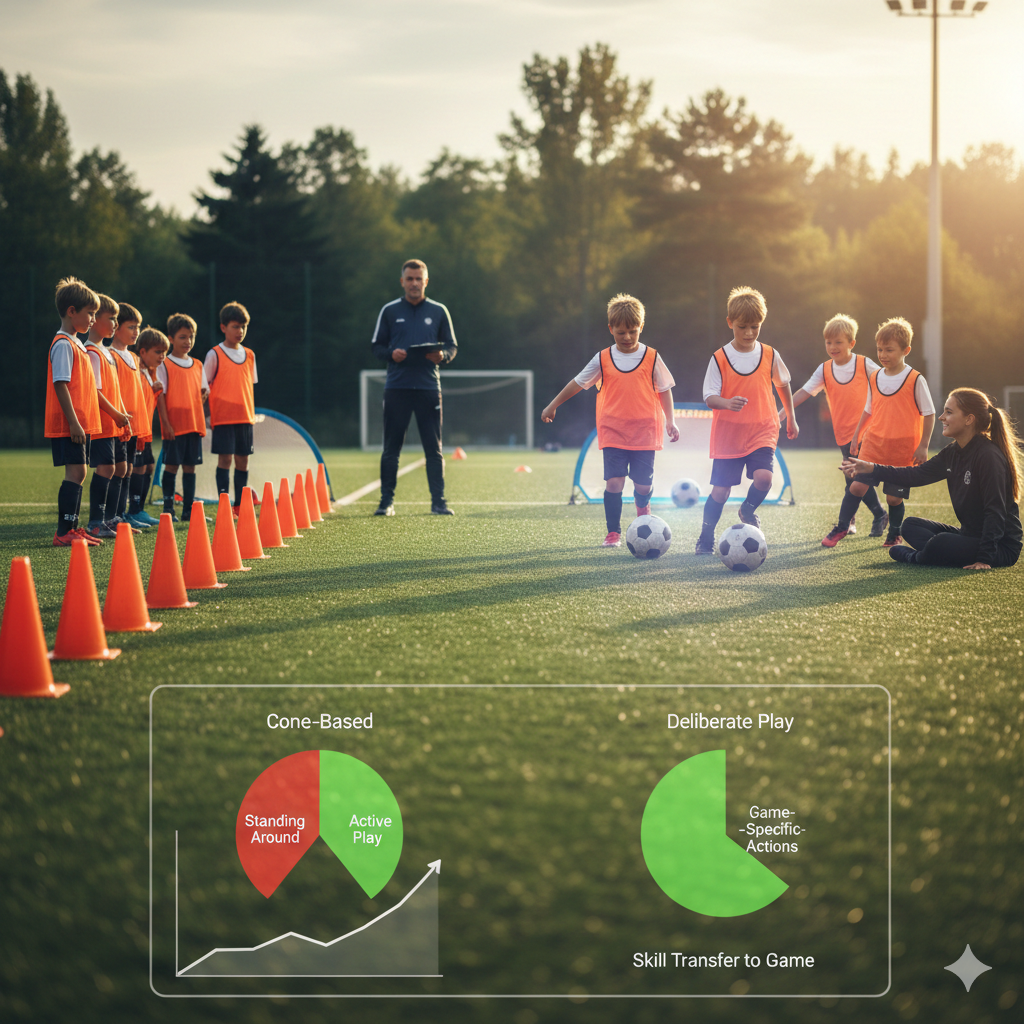
The "Death of the Cone": Why Modern Soccer Should Ditch Drills for "Messy" Play
For decades, the image of a youth soccer practice was universal: lines of children weaving through orange plastic cones, repeating the same scripted movements under the watchful eye of a whistle-blowing coach.
It looked organized, it looked professional, and—according to a growing body of cognitive science—it might be holding our players back.
For decades, the image of a youth soccer practice was universal: lines of children weaving through orange plastic cones, repeating the same scripted movements under the watchful eye of a whistle-blowing coach. It looked organized, it looked professional, and—according to a growing body of cognitive science—it might be holding our players back.
A new wave of research into athlete development is sparking a quiet revolution on the pitch. The debate pits "cone-based instruction"—the traditional, prescriptive model of isolated drills—against "deliberate play," a holistic approach where the game itself serves as the primary teacher.
The findings are stark: while cones might make a practice look orderly, they often fail to prepare players for the chaotic, split-second decision-making required in a real match.
The "De-Coupling" Problem
At the heart of this shift is the concept of Perception-Action Coupling. In a live game, a player’s movement is a response to "affordances"—environmental cues like a defender’s leaning posture or a teammate’s darting run.
When a player trains with inanimate cones, the "perception" and "decision" stages of the brain are bypassed. The player isn't reading a defender; they are simply following a pre-set pattern. Experts warn that this creates "de-coupled" athletes: players who can navigate a slalom course with Olympic precision but "freeze" the moment a live opponent enters their space.
The U.S. Soccer Solution: Play-Practice-Play
In response to these findings, U.S. Soccer has championed the Play-Practice-Play (PPP) model for children aged 6 to 12. This evidence-based framework moves away from laps and lines in favor of three distinct phases:
Intentional Free Play: Starting the session immediately with small-sided games (2v2 or 3v3) to boost intrinsic motivation and "warm up" the brain’s decision-making centers.
Game-Like Practice: Activities that emphasize a specific goal (like "finding space") but always involve an opponent to keep the perception-action loop intact.
The Uninterrupted Game: A final scrimmage where the coach observes silently, allowing players to apply skills autonomously without micro-management.
Conclusion: The Parent Trap and the "Illusion of Progress"
For parents, the pressure to "invest" in a child’s athletic future often leads to the $100-an-hour private 1:1 skills session. These sessions, filled with intricate cone patterns and high-repetition "technical work," offer a seductive illusion of progress. Because there is no "noise" or opposition, the child looks sharp, fast, and technically "perfect."
However, the data suggests this is largely meaningless rehearsal. Without a defender to read or a teammate to find, these skills exist in a vacuum. A child might learn to execute a "step-over" 50 times in a row against a plastic marker, but because they haven't self-developed the timing to use it against a lunging opponent, the skill is effectively useless on game day.
True development is "messy." It happens when a child is forced to solve problems in real-time, failing and adapting within the chaos of a game. If we want to produce intelligent, creative players, we must stop paying for the comfort of orderly drills and start valuing the "organized chaos" of play. The best teacher isn't a private coach with a bag of cones—it’s the game itself
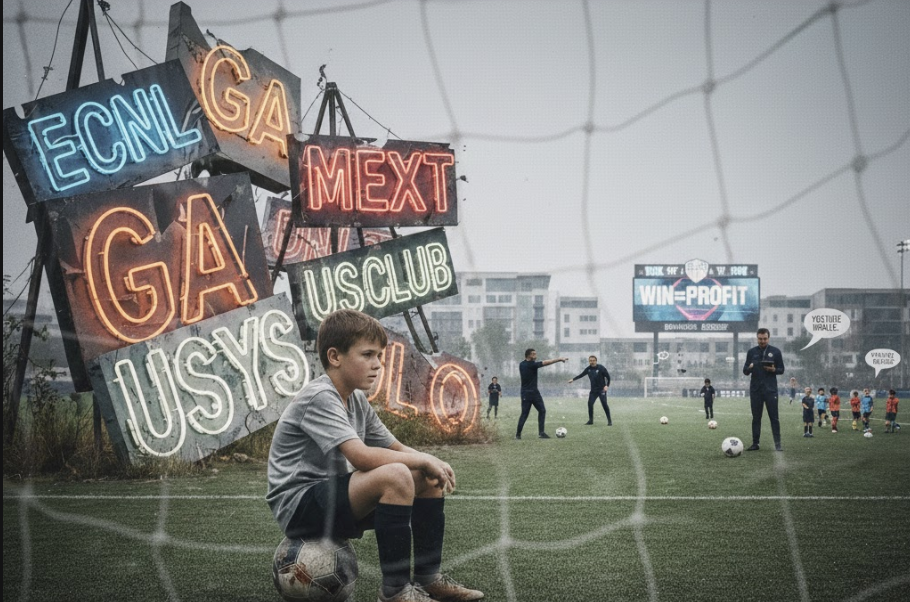
The American Soccer Paradox: “Why a Nation of Millions Produces Zero Top-50 Stars”
Despite having millions of children laced up in cleats every weekend, the United States remains a soccer superpower in potential only.
As U.S. Soccer Sporting Director Matt Crocker recently pointed out, the men’s side has produced zero top-50 players in the last decade.
Despite having millions of children laced up in cleats every weekend, the United States remains a soccer superpower in potential only. As U.S. Soccer Sporting Director Matt Crocker recently pointed out, the men’s side has produced zero top-50 players in the last decade.
The "U.S. Way" is the latest attempt to fix this, but it faces a monumental challenge: an ecosystem that is fractured, profit-driven, and structurally incapable of uniform excellence. Here is a breakdown of the systemic shortcomings plaguing the American youth game.
1. The "Alphabet Soup" of Leagues (ECNL, GA, MLS NEXT)
In most successful soccer nations, there is a clear, singular pathway to the top. In the U.S., the landscape is a "disjointed" web of competing leagues, each claiming to be the "elite" standard.
The Conflict: MLS NEXT, ECNL (Elite Clubs National League), and the Girls Academy (GA) often operate in silos. Instead of a unified national philosophy, these leagues frequently compete for market share and player fees.
The Travel Burden: Because these leagues are national or regional in a country the size of a continent, teenage players spend more time in minivans and airplanes than on the training pitch. This "mileage over minutes" approach leads to burnout and high financial barriers.
2. The Mega-Club and the "Pay-to-Play" Trap
The American youth system is built on a business model, not a developmental one. "Mega-clubs"—massive organizations with thousands of players—rely on registration fees to survive.
Profit vs. Pedagogy: When a club’s revenue depends on the number of players enrolled, the focus shifts from individual development to recruitment and retention.
The Winning Bias: To keep parents paying, coaches feel immense pressure to win games today rather than develop skills for tomorrow. As Crocker noted, this "win-win-win" mentality hinders the technical growth required to produce world-class talent.
3. Governing Bodies: A Divided House
U.S. Soccer governs the national teams (the "5%"), but the "95%" of development happens under the watch of US Youth Soccer (USYS) and US Club Soccer.
State-Level Bureaucracy: USYS alone oversees 54 different state associations. As Crocker noted, trying to align them feels like "trying to get the whole of UEFA on the same page."
Lack of Authority: Unlike the English FA, U.S. Soccer cannot simply mandate a philosophy. It lacks the budget and the "stick" to force thousands of independent amateur clubs to change how they train a 7-year-old.
4. The Coaching Gap: Underprepared and Overwhelmed
Perhaps the greatest bottleneck is the quality of instruction. In England, an elite prospect is never more than minutes away from a highly qualified coach. In the U.S., many "coaches" are well-meaning parents or underpaid staffers who:
Rely on "YouTube Drills": Without a formal, accessible education hub in every state, coaches often pick random drills without understanding the underlying "why" of player movement.
Prioritize Physicality: Because winning is the metric of success, coaches often favor the "Early Bloomers"—kids who are faster and stronger—while ignoring the smaller, more technical players who might actually have a professional ceiling.
The "Astronomical Ask"
Crocker’s vision of a "coaching bible" and a unified digital platform is a start, but as critics point out, "a presentation is not a plan." Until the U.S. can move away from a model where the "sausage makers" (the clubs) are incentivized by trophies and checks rather than professional call-ups, the "U.S. Way" will remain a dream deferred.
The infrastructure is built for participation; it is not yet built for excellence.

The Soccer Parent’s Ego: Are You Raising an Athlete or a Proxy?
The smell of freshly cut grass, the orange slices at halftime, and the simple joy of a child kicking a ball into a net have been replaced by a more clinical, high-stakes reality. In the modern era of youth soccer, the pitch has become less of a playground and more of a stage for parental redemption.
As youth sports balloon into a $70 billion industry, we are witnessing the "Pathological Professionalization" of childhood. At the center of this shift isn't just the desire for a college scholarship; it is a psychological phenomenon known as Achievement by Proxy Distortion (ABPD).
The smell of freshly cut grass, the orange slices at halftime, and the simple joy of a child kicking a ball into a net have been replaced by a more clinical, high-stakes reality. In the modern era of youth soccer, the pitch has become less of a playground and more of a stage for parental redemption.
As youth sports balloon into a $70 billion industry, we are witnessing the "Pathological Professionalization" of childhood. At the center of this shift isn't just the desire for a college scholarship; it is a psychological phenomenon known as Achievement by Proxy Distortion (ABPD).
The ROI Trap: When Children Become Assets
For many parents, a child’s soccer career is increasingly viewed through the lens of Return on Investment (ROI). When a family spends 3% to 12% of their annual income on travel teams, private technical trainers, and "elite" showcase tournaments, the child ceases to be a participant and starts to feel like a financial commodity.
This financial pressure creates a "transactional" relationship. If a parent pays $\$5,000$ a year for a club, they subconsciously—or explicitly—demand a performance that justifies the cost. This often leads to the "Investment Trap," where the higher the spending, the lower the child’s reported enjoyment of the sport.
The Psychology of the "Second Chance"
Why do parents scream at referees or berate a ten-year-old for a missed penalty? Research suggests it is often a defense mechanism against their own "broken dreams."
Achievement by Proxy Distortion (ABPD)
ABPD occurs when a parent’s identity and emotional regulation become indistinguishable from the child's success. It exists on a spectrum:
Normal Support: Facilitating the child's joy and skill acquisition.
Risky Sacrifice: Prioritizing soccer over the child’s health or family finances to seek status.
Objectification: Viewing the child as a tool for adult status.
Abuse/Exploitation: Total narcissistic self-extension where the child's failure is felt as a personal attack on the parent.
"For these parents, the child's triumph is not merely a cause for celebration but a mechanism to reduce their own past regrets and heal emotional wounds."
The Toll: Burnout and the "Silent Car Ride"
The most damaging tool in the vicarious parent’s arsenal is Parental Conditional Regard (PCR). This is the practice of making affection and attention contingent upon performance.
Positive Regard: Excessive praise and "love bombing" after a win.
Negative Regard: Withholding affection, using the "silent treatment," or being overly critical on the car ride home after a loss.
This dynamic thwarts a child's basic psychological needs for autonomy, competence, and relatedness. When a child realizes their parent's mood depends on the scoreboard, they develop a fragile sense of self-worth.
The Statistical Cost of Pressure
Research shows a clear correlation between parental pressure and negative athlete outcomes:
Anxiety ($r = 0.16$): A constant fear of failure to satisfy the parent.
Burnout ($r = 0.35$): Physical and emotional exhaustion leading to total sport devaluation.
Amotivation ($r = 0.44$): The child eventually loses all intrinsic interest in the game.
A Call for Cultural Recalibration
To save youth soccer—and the mental health of the children playing it—we must decouple parental self-worth from athletic performance. This requires moving away from an Ego-Involved Climate and toward a Task-Involved Climate.
The "4 Cs" of Positive Youth Development
Parents should focus on facilitating these four pillars rather than chasing a 1% chance at a scholarship:
Competence: Focus on skill acquisition, not the score.
Confidence: Building self-worth that exists independent of the game.
Connection: Supporting social bonds with teammates and coaches.
Character: Prioritizing integrity and sportsmanship over "winning at all costs."
The soccer pitch should be a theater for a child's growth, not a laboratory for a parent’s ego. If we don't allow children to own their own sports journey, we risk them winning the game but losing themselves.

The Pathological Professionalization of Youth Athletics: A Deep Analysis of Achievement by Proxy Distortion and the Erosion of the Child-Athlete Experience
The contemporary landscape of youth sports has undergone a seismic shift, transitioning from the informal, self-regulated "sandlot" games of previous generations into a highly structured, adult-driven, and professionalized multi-billion-dollar industry. This metamorphosis is not merely an evolution of athletic training but a fundamental restructuring of the parent-child relationship within the context of achievement.
The contemporary landscape of youth sports has undergone a seismic shift, transitioning from the informal, self-regulated "sandlot" games of previous generations into a highly structured, adult-driven, and professionalized multi-billion-dollar industry.
This metamorphosis is not merely an evolution of athletic training but a fundamental restructuring of the parent-child relationship within the context of achievement. As the youth sports market is projected to reach a staggering $70 billion valuation by 2030, the psychological and sociological pressures on young athletes have intensified, frequently catalyzed by parents living vicariously through their children's performances.1
This vicarious involvement often manifests as Achievement by Proxy Distortion (ABPD), a maladaptive parenting approach where the adult's identity and emotional regulation become dangerously intertwined with the child's athletic success.3
Psychological Mechanisms of Vicarious Achievement
At the heart of vicarious living is the phenomenon of parental self-extension. Research from Utrecht University demonstrates that parents who experience unresolved disappointment or "broken dreams" in their own pasts feel a profound sense of pride and emotional healing when their children succeed.10 For these parents, the child's triumph is not merely a cause for celebration but a mechanism to reduce their own past regrets and heal emotional wounds.10
Achievement by Proxy Distortion (ABPD)
When this emotional transference becomes pathological, it is classified as Achievement by Proxy Distortion. This condition involves a shift in an adult's ability to distinguish their own needs for success from the child's developmental goals.4 ABPD exists on a spectrum, moving from healthy encouragement to risky sacrifice and, ultimately, to abuse and exploitation.3
In the objectification stage, parents come to regard their children as objects rather than persons, utilizing them as instruments to satisfy their own needs for achievement.12 This objectification is often introjected by the child, who may succeed initially to please the parent but eventually suffers from a dampened sense of autonomy and a loss of self-value.12 The pathological parent often fails to recognize the child's physical or emotional pain, viewing injury as an inconvenience or an "excuse" that prevents the fulfillment of potential.4
Parental Conditional Regard
A primary mechanism of control in these relationships is Parental Conditional Regard (PCR). This involves the parent making their affection, love, and attention contingent upon the child's performance.12 Parental Conditional Positive Regard (PCPR) occurs when a child receives excessive affection only when they meet performance expectations, while Parental Conditional Negative Regard (PCNR) occurs when affection is withheld following a loss or a "sub-par" performance.12
This dynamic thwarts the three basic psychological needs identified by Self-Determination Theory (SDT): autonomy, competence, and relatedness.12 When children perceive that their parents' love is a reward for victory, they internalize a fragile sense of self-worth that is entirely dependent on external validation.5 This "introjection" of parental goals creates a high-pressure environment where the child fears failure not for their own sake, but because it represents a loss of parental connection.5
The Financial Nexus and the ROI Mindset
The correlation between family financial investment and parental pressure is one of the most significant findings in modern youth sports research. A study involving 163 parent-child dyads illuminated a direct positive relationship between the percentage of household income spent on sports and the reported levels of parental pressure.9
This "investment trap" suggests that as parents spend more on private coaching, elite equipment, and travel, their expectations for a "return" elevate.9 This return is often not financial but social or psychological; the parent wants the child to validate the expenditure through performance.9 Consequently, the child begins to feel like a "financial commodity," which destroys their sense of ownership over their own athletic career.1
The psychological term for this is the "commodification of childhood," where children are labeled as "burnouts" when they are actually manifesting deep-seated anger at having their life options foreclosed by parental investment.9 Parents who hire private coaches and buy the most expensive shoes have been found to be more likely to behave disruptively—yelling at coaches and officials—because they feel their financial outlay entitles them to specific outcomes.9
Sideline Sociology and the Contagion of Aggression
The sideline behavior of parents serves as a visible metric of their vicarious investment. A University of South Australia study found a strong link between parents' conduct and their children's on-field behavior, a phenomenon described as "monkey see, monkey do".16 Parents who engage in antisocial behavior—such as berating referees, yelling abuse, or being overly critical—provide a blueprint for their children, who then model similar aggression toward teammates and opponents.16
Emotional Volatility and Identity
For many parents, watching a child participate is an emotional rather than a rational experience.18 Research indicates that sports can trigger emotional experiences from the parent's own childhood.19 For example, a parent who felt shame after performing poorly as a child may experience that same visceral shame when watching their own child struggle.19 This lack of emotional regulation leads to the "crazed fan" behavior frequently seen at youth events, where parents argue with officials, blame coaches, and humiliate their children publicly.18
Children report that supportive behaviors (cheering, encouragement) amplify their joy, while negative behaviors (cell phone use during games, disrupting competition, hostility) significantly diminish their commitment.18 Most concerningly, 69% of young athletes report witnessing some form of negative sideline behavior from their parents, including derogatory comments that, while a small percentage of total interactions, cause disproportionate emotional damage.16
Negative Outcomes: The Physical and Psychological Toll
The physical and psychological consequences of vicarious achievement are profound and often lifelong. When a parent's self-worth is tethered to a child's performance, the child is pushed beyond their physiological and emotional limits, leading to an array of pathologies.
Physical Health Risks and Injury Epidemic
Early specialization and the drive for extraordinary success have created a spike in acute and overuse injuries.21 In the professionalized model, children are often viewed as "impaired adults" who must be forced to work harder, leading to the neglect of growth plate health and skeletal development.11
Common physical outcomes of high-pressure parenting include:
Overuse Injuries: High intensity and year-round training lead to fractures and surgeries previously reserved for professional athletes.1
Disordered Eating: Particularly in sports with weight classes or aesthetic requirements, pressure to succeed can lead to eating disorders.4
Doping and Doping-Related Behaviors: Athletes may resort to performance-enhancing drugs to satisfy parental expectations or manage chronic pain.4
Psychosomatic Illness: Stress-related symptoms such as headaches, stomachaches, and conversion disorders manifest when the emotional burden becomes intolerable.4
In clinical settings, "red flags" for ABPD include a parent's refusal to allow a child to rest despite a clear medical need, or a parent who talks over the child during a medical examination to downplay symptoms.3 In extreme cases, this can lead to factitious disorder by proxy, where the parent's drive for achievement leads them to manipulate the child's medical narrative to justify more training or faster returns to play.11
Psychological Erosion and Mental Ill-Being
A meta-analysis of 31 studies involving over 6,000 athletes confirmed that perceived parental pressure has a direct positive correlation with anxiety () and an ego/performance goal orientation ().23 Athletes focused on ego-oriented goals are more likely to adopt a "win-at-all-costs" attitude, which eventually undermines teamwork and long-term intrinsic motivation.23
Athlete burnout is characterized by three dimensions: emotional and physical exhaustion, a reduced sense of accomplishment, and sport devaluation.22 When parents live vicariously through their children, they often ignore these signs, viewing the child's fatigue as a lack of "grit" or dedication.4 This leads to a breakdown of organized attachment strategies, where the child no longer feels that seeking emotional support from the parent is a viable option.12
Family Systems: Triangulation and Sibling Dynamics
The impact of vicarious living is not isolated to the parent and the athlete; it ripples through the entire family system. Families characterized by ABPD often exhibit "enmeshment," a state where boundaries are so permeable that the family members have difficulty knowing where one person ends and another begins.21
In enmeshed athlete families:
Triangulation: A single child athlete may be "triangulated" into the parents' relationship, serving as the primary source of connection or a buffer for marital conflict.21
Sibling Marginalization: Other children in the family may be excluded or have their needs subordinated to the athlete's training schedule, leading to long-term resentment and relationship distress.11
Nuclear Family Emotional System: The family's emotional stability becomes dependent on the outcome of the weekend's competition, creating a volatile household environment.25
Emotional Cut-off: To manage the overwhelming tension, some children may eventually withdraw emotionally or physically from the family, seeking distance to protect their own identity.25
This "Nuclear Family Emotional System" often replicates patterns from previous generations, where the anxiety of the parents is projected onto the "most sensitive child," who then displays the most symptoms of burnout or rebellion.25
Clinical Interventions and Developmental Frameworks
Mitigating the negative outcomes of vicarious parenting requires a multi-faceted approach involving education, behavioral modeling, and clinical intervention.
The 4 Cs of Sport Psychology and Positive Youth Development
To counter the ego-oriented climate created by high-pressure parenting, researchers suggest focusing on the "4 Cs." There are two primary versions of this framework: one focused on mental qualities for performance and another focused on Positive Youth Development (PYD).26
When parents focus on these domains, they promote the "task-involved climate" that lead to higher effort and enjoyment.28 Effective coaching and parenting should result in athletes experiencing satisfaction in their autonomy, competence, and relatedness—the core tenets of Self-Determination Theory.13
Empowering Parents in Sports (EPIS)
Intervention programs like EPIS aim to support parents in embodying facilitative roles. These programs emphasize:
Perspective Reflection: Helping parents realize that their child's sports journey is not a second chance at their own.19
Unconditional Support: Teaching parents to communicate love that is independent of performance.19
Process Goals: Shifting the conversation from "did you win?" to "what did you learn?" or "did you have fun?".17
Managing the Car Ride Home: Establishing routines to de-escalate emotional tension after games, such as the "React, Relax, Reflect, Refocus" routine.30
Research into these interventions has shown that when parents are educated on the psychological needs of their children, the children report improved confidence and self-esteem within a short period.19
Conclusion: A Call for Cultural Recalibration
The pathological drive for vicarious achievement in youth sports is a symptom of a broader societal obsession with early specialization and meritocratic status. While the investment of time and money is often born out of well-intentioned support, the resulting Achievement by Proxy Distortion (ABPD) creates a toxic environment that prioritizes the parent's ego over the child's development.
The negative outcomes—ranging from acute physical injury and chronic anxiety to the permanent erosion of the parent-child bond—are well-documented across decades of research. To protect the next generation of athletes, a cultural recalibration is necessary. This involves a return to child-centered participation, where the values of competence, character, and connection are prioritized over scholarships and professional aspirations. Parents must be supported in recognizing the boundaries of their own identity, ensuring that the sports arena remains a place for children to build autonomy, rather than a theatre for adult redemption. Only by decoupling parental self-worth from athletic performance can we ensure that youth sports serve their primary purpose: the healthy, holistic development of the child.
Works cited
The Crisis in American Youth Sports and Its Cost to Our Future, accessed on February 9, 2026, https://edworkforce.house.gov/uploadedfiles/john_osullivan_testimony.pdf
Parental involvement in youth sports: historical trends and links to, accessed on February 9, 2026, https://www.tandfonline.com/doi/full/10.1080/14927713.2025.2503183
Achievement by Proxy Distortion in Sports - ResearchGate, accessed on February 9, 2026, https://www.researchgate.net/publication/7595194_Achievement_by_Proxy_Distortion_in_Sports_A_Distorted_Mentoring_of_High-Achieving_Youth_Historical_Perspectives_and_Clinical_Intervention_with_Children_Adolescents_and_their_Families
Parenting in Youth Sports – the Good, the Not So Good, and the ..., accessed on February 9, 2026, https://www.casem-acmse.org/news/parenting-in-youth-sports/
Parental Pressure in Youth Sports: When It Becomes Harmful, accessed on February 9, 2026, https://safeathlete.org/parental-pressure-youth-sports/
(PDF) Changes in Sports Participation, Specialization, and Burnout, accessed on February 9, 2026, https://www.researchgate.net/publication/377780138_Changes_in_Sports_Participation_Specialization_and_Burnout_From_7th_to_12th_Grade_Final_Results_From_a_6-Year_Longitudinal_Study
The Impact of Family Financial Investment on Perceived Parent, accessed on February 9, 2026, http://jvlone.com/sportsdocs/ParentalInvestmentYouthSportsImpact2016.pdf
Study: Most parents have realistic expectations of their children's, accessed on February 9, 2026, https://www.news-medical.net/news/20251121/Study-Most-parents-have-realistic-expectations-of-their-childrens-future-athletic-achievement.aspx
The Problem for Sports Parents: Overspending - Ngin, accessed on February 9, 2026, https://cdn4.sportngin.com/attachments/document/23f6-2570310/problem_sports_parents.pdf
Are you living vicariously through your sporting children?, accessed on February 9, 2026, https://www.parentsinsport.co.uk/2022/08/16/are-you-living-vicariously-through-your-sporting-children/
Achievement by proxy distortion in sports: a distorted mentoring of ..., accessed on February 9, 2026, https://scispace.com/pdf/achievement-by-proxy-distortion-in-sports-a-distorted-354bf7sjoa.pdf
A Critical Exploration of Child-Parent Attachment as a Contextual ..., accessed on February 9, 2026, https://pmc.ncbi.nlm.nih.gov/articles/PMC6315501/
The role of parents in the motivation of young athletes: a systematic, accessed on February 9, 2026, https://pmc.ncbi.nlm.nih.gov/articles/PMC10800670/
Family Financial Investment in Organized Youth Sport, accessed on February 9, 2026, https://digitalcommons.usu.edu/cgi/viewcontent.cgi?article=1016&context=poth_slc
(PDF) The Impact of Family Financial Investment on Perceived, accessed on February 9, 2026, https://www.researchgate.net/publication/303511177_The_Impact_of_Family_Financial_Investment_on_Perceived_Parent_Pressure_and_Child_Enjoyment_and_Commitment_in_Organized_Youth_Sport_Family_Investment_in_Youth_Sport
Parents behaving badly: the impact on kids' sport, accessed on February 9, 2026, https://www.unisa.edu.au/unisanews/2024/february/parents-behaving-badly-the-impact-on-kids-sport/
Unruly sports parents' effect on children's mental health | BCM, accessed on February 9, 2026, https://cdn.bcm.edu/news/unruly-sports-parents-effect-on-childrens-mental-health
Emotional Experiences of Youth Sport Parents I: Anger - Club Referee, accessed on February 9, 2026, https://www.club-referee.ch/wp-content/uploads/2024/04/Emotional-Experiences-of-Youth-Sport-Parents-I-Anger.pdf
How Parents' Emotions Affect Sports Kids - Youth Sports Psychology, accessed on February 9, 2026, https://www.youthsportspsychology.com/youth_sports_psychology_blog/how-parents-emotions-affect-sports-kids/
From the Voice of Athletes: Positive and Negative Aspects of Parent, accessed on February 9, 2026, https://www.researchgate.net/publication/350881629_From_the_Voice_of_Athletes_Positive_and_Negative_Aspects_of_ParentAthlete_Relationships
(PDF) Parental Involvement, Pressure, and Support in Youth Sport ..., accessed on February 9, 2026, https://www.researchgate.net/publication/263479399_Parental_Involvement_Pressure_and_Support_in_Youth_Sport_A_Narrative_Literature_Review
Burnout and Mental Interventions among Youth Athletes - MDPI, accessed on February 9, 2026, https://www.mdpi.com/1660-4601/19/17/10662
The Impact of Parental Involvement and Perceived ... - SFU Summit, accessed on February 9, 2026, https://summit.sfu.ca/_flysystem/fedora/2025-02/etd23643.pdf
Is the Perception of the Frequency of Use of Parental Pressure and, accessed on February 9, 2026, https://pmc.ncbi.nlm.nih.gov/articles/PMC12544709/
Parents' role in dropout: one of the important stakeholders in, accessed on February 9, 2026, https://www.emerald.com/sbm/article/doi/10.1108/SBM-09-2024-0117/1320200/Parents-role-in-dropout-one-of-the-important
4 C's of Psychology - ATHLETE'S MIND, accessed on February 9, 2026, https://www.athletesmind.ca/four-cs.html
Positive Youth Development: A Measurement Framework for Sport, accessed on February 9, 2026, https://www.queensu.ca/sportpsych/sites/splwww/files/uploaded_files/Vierimaaetal2012-4Csmeasurementframework.pdf
The role of parents in the motivation of young athletes: a systematic, accessed on February 9, 2026, https://www.frontiersin.org/journals/psychology/articles/10.3389/fpsyg.2023.1291711/full
Supporting Parents in Sport: How to Build a Positive Experience for, accessed on February 9, 2026, https://www.paddlecymru.org.uk/supporting-parents-in-sport-how-to-build-a-positive-experience-for-families
The 4 C's | Peter Harrison Centre - Loughborough University, accessed on February 9, 2026, https://www.lboro.ac.uk/research/phc/resources/fitforsport/the4cs/

Selling the Dream, Funding the Machine: An Analysis of Scholarship Rhetoric vs. Statistical Probability in Elite Soccer Clubs.
This research explores the transformation of American youth soccer from a community-based pastime into a multi-billion dollar "pay-to-play" industry. Using North Texas as a primary case study, the analysis reveals how "mega-clubs" and national leagues prioritize corporate revenue and aggressive recruitment over actual player development.
The American youth soccer landscape has transitioned from a decentralized collection of community-based programs into a sophisticated, multi-billion dollar industrial complex. 1 This evolution, while increasing the professionalization of coaching and facilities, has simultaneously institutionalized a "pay-to-play" model that prioritizes revenue generation over technical excellence. 3 In the United States, the epicenter of this model is North Texas, where "mega-clubs" like Solar SC, Dallas Texans, and Sting operate as major corporate entities, utilizing national recruitment platforms to monetize the youth developmental pathway.
The Business of the "Mega-Club": Revenue and Financial Obligations
In North Texas, elite clubs function as high-revenue businesses. Organizations like the Dallas Texans (operating under Club Soccer, Inc.) have reported serving approximately 1,300 players across 80 teams, generating total annual revenues exceeding $5.3 million, with membership dues alone accounting for $4 million. Similarly, Solar SC has grown into a massive organization with over 125,000 registered players across its various tiers and affiliations.
The financial burden on families is significant and involves rigid legal commitments. At Solar SC, annual club costs per player are estimated between $2,501 and $3,500, excluding additional "team fees" for travel and tournaments. These clubs frequently employ strict financial contracts:
Non-Refundable Commitments: Solar SC contracts specify that signing the agreement constitutes a "legally binding full year commitment." Even in cases of injury or early departure, families remain responsible for the full year's dues.
Mandatory Fundraising: Elite Academy players at Solar SC are responsible for selling $300 to $450 in raffle tickets annually, with the balance due to the club if targets are not met.
Brand Exclusivity: Solar SC's Adidas sponsorship requires Academy players to wear Adidas cleats; failure to do so can result in parents being charged up to $500 for the uniform package.
The Recruitment "Hype" and the Scholarship Illusion
Mega-clubs often utilize aggressive marketing to attract talent, framing their "big brand" as an essential ticket to collegiate exposure. The Dallas Texans, for instance, claim to have secured "over a billion dollars of scholarships" for their student-athletes. However, this contributes to a "recruitment illusion" that masks the stark statistical reality of collegiate soccer.
Soccer remains an "equivalency sport," meaning the 9.9 scholarships allowed for a Division I men's team are typically split as partial awards across a 32-player roster. 15 With international players now occupying 37% of men's roster spots, the path for domestic youth players is increasingly narrow. 15
The National League Monopoly: Commercializing the Scouting Pipeline
National leagues such as the Elite Clubs National League (ECNL) and the Girls Academy (GA) have successfully branded themselves as the "only" path to high-level recruitment. These leagues operate as talent filters where the ability to pay for national travel is as important as athletic ability.
The "Volume" Tactic and Scout Attraction
Leagues convince college coaches to attend their showcases by concentrating the nation's top "brand-name" clubs in a single location. ECNL national events, for example, often feature "Selection Games" played under stadium lights to maximize exposure for top prospects. This concentration is highly effective; the ECNL Boys recently reported record scout attendance, with 60 to 70 college coaches consistently on the sidelines for U17 and U18/19 games.
The Financial Cost of National Competition
Attending these leagues requires a substantial financial commitment from both the club and the individual family.
For individual families, a single showcase weekend can be financially devastating. A three-day event often costs a parent and player between $3,500 and $5,000 when accounting for flights, mandatory "Stay-to-Play" hotels, and local travel.
Governing Bodies: The Institutional Architecture of Monetization
The primary governing bodies of youth soccer, US Youth Soccer (USYS) and US Club Soccer, have built sophisticated financial models that leverage these national showcases into significant annual revenues. In 2024, USYS reported total revenues of over $20.5 million, while US Club Soccer reported nearly $20 million. Over 90% of this revenue is derived from "program services," which include registration fees, player cards, and the sanctioning of high-cost tournaments and showcases.
The "Backdoor Tax" of Stay-to-Play Rebates
A major revenue driver for these organizations is the "Stay-to-Play" hotel mandate. Housing providers typically negotiate hidden rebates of $10 to $20 per room-night, which are kicked back directly to the tournament organizers and governing bodies. 5 Critics describe this model as a "backdoor tax" on families, allowing organizations to fund their events and administrative costs—including six-figure executive salaries—without raising the advertised registration fees.
Mandatory Registration and Sanctioning Fees
The monetization of the sport begins with mandatory player registration and "player carding" fees, which provide a constant stream of low-overhead income. US Club Soccer, for example, charges approximately $25.25 for every competitive youth player pass, while state associations under USYS charge similar annual fees. Additionally, organizations charge tournament organizers "sanctioning fees" ranging from $100 to $500 per event, further jacking up the final cost for participating teams.
Institutional Favoritism and Conflicts of Interest
The financial relationship between governing bodies and elite leagues has raised concerns about institutional favoritism. US Club Soccer recently entered into a "shared services partnership" with the U.S. Soccer Federation (USSF), a move critics argue consolidates power among the most expensive segments of the sport. This centralization often leads to revolving-door appointments, where leadership from private leagues like ECNL moves directly into decision-making roles within the national governing bodies, potentially influencing age-group changes and league structures to favor the "pay-to-play" model.
The Showcase Economy and "Stay-to-Play" Mandates
National showcases serve as significant revenue drivers through "Stay-to-Play" policies. 5 These mandates require all out-of-town teams to book lodging through a tournament's designated housing provider. 7
While organizers claim these policies streamline logistics, families often view them as predatory; housing providers frequently charge room rates significantly higher than the public market. For example, families have reported being forced to pay $249 per night for a room available elsewhere for $169. 5 Failure to comply can result in immediate team disqualification or heavy fines, such as the $1,000 "opt-out" fee assessed at major regional competitions.
Negative Impacts on Player Development and Health
The commercialization of the recruiting process has profound negative effects on the physical and psychological health of young athletes. 4
The "Physicality Trap" and Technical Stunting
To maintain high rankings and attract paying customers, clubs often prioritize "physical dominance" in early age groups. 11 Larger, faster players are selected to win games and protect the club’s "elite" brand. These players, however, are often "Trojan horses" who dominate at age 14 due to biological maturity but lack the technical fundamentals required at age 20 when their peers catch up physically. 11
Burnout and Over-Specialization
The pressure to justify thousands of dollars in fees leads to early specialization and year-round training, primary drivers of youth injury. 10 An estimated 70% of young athletes stop participating in organized sports by age 13, often due to burnout. 10 In North Texas, elite players may practice four or more times per week and play over 30 league games annually, leading to cases of prominent local players quitting their elite teams due to "emotional and physical exhaustion."
Synthesized Conclusions
The American youth soccer ecosystem represents a study in commercial efficiency at the expense of developmental effectiveness. While ECNL and the Girls Academy have institutionalized a high-volume scouting pipeline, and governing bodies like USYS and US Club Soccer have built $20 million annual revenue streams, they have done so by creating financial barriers that filter talent by socioeconomic status. 3 Until player development is decoupled from parent tuition and hidden showcase-driven rebates, the system will continue to prioritize the "business of sports" over the actual education of world-class players. 11
Works cited
Club Development Manual | US Youth Soccer, accessed on January 23, 2026, https://www.usyouthsoccer.org/wp-content/uploads/sites/160/2023/09/Club-Development-Manual.pdf
A $-Heavy System Built for Families, Not for the Pathway, accessed on January 23, 2026, https://www.whitesportsventures.com/insights/a-heavy-system-built-for-families-not-for-the-pathway
The Hidden Cost of Pay-to-Play in American Youth Soccer | SIA ..., accessed on January 23, 2026, https://soccerinteraction.academy/en/soccer-academy-blog/hidden-cost-pay-play-american-youth-soccer
The US Soccer Pay-to-Play System: A Barrier to Growth and ..., accessed on January 23, 2026, https://medium.com/@amiraelq/the-us-soccer-pay-to-play-system-a-barrier-to-growth-and-development-d15ca4e6f941
Stay-to-Play hotel policies are a scam—and parents are footing the bill, accessed on January 23, 2026, https://www.reddit.com/r/youthsoccer/comments/1lq55qe/staytoplay_hotel_policies_are_a_scamand_parents/
Breaking Free from Stay-to-Play: Why Youth Sports Travel Needs to ..., accessed on January 23, 2026, https://sportsxtravel.com/breaking-free-from-stay-toplay-why-youth-sports-travel-needs-a-change/
Stay-to-Play Policy - EDP Soccer, accessed on January 23, 2026, https://www.edpsoccer.com/policies/stay-to-play-policy
2025 surf college cup, accessed on January 23, 2026, https://surfsports.com/college-cup/
The Problems Lie Deep: The State of US Soccer - Neirad, accessed on January 23, 2026, https://neirad.org/1631/sports/the-problems-lie-deep-the-state-of-us-soccer/
Youth Sport Specialization: Pros, Cons and Age Guidelines, accessed on January 23, 2026, https://www.hopkinsmedicine.org/health/conditions-and-diseases/sports-injuries/youth-sport-specialization
Why U.S. Youth Soccer Fails to Develop Players : r/youthsoccer, accessed on January 23, 2026, https://www.reddit.com/r/youthsoccer/comments/1ncnnmd/why_us_youth_soccer_fails_to_develop_players/
College & Scholarships - American Canyon Atletico FC, accessed on January 23, 2026, https://www.acatleticofc.com/page/show/3499077-college-and-scholarships
Are College Soccer ID Camps Worth it? - Trace, accessed on January 23, 2026, https://traceup.com/academy/are-college-soccer-id-camps-worth-it
US Youth Soccer Renews Partnership with NCSA College Recruiting, accessed on January 23, 2026, https://www.usyouthsoccer.org/news/2022/08/23/us-youth-soccer-renews-partnership-with-ncsa-college-recruiting/
What Are the Chances of a High School Soccer Player Making it to ..., accessed on January 23, 2026, https://warubi-sports.com/college-soccer-odds/
Soccer Scholarships: A Complete Guide - Plus31 Sports, accessed on January 23, 2026, https://plus31-sports.webflow.io/blog/soccer-scholarships