

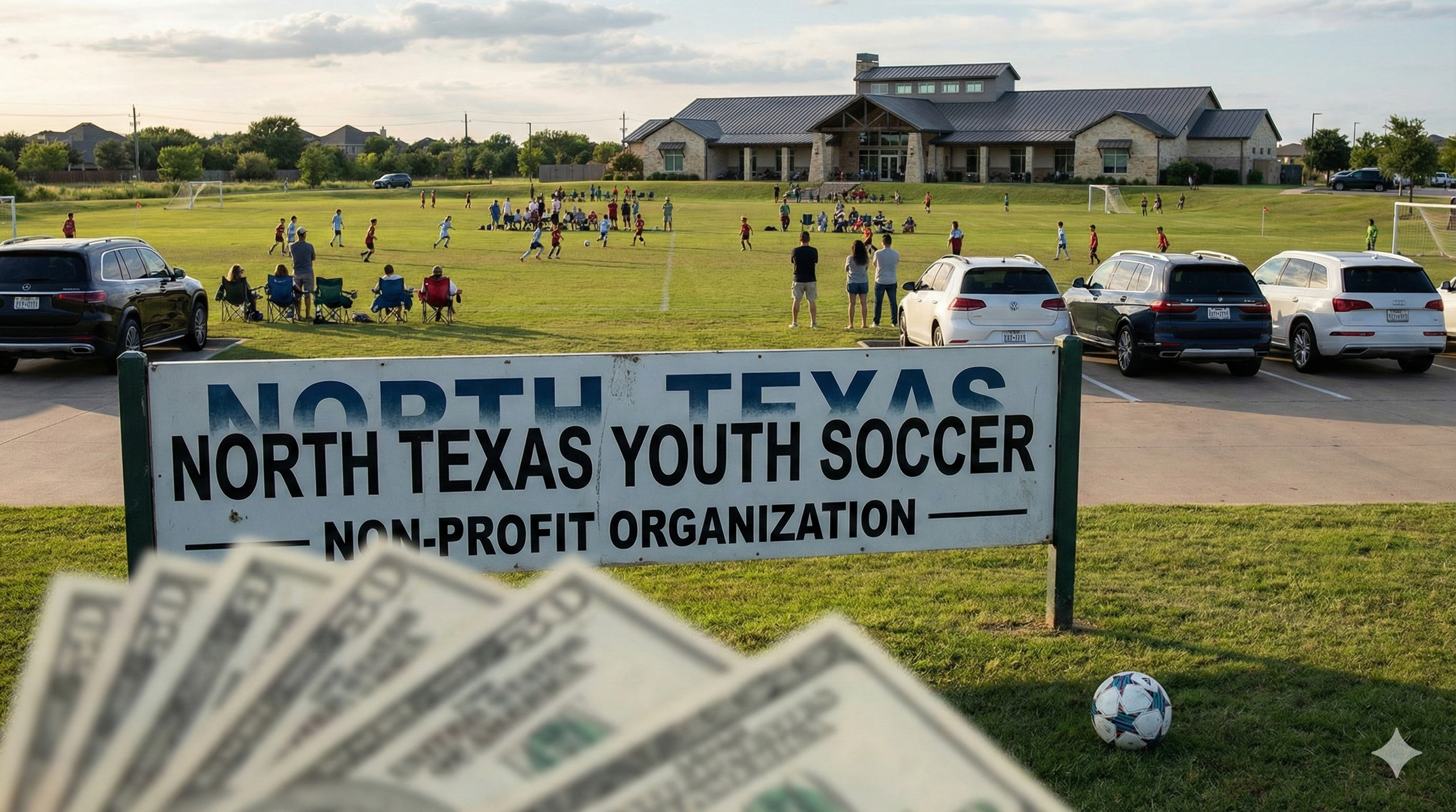
The Structural Paradox of Non-Profit Youth Athletics: An Economic and Forensic Analysis of the North Texas Soccer Ecosystem (Full Report)
Through a granular examination of financial filings, legal proceedings, and market dynamics, this report argues that the 501(c)(3) status in elite youth soccer has evolved from a mechanism of community service into a strategic tax shield for quasi-commercial entities. The analysis reveals that the tax benefits intended to subsidize public access are instead absorbed by organizational overhead, executive compensation, and capital asset accumulation. Furthermore, the "pay-to-play" model creates a regressive financing structure where families bear the full tax burden of participation, while the "non-profit" entities accumulate retained earnings and utilize vendor rebates that function as opaque revenue streams. The following sections detail the legal incentives for this status, the forensic failure of cost-savings to trickle down to the consumer, and provide a comprehensive profile of the major non-profit actors in the North Texas region, including Solar Soccer Club, Dallas Texans, and the Sting Soccer Organization.
Executive Abstract
The United States youth soccer apparatus represents a unique economic anomaly within the global sports landscape. While the rest of the world largely operates on a solidarity-based model supported by professional clubs and government subsidies, the American system is fundamentally a consumer-funded, market-driven industry. Paradoxically, the primary engines of this multi-billion-dollar commercial enterprise are entities designated as 501(c)(3) tax-exempt charitable organizations. This report provides an exhaustive analysis of this structural dichotomy, utilizing the high-density competitive market of North Texas as a primary case study.
Through a granular examination of financial filings, legal proceedings, and market dynamics, this report argues that the 501(c)(3) status in elite youth soccer has evolved from a mechanism of community service into a strategic tax shield for quasi-commercial entities. The analysis reveals that the tax benefits intended to subsidize public access are instead absorbed by organizational overhead, executive compensation, and capital asset accumulation. Furthermore, the "pay-to-play" model creates a regressive financing structure where families bear the full tax burden of participation, while the "non-profit" entities accumulate retained earnings and utilize vendor rebates that function as opaque revenue streams. The following sections detail the legal incentives for this status, the forensic failure of cost-savings to trickle down to the consumer, and provide a comprehensive profile of the major non-profit actors in the North Texas region, including Solar Soccer Club, Dallas Texans, and the Sting Soccer Organization.
Part I: The Statutory and Strategic Architecture of the 501(c)(3) Youth Club
The dominance of the 501(c)(3) designation among youth soccer clubs is not merely a legacy of their volunteer-based origins; it is a calculated structural necessity for survival in the modern youth sports economy. To understand why organizations generating revenues comparable to mid-sized for-profit corporations choose to remain within the charitable sector, one must dissect the convergence of federal tax law, state liability statutes, and municipal resource allocation.
1.1 The Federal Tax Exemption as a Capital Preservation Strategy
Under the Internal Revenue Code (IRC), Section 501(c)(3) provides exemption from federal income tax for organizations organized and operated exclusively for charitable or educational purposes. For youth sports clubs, the "educational" component—instructing youth in sports skills—and the "charitable" component—combating juvenile delinquency and lessening the burdens of government—form the statutory basis for exemption.1
However, the operational reality of elite clubs in North Texas, such as Solar Soccer Club or the Dallas Texans, resembles a commercial enterprise more than a traditional charity. These entities generate millions in revenue, primarily through "program service fees" rather than donations.3 The strategic advantage of the 501(c)(3) status in this context is the preservation of working capital.
Retained Earnings Shield: A for-profit Limited Liability Company (LLC) or C-Corporation would be subject to taxation on its net income. In the youth soccer industry, "profit" is often reclassified as "surplus" or "retained earnings" intended for future reinvestment. By operating as a non-profit, a club can accumulate significant cash reserves for capital projects—such as the construction of the Ross Stewart Soccer Complex by the Dallas Texans—without the friction of a 21% federal corporate tax rate or pass-through taxation to owners.5
Unrelated Business Income Tax (UBIT) Loopholes: While non-profits are subject to tax on income unrelated to their mission, the IRS has generally treated tournament fees, coaching fees, and merchandise sales connected to the "educational" mission as exempt. This allows clubs to operate substantial commercial activities—such as hosting the Dallas Cup or massive regional tournaments—completely tax-free, provided the revenue is recycled into the organization.7
1.2 State-Level Fiscal Immunities: The Texas Franchise Tax
In Texas, the benefits of federal exemption cascade down to state obligations. Texas imposes a "Franchise Tax" on most business entities, including LLCs and partnerships, based on their margin. However, entities with a finalized 501(c)(3) determination from the IRS are statutorily exempt from this tax.9
Sales Tax Exemption: Perhaps the most immediate operational benefit is the exemption from Texas Sales and Use Tax. For an organization like Solar SC, which may process hundreds of thousands of dollars in equipment, field maintenance gear, and administrative supplies, the ability to bypass the 8.25% sales tax represents a direct operational subsidy. A for-profit competitor would effectively pay a nearly 10% premium on all tangible goods, putting them at an immediate pricing disadvantage.1
1.3 The Liability Shield: Risk Management in a Litigious Environment
Youth sports are high-risk environments, prone to injuries ranging from concussions to ACL tears. The legal structure of the club dictates the personal exposure of its leadership.
The Corporate Veil vs. The Volunteer Protection Act: While an LLC protects members' personal assets, the non-profit corporate structure is bolstered by state and federal volunteer protection laws. In Texas, the Charitable Immunity and Liability Act typically limits the liability of volunteer officers and directors, provided they act in good faith. This is a critical recruitment tool for Board members who might otherwise refuse to serve if their personal assets were at risk for a field accident.11
The Unincorporated Association Trap: Research indicates that many smaller clubs operate as "unincorporated associations," often due to a failure to file proper paperwork. This is the most dangerous structure, as it imposes joint and several liability on all members—meaning a parent volunteering as treasurer could theoretically be personally liable for a lawsuit against the club. The transition to formal 501(c)(3) incorporation is thus a mandatory risk mitigation step for any club reaching a certain scale.11
1.4 Access to Municipal Resources: The "Public Partner" Privilege
A decisive factor in the non-profit hegemony is the control of playing surfaces. In the dense urban and suburban sprawl of Dallas-Fort Worth, land is expensive, and private ownership of field complexes is rare for all but the largest clubs.
Priority Permitting: Municipal Parks and Recreation departments frequently utilize a tiered allocation system for athletic fields. Non-profit organizations based in the community are typically granted "Priority 1" status, receiving access to fields at subsidized rates. For-profit academies are often relegated to the lowest priority tier or charged commercial rental rates (often 300-400% higher), rendering their business models uncompetitive.13
School District Partnerships: Independent School Districts (ISDs) in Texas are prohibited from gifting public funds to private business. However, they can enter into Interlocal Agreements or facility usage contracts with non-profits that demonstrate a community benefit. This allows 501(c)(3) clubs to access high-quality high school stadiums and turf fields that are off-limits to commercial operators.13
Part II: The Economic Disconnect — Why Tax Benefits Fail to Lower Costs for Families
The theoretical justification for the non-profit tax subsidy is that the savings will be passed on to the community in the form of lower costs or expanded access. However, a forensic review of the North Texas market reveals a "reverse-subsidy" effect. The tax savings are absorbed by the organization's expanding infrastructure, executive compensation, and vendor relationships, while the cost to the consumer continues to outpace inflation.
2.1 The Myth of Tax Deductibility for Parents
A pervasive misunderstanding among families entering the competitive soccer market is the belief that payments to a non-profit club are tax-deductible. This belief is aggressively corrected by tax professionals but persists due to the ambiguity of "club dues" vs. "donations."
The "Quid Pro Quo" Barrier: The IRS strictly enforces the "quid pro quo" rule. If a payment is made in exchange for goods or services, it is not a gift. Therefore, the $3,000 to $5,000 in annual dues paid to clubs like D'Feeters or Solar SC for coaching, field use, and league entry fees are non-deductible personal expenses. The family pays these fees with after-tax dollars, receiving no benefit from the club's 501(c)(3) status.14
Prohibition on Earmarking: Families often attempt to donate to the club's "scholarship fund" with the informal understanding that the funds will support their own child's team or travel expenses. The IRS views this as "earmarking," and disallows the deduction. This creates a scenario where the club pays no tax on the income, but the family receives no tax relief for the expenditure, creating a fiscal asymmetry that favors the institution over the individual.12
2.2 The Commercialization of Executive Leadership: A Market Comparison
One of the most contentious aspects of the non-profit soccer model is the level of compensation awarded to executive leadership. While managing a multimillion-dollar sports organization requires professional expertise, the compensation packages often mirror or exceed those of corporate executives in the region, creating a stark contrast with the "charitable" mission.
The "Transparent" High Earners
Analysis of IRS Form 990 filings for Solar Soccer Club (Allen, TX) reveals a highly commercialized compensation structure.
Executive Compensation: In recent filings (2023 tax year), Solar SC's Executive Director, Adrian Solca, received reportable compensation of $300,000.15
Contextual Comparison: To contextualize this figure, the average annual mean wage for all occupations in the Dallas-Fort Worth-Arlington Metropolitan Statistical Area (MSA) is approximately $68,400 ($32.89/hour).
Management Disparity: Even when compared to the "Management Occupations" sector in DFW—which includes corporate CEOs and senior managers and averages $142,540 annually ($68.53/hour)—the non-profit soccer executive is earning more than double (210%) the regional average for management professionals.
The "Ghost" Salaries: The Dual-Entity Loophole
A more opaque practice involves clubs where the key decision-makers report $0 compensation on the non-profit's Form 990, despite being the face and operational leader of the club.
Dallas Texans Soccer Club: IRS filings for "Club Soccer Inc." (the 501(c)(3) entity for Dallas Texans) consistently list the Founder/Executive Director, Hassan Nazari, with $0 in reportable compensation from the non-profit.
Sting Soccer Organization: Similarly, the Sting Soccer Foundation reports $0 compensation for its President/Principal, Brent Coralli.17
The Mechanism: This lack of reported salary does not imply these individuals are volunteers. It suggests the existence of a parallel for-profit entity (e.g., Sting Soccer Group, LP or a management LLC) that captures the revenue through "management fees," "licensing fees," or "facility rentals" paid by the non-profit.
The Consequence: This structure effectively hides the true executive compensation from public scrutiny (Form 990s are public; private LLC tax returns are not). It allows the club to present a "charitable" face while potentially channeling significant tax-exempt revenue into private hands through vendor contracts.
2.3 The "Kickback" Economy: The Opaque World of Uniform Rebates
One of the most significant, yet least transparent, cost drivers in youth soccer is the mandatory uniform cycle. Clubs often frame their exclusive partnerships with brands like Nike, Adidas, or Capelli as prestigious endorsements. However, forensic analysis of the industry suggests a more extractive economic model.
The Rebate Mechanism: Contracts between youth clubs and uniform manufacturers often include "rebate" or "kickback" clauses. For every dollar a parent spends on a mandatory uniform kit (which can range from $300 to $600 per player), the club receives a percentage back in cash or credit. In some cases, such as with Capelli Sport, these rebates are explicitly cash-based incentives.18
Conflict of Interest: This structure creates a direct conflict of interest. The club, which mandates the purchase, has a financial incentive to maximize the cost and quantity of items in the "required kit." Parents are forced to buy practice vests, warm-ups, and backpacks they may not need, driving up the manufacturer's revenue and, consequently, the club's rebate.
The Subsidy Shift: Instead of using their bulk purchasing power to negotiate lower prices for families (e.g., a $50 jersey for $30), non-profit clubs often negotiate for the standard retail price for families, taking the margin as a donation to the club's general fund. Thus, the parent is unknowingly donating to the club through the markup on shorts and socks.20
2.4 Asset Accumulation and the "Arms Race"
The 501(c)(3) mandate to reinvest surplus revenue often incentivizes asset accumulation over fee reduction.
Facility Ownership as a Status Symbol: Clubs like the Dallas Texans have invested millions into private complexes (Ross Stewart Soccer Complex). While this ensures field security, it requires massive debt service and maintenance obligations, which are funded by player fees. The "non-profit" entity becomes a property holding company supported by the tuition of 10-year-olds. This contributes to the rising cost of entry, as fees must cover not just coaching, but mortgage payments on prime real estate.6
Sunk Cost Economics in Pro Affiliates: In the case of FC Dallas Youth, the non-profit youth arm operates within the orbit of a for-profit Major League Soccer franchise. Revenue from the thousands of "pay-to-play" youth players helps subsidize the infrastructure (fields, medical staff, administrative overhead) that supports the professional academy. The non-profit status of the youth club effectively allows the for-profit parent entity to offload development costs onto the community.22
2.5 Inadequate Scholarship Allocation
Despite "financial aid" being a primary justification for tax-exempt status, the ratio of scholarship dollars to gross revenue is often low.
Fundraising vs. Operating Budget: Scholarship funds are frequently treated as distinct "restricted funds" dependent on external fundraising (galas, golf tournaments) rather than a core line item in the operating budget. If the gala raises $50,000, that is the scholarship budget; the millions in player fees are often ring-fenced for operations.6
Merit-Based Aid Disguised as Charity: A significant portion of what clubs report as "scholarships" is often merit-based aid used to recruit elite players who strengthen the club's competitive ranking (and thus its marketing power). This practice, while common, deviates from the 501(c)(3) intent of charitable aid based on financial need. It results in a system where middle-class families paying full freight are effectively subsidizing the recruitment of star athletes, rather than the tax status facilitating broad access for low-income participants.19
Part III: Case Study Analysis of North Texas Non-Profit Clubs
North Texas is home to one of the most competitive youth soccer markets in the world, anchored by the Dallas Cup and a high density of professional talent production. The following section provides detailed profiles of the region's dominant non-profit clubs, utilizing IRS Form 990 data and public records to illuminate their financial structures.
3.1 Solar Soccer Club (Allen/Dallas, TX)
Solar SC is a titan in the U.S. youth soccer landscape, consistently ranked among the top clubs nationally for both boys (MLS Next) and girls (ECNL).
Legal Entity: Solar Soccer Club (501(c)(3)).
Financial Scale:
Annual Revenue: Approximately $6.88 million (2024 reporting period).3
Program Service Revenue: Over $5.6 million (94% of total revenue). This confirms the organization relies almost exclusively on player fees rather than charitable donations.3
Assets: Reported assets of $5.52 million.3
Governance & Compensation: The club's leadership is highly professionalized. IRS filings have shown executive compensation levels for the Executive Director in the $300,000 range.15
Operational Notes: Solar has aggressively expanded through mergers, most notably with Mutiny FC.27 This consolidation strategy allows them to control a larger share of the player market in the northern Dallas suburbs. Their financial aid structure is tiered (25%, 50%, 75%, 90%), but heavily dependent on the "financial assistance account" balance, which fluctuates based on external fundraising.28
3.2 Dallas Texans Soccer Club (Plano, TX)
The Dallas Texans are perhaps the most historically significant club in the region, known for producing national team players like Clint Dempsey.
Legal Entity: Dallas Texans Soccer Club (501(c)(3)).4
Financial Scale:
Annual Revenue: Approximately $4.5 million (2024 reporting period).4
Revenue Anomaly: Recent data shows a massive spike in "Grants, Contributions, etc." (~$4.1M), which contrasts with other years where program services dominated. This could indicate a major capital campaign, a change in accounting method for sponsorship revenue (e.g., Nike), or a specific one-time grant.4
Assets: $4.4 million.4
The Nike Partnership: The Texans are a flagship Nike Premier club. This sponsorship is central to their business model, providing equipment credits and marketing prestige. However, it locks families into the Nike ecosystem for all purchases.29
Scholarship Claims: The club claims to support approximately 130 players annually through its scholarship fund. However, the funding mechanism relies heavily on corporate sponsors and donors rather than a percentage of general dues.6
3.3 Sting Soccer Organization (Addison, TX)
Sting is a historic all-female club that has faced significant recent turbulence, offering a case study in the risks of non-profit governance.
Legal Entity Complexity: The organization operates through multiple entities, including the Sting Soccer Foundation (501(c)(3)) and Sting Soccer Group LP (a limited partnership, potentially for-profit or a distinct operating vehicle). This dual structure can sometimes be used to separate charitable activities from liability-prone or commercial activities.30
Financial Volatility:
Foundation Revenue: The Sting Soccer Foundation reported a catastrophic drop in revenue, falling from ~$2.5 million in 2022 to just $471,499 in 2023.32
Assets: ~$1.87 million.33
Litigation & Conflict: The club was involved in a high-profile lawsuit (Vola, LLC v. Sting Soccer Group, LP) regarding uniform supply contracts. The lawsuit exposed internal conflicts involving the club's leadership and fiduciary duties related to vendor contracts. This litigation underscores the "kickback" risks inherent in uniform deals, where the boundary between club benefit and vendor profit becomes blurred.31
3.4 FC Dallas Youth (Frisco, TX)
FC Dallas Youth operates a hybrid model unique to MLS markets.
Legal Structure: The FC Dallas Foundation is a 501(c)(3) focused on community grants (STEAM programs, field building for underserved areas).34 However, the FC Dallas Youth club operations are deeply integrated with the for-profit MLS franchise.
Financial Profile (Foundation): The Foundation's revenue is surprisingly modest for an MLS affiliate, reporting roughly $390,000 in revenue for 2023.36 This confirms that the youth club's massive operating budget (fees from thousands of players) does not flow through the Foundation.
The Subsidy Model: The "pay-to-play" fees from the youth club (Select/Premier teams) generate revenue that supports the facility and coaching infrastructure used by the tuition-free MLS Academy teams (the pro pathway). Thus, the non-profit status of the youth affiliate facilitates the collection of fees that subsidize the development of assets for the for-profit senior team.22
3.5 D'Feeters Kicks Soccer Club (Farmers Branch, TX)
Legal Entity: D'Feeters Soccer Club (501(c)(3)).37
Financial Scale:
Revenue: $3.37 million (2024).37
Expenses: $3.38 million (2024).
Operational Insight: D'Feeters operates on a razor-thin break-even model, a classic characteristic of a true non-profit. Unlike Solar or Texans, which hold millions in assets, D'Feeters reported only ~$91,000 in total assets.37 Over 98% of its revenue comes from program services, indicating a pure "fee-for-service" model with minimal donor support.38
Part IV: The Industrial Mechanics of the "Pay-to-Play" System
The persistence of high costs in non-profit soccer is driven by systemic factors that extend beyond the balance sheets of individual clubs. It is an industrial ecosystem designed to extract maximum value from families under the guise of competitive necessity.
4.1 The Inflationary Impact of League Hierarchies
The youth soccer landscape is stratified into a dizzying array of leagues: ECNL, MLS Next, Girls Academy, ECNL-RL, NPL, and local leagues.
Artificial Scarcity: League organizers (ECNL/MLS Next) limit the number of member clubs in a region. This creates artificial scarcity. To play in the "best" league (which is viewed as the only path to college recruitment), a player must join one of the few member clubs (e.g., Solar or Texans).
Pricing Power: This oligopoly gives the major non-profit clubs immense pricing power. They can raise fees without fear of losing customers because the alternative (a cheaper club) cannot offer access to the showcase league. The non-profit status does nothing to curb this monopolistic pricing behavior.39
Travel Mandates: These national leagues require extensive travel (cross-country flights for regular season games). The clubs mandate this travel as part of the curriculum. The "non-profit" club does not subsidize this; the family pays. The result is a $3,000 club fee ballooning into a $15,000 annual expenditure when travel is included.19
4.2 The "Gentrifiers" of the Game
The economic barriers erected by this system have profound sociological implications.
Socio-Economic Filtering: The system effectively filters out talent based on income rather than ability. While the U.S. population is diverse, the elite youth soccer demographic is disproportionately white and upper-middle class. The 501(c)(3) entities, by adhering to this pay-to-play model, are functionally exclusive clubs. The "public benefit" required for tax exemption is arguably not being met when the "public" is restricted to the top 10% of income earners.25
The College Scholarship Mirage: The entire industry is marketed on the premise of obtaining a college scholarship. Parents justify the $10,000 annual spend as an investment. However, the data suggests this is a negative-ROI proposition for most. An average NCAA soccer scholarship (often partial) is worth far less than the cumulative cost of ten years of elite club soccer. The non-profit clubs market this dream aggressively to justify their fee structures.21
4.3 Governance Gaps and Fraud Risks
The reliance on volunteer oversight for multi-million dollar businesses creates opportunities for mismanagement.
Embezzlement Vulnerability: The decentralized nature of cash collection (team managers collecting fees, tournament cash boxes) makes youth sports uniquely vulnerable to fraud. There have been numerous documented cases of treasurers or directors embezzling funds. The IRS audit rate for these entities is negligible, meaning financial malfeasance often goes undetected for years.42
Board Entrenchment: In many "non-profit" clubs, the Board of Directors is self-perpetuating or hand-picked by the Director of Coaching. This lack of democratic accountability prevents parents from exercising oversight on spending, salaries, or uniform contracts. The "members" (parents) often have no voting rights regarding the bylaws or budget.5
Part V: Litigation, Fraud, and Governance Failures — A Review of Public Records
The decentralized and often opaque nature of youth sports governance has led to significant legal and ethical controversies within the North Texas market. A review of public court filings and criminal records reveals instances where non-profit assets were misappropriated or where the "charitable" mission was overshadowed by allegations of fraud, negligence, and conflicts of interest. These cases highlight the risks inherent in a system where millions of dollars flow through entities with limited external oversight.
5.1 Solar Soccer Club: The David Ringer Embezzlement Case
One of the most high-profile instances of fraud in U.S. youth soccer history occurred directly within the Solar Soccer Club hierarchy.
The Crime: In 2011, David Ringer, the long-serving volunteer President and Chairman of Solar Soccer Club, was indicted for theft of property. Prosecutors alleged that Ringer siphoned over $800,000 (some reports cited up to $1 million) from the club's accounts over a multi-year period.
The Mechanism: Ringer, an attorney by trade, reportedly issued checks from club funds to his own law firm and took out unauthorized loans to cover the deficits. The fraud went undetected for years because he held a position of absolute trust with little segregation of financial duties—a common vulnerability in non-profit boards.
The Outcome: Ringer eventually pleaded guilty to misapplication of fiduciary property. He was sentenced to 10 years of probation and ordered to pay nearly $700,000 in restitution.
Impact: This case serves as a cautionary tale regarding "Founder's Syndrome" and the lack of internal controls. It demonstrated how player fees—paid by families assuming they were funding fields and jerseys—could be diverted for personal enrichment when board oversight is weak.
5.2 Sting Soccer Organization: Kickbacks and Criminal Connections
The Sting Soccer Organization has faced legal scrutiny regarding both its business practices and the personal conduct of its leadership.
The Gambling Ring Scandal: In 2013, Brent Coralli, the owner/principal of the Sting Soccer Organization, was indicted and later pleaded guilty to involvement in a massive illegal gambling ring. The federal investigation revealed a betting operation that handled over $5 billion in wagers. Coralli's involvement raised serious questions about the suitability of leadership within a youth development organization and the potential commingling of personal and organizational risks.
The "Kickback" Lawsuit (Vola, LLC vs. Sting): In a separate commercial dispute, Sting was sued by Vola, LLC, a uniform manufacturer. The lawsuit exposed the inner workings of the "rebate" economy. Vola alleged that Coralli and Sting breached contracts and fiduciary duties. The litigation brought to light the aggressive monetization of player uniforms, where the club demanded "rebates" (effectively kickbacks) from the manufacturer in exchange for mandating that all families buy the specific gear. This legal battle underscored how the "non-profit" entity can be used as a vehicle to extract commercial concessions that drive up costs for families.31
5.3 Sting Soccer / Brent Coralli: Securities Fraud Allegations
Beyond the gambling and kickback controversies, Brent Coralli and his entities faced civil allegations of securities fraud, further illuminating the complex intersection of his personal business ventures and youth sports.
The Case: Purser v. Coralli et al. (2011-2013) filed in the U.S. District Court for the Northern District of Texas.
The Allegation: An investor, Lee Purser, sued Coralli (owner of Sting Soccer) and associated entities, alleging he was defrauded of over $200,000. The investment was purportedly for a "mobile lottery" business in Peru known as "Corporacion Galena."
Connection to Soccer: In his complaint, the plaintiff alleged that the invested funds were never used for the lottery business but were instead diverted to "fund fiscal shortages in the sports world of Sting, Royal and Titan" (referencing Coralli's soccer organizations).
The Outcome: The federal securities fraud claims were eventually dismissed by the court. The judge ruled that while the plaintiff raised the "possibility of wrongdoing," the allegations were insufficient to prove a violation of federal securities laws. However, the lawsuit remains a matter of public record, highlighting the risks of commingling funds between "non-profit" sports clubs and the private speculative ventures of their owners.
5.4 FC Dallas Youth: The $40 Million Negligence Suit
While not a financial fraud case, the lawsuit filed by former academy player Kris Kelley against FC Dallas (and its youth affiliates) highlights the potential for gross negligence in the pursuit of asset development.
The Allegation: In 2022, Kelley sued the club for $40 million, alleging that club officials forced him to play in a match against younger players as a form of punishment (disciplinary action for being late). During this punitive match, Kelley suffered a catastrophic injury that effectively ended his promising professional career.
The Implication: The lawsuit paints a picture of a "development machine" where the welfare of the child is secondary to the commercial and authoritarian control of the club directors. It challenges the "educational" and "charitable" defense of these organizations, suggesting instead a high-pressure, commodified environment where players are assets to be managed—and occasionally mishandled—rather than youth to be served.
5.5 Systemic Vulnerabilities: The Wylie Youth Soccer Theft
Governance failures are not limited to the elite "super-clubs." Community associations are equally vulnerable.
Recent Case (2025): In May 2025, the former treasurer of the Wylie Youth Soccer Association (a large feeder league in North Texas) was arrested and charged with stealing over $300,000 from the association.
Pattern of Fraud: Similar to the Solar case, this involved a trusted insider diverting funds meant for field maintenance and referees. These repeated instances of embezzlement across the North Texas landscape (including similar cases in Trophy Club and Honey Grove) indicate a systemic failure in the regulatory framework of youth sports non-profits. The lack of mandatory independent audits for organizations of this size creates a fertile ground for financial abuse.
Part VI: Comprehensive List of North Texas Non-Profit Soccer Organizations
The following list comprises the significant youth soccer organizations in the North Texas region operating under 501(c)(3) or affiliated non-profit status. This list includes both the elite "super-clubs" and the major community associations that form the base of the pyramid.
Elite Competitive Clubs (The "Super-Clubs")
Solar Soccer Club (Allen/Dallas) – ECNL/MLS Next Powerhouse
Dallas Texans Soccer Club (Plano) – ECNL/Nike Premier Club
Sting Soccer Club / Sting Soccer Foundation (Addison) – All-Girls Elite Legacy Club
D'Feeters Kicks Soccer Club (Farmers Branch) – ECNL Competitor
FC Dallas Youth (Frisco) – MLS Affiliate (Hybrid Ops/Non-Profit Fdn)
Sparta FC (Burleson/Fort Worth)
Liverpool FC America (North Texas affiliates)
Renegades Soccer Club (Dallas area)
BVB International Academy Texas (Affiliates in North Texas)
Avanti Soccer Academy (Dallas)
Member Associations (Community/Recreational & Competitive)
These organizations are typically members of the North Texas State Soccer Association (NTSSA) and operate the local leagues that feed into the elite clubs.
North Texas State Soccer Association (NTSSA) – The Governing Body (Frisco)
Plano Youth Soccer Association (PYSA) – Major feeder for Dallas Texans/Solar
Arlington Soccer Association
Allen Sports Association (Soccer Division)
Frisco Soccer Association
Greater Lewisville Area Soccer Association (GLASA)
Richardson Soccer Association
McKinney Soccer Association
Mesquite Soccer Association
Garland Soccer Association
Denton Soccer Association
Grand Prairie Soccer Association
Irving Soccer Association
Birdville Area Youth Futbol Alliance
Mansfield Soccer Association
Lake Highlands Soccer Association
Chamber Classic Soccer Alliance – League Organizer
Dallas Cup, Inc. – Organizer of the prestigious international tournament
Conclusion
The non-profit youth soccer club in North Texas represents a sophisticated evolution of the charitable organization. It is an entity that has successfully decoupled its legal status from its economic reality. While legally a charity designed to foster amateur sports, operationally it is a fee-for-service business that utilizes tax exemption to subsidize facility acquisition and executive compensation.
For the families of North Texas, the "non-profit" designation is largely illusory in its financial benefit. It does not provide tax deductions for their payments, nor does it result in low-cost access to the sport. Instead, it supports an ecosystem where the costs of participation—driven by travel, uniforms, and professional salaries—continue to rise unchecked by the deflationary pressure that genuine charitable subsidies would provide.
Furthermore, the lack of rigorous oversight inherent in this "charitable" model has created a fertile ground for financial malfeasance. As evidenced by the embezzlement scandals at Solar Soccer Club, Wylie Youth Soccer, and others, the combination of high cash flow, volunteer governance, and minimal external auditing makes these organizations uniquely vulnerable to fraud.
Until regulatory bodies enforce stricter accountability standards, the cycle of enrichment and embezzlement is destined to repeat, leaving families to foot the bill for the personal excesses of club leadership. Unless there is a fundamental shift in how the IRS regulates "commerciality" in youth sports, or a cultural shift away from the "pay-to-play" model, the disparity between the tax-exempt wealth of the clubs and the financial burden on the families will likely continue to widen. The "beautiful game" in America remains, for now, a luxury good packaged in a charitable wrapper.
Works cited
Most Youth Sports Organizations Don't Have 501 (c) (3) Tax Exempt ..., accessed on December 25, 2025, https://www.sadlersports.com/blog/youth-sports-organizations-501-3-tax-exempt-status/
GiftLaw Pro - PLR, accessed on December 25, 2025, https://giftlawpro.giftlegacy.com/glawpro_plr.jsp?WebID=GL1999-0001&ID=201835012
Solar Soccer Club - Nonprofit Explorer - ProPublica, accessed on December 25, 2025, https://projects.propublica.org/nonprofits/organizations/752542947
Dallas Texans Soccer Club | Plano, TX - Cause IQ, accessed on December 25, 2025, https://www.causeiq.com/organizations/club-soccer,201652302/
Understanding the Obligations of Not-for-Profit Organizations, accessed on December 25, 2025, https://sportsmanagementresources.com/library/understanding-obligations-not-profit-organizations
Sponsors - Dallas Texans Soccer Club, accessed on December 25, 2025, https://dallastexans.com/the-club/sponsors/
Dallas Texans have risen to the top of youth clubs, accessed on December 25, 2025, https://www.fcdallas.com/news/dallas-texans-have-risen-top-youth-clubs
Dallas soccer leagues | Cause IQ, accessed on December 25, 2025, https://www.causeiq.com/directory/soccer-leagues-list/dallas-fort-worth-arlington-tx-metro/
Franchise Tax Account Status - Texas Comptroller, accessed on December 25, 2025, https://comptroller.texas.gov/taxes/franchise/coas-instructions.php
Franchise Tax - Texas Comptroller, accessed on December 25, 2025, https://comptroller.texas.gov/taxes/franchise/
You Run a Youth Sports Organization. Should you set up a 501(c)(3 ..., accessed on December 25, 2025, https://discover.sportsengineplay.com/article/you-run-youth-sports-organization-should-you-set-501c3-or-llc/
You Run a Youth Sports Organization. Should you set up a 501(c)(3 ..., accessed on December 25, 2025, https://nilanjohnson.com/you-run-a-youth-sports-organization-should-you-set-up-a-501c3-or-an-llc/
Non profit vs For profit soccer club : r/SoccerCoachResources - Reddit, accessed on December 25, 2025, https://www.reddit.com/r/SoccerCoachResources/comments/1fdhia0/non_profit_vs_for_profit_soccer_club/
Are soccer fees/expenses tax deductible if the club is registered as a ..., accessed on December 25, 2025, https://socalsoccer.com/threads/are-soccer-fees-expenses-tax-deductible-if-the-club-is-registered-as-a-non-profit.21593/
Reviews of Solar Soccer Club, CEO Salary, Legit, Mission, 990 and ..., accessed on December 25, 2025, https://givefreely.com/charity-directory/nonprofit/ein-752542947/
Solar Soccer Club | Allen, TX - Cause IQ, accessed on December 25, 2025, https://www.causeiq.com/organizations/solar-soccer-club,752542947/
Reviews of Sting Soccer Foundation, CEO Salary, Legit, Mission ..., accessed on December 25, 2025, https://givefreely.com/charity-directory/nonprofit/ein-261463492/
Parents are being robbed even for uniforms cost. : r/youthsoccer, accessed on December 25, 2025, https://www.reddit.com/r/youthsoccer/comments/1l7g3xf/parents_are_being_robbed_even_for_uniforms_cost/
The Cost Crisis in Youth Soccer: How Pay-to-Play is Reshaping ..., accessed on December 25, 2025, https://admiral-sports.com/shop/usa_en/journal/the-cost-crisis-in-youth-soccer-how-pay-to-play-is-reshaping-american-talent-development-and-limiting-participation/
Cost of Uniforms - Georgia Soccer Forum, accessed on December 25, 2025, https://gasoccerforum.com/thread/5077/cost-uniforms
History/Vision - Dallas Texans - SportsEngine, accessed on December 25, 2025, https://dallastexans.sportngin.com/page/show/2425798-history-vision
P2P profits from Youth Soccer & the DA..., accessed on December 25, 2025, https://socalsoccer.com/threads/p2p-profits-from-youth-soccer-the-da.16510/
Youth soccer in US is an oligarchic system founded on business and ..., accessed on December 25, 2025, https://www.reddit.com/r/ussoccer/comments/10pbol8/youth_soccer_in_us_is_an_oligarchic_system/
Sponsorships & Fundraising - Solar Soccer Club, accessed on December 25, 2025, https://solarsoccerclub.net/resource-hub/sponsorships-fundraising/
'You can't have barriers': is pay-to-play having a corrosive effect on ..., accessed on December 25, 2025, https://www.theguardian.com/football/article/2024/jul/23/you-cant-have-barriers-is-pay-to-play-having-a-corrosive-affect-on-us-soccer
Solar Soccer Club - Full Filing - Nonprofit Explorer - ProPublica, accessed on December 25, 2025, https://projects.propublica.org/nonprofits/organizations/752542947/202421369349314612/full
Texas youth soccer clubs Solar SC, Mutiny FC announce merger, accessed on December 25, 2025, https://www.soccerwire.com/news/texas-youth-soccer-clubs-solar-sc-mutiny-fc-announce-merger/
Financial Assistance - Salvo Soccer Club, accessed on December 25, 2025, https://salvosoccer.org/financial-assistance/
Dallas Texans SC slashes or eliminates fees for Development ..., accessed on December 25, 2025, https://www.soccerwire.com/news/dallas-texans-soccer-club-eliminates-fees-for-ussda-ecnl/
Texas Soccer Foundation v. Sting Soccer Foundation Appeal from ..., accessed on December 25, 2025, https://law.justia.com/cases/texas/fifth-court-of-appeals/2020/05-19-01228-cv.html
In Re: Sting Soccer Group, LP, and Brent Lee Coralli Appeal from ..., accessed on December 25, 2025, https://law.justia.com/cases/texas/fifth-court-of-appeals/2017/05-17-00317-cv.html
Sting Soccer Foundation | Addison, TX | Cause IQ, accessed on December 25, 2025, https://www.causeiq.com/organizations/sting-soccer-foundation,261463492/
Sting Soccer Foundation - Nonprofit Explorer - ProPublica, accessed on December 25, 2025, https://projects.propublica.org/nonprofits/organizations/261463492
Foundation - Community | FC Dallas, accessed on December 25, 2025, https://www.fcdallas.com/community/grants
FC Dallas Foundation - Cause IQ, accessed on December 25, 2025, https://www.causeiq.com/organizations/fc-dallas-foundation,870757201/
Fc Dallas Foundation - Nonprofit Explorer - ProPublica, accessed on December 25, 2025, https://projects.propublica.org/nonprofits/organizations/870757201
Dfeeters Soccer Club - Nonprofit Explorer - ProPublica, accessed on December 25, 2025, https://projects.propublica.org/nonprofits/organizations/752778612
D'Feeters Soccer Club | Dallas, TX - Cause IQ, accessed on December 25, 2025, https://www.causeiq.com/organizations/dfeeters-soccer-club,752778612/
Soccer Club fees : r/youthsoccer - Reddit, accessed on December 25, 2025, https://www.reddit.com/r/youthsoccer/comments/1ka055d/soccer_club_fees/
Distrust in government has contributed to the privatization of sports ..., accessed on December 25, 2025, https://projectplay.org/news/distrust-in-government-has-contributed-to-the-privatization-of-sports-leaving-behind-children-who-lack-access
The Hidden, Ugly Side of Youth Soccer, Part 2: Nightmare Parents ..., accessed on December 25, 2025, https://urbanpitch.com/ugly-side-of-youth-soccer-nightmare-parents-feeble-leadership-and-dirty-politics/
Keep Thieves From Stealing From Your Nonprofit Youth Sports ..., accessed on December 25, 2025, https://www.mjcpa.com/keep-thieves-from-stealing-from-your-nonprofit-youth-sports-league/
Keep thieves from stealing from your nonprofit youth sports league, accessed on December 25, 2025, https://mordfin.com/blog/keep-thieves-from-stealing-from-your-nonprofit-youth-sports-league-2/
How to make your youth sport leagues into a 501(c)(3) nonprofit, accessed on December 25, 2025, https://peakplatforms.com/2019/08/02/how-to-make-your-youth-sport-leagues-into-a-501/
Texas Soccer Foundation v. Sting Soccer Foundation Appeal from ..., accessed on December 25, 2025, https://law.justia.com/cases/texas/fifth-court-of-appeals/2021/05-19-01228-cv.html
Youth Member Associations - North Texas Soccer, accessed on December 25, 2025, https://www.ntxsoccer.org/youth-member-associations/
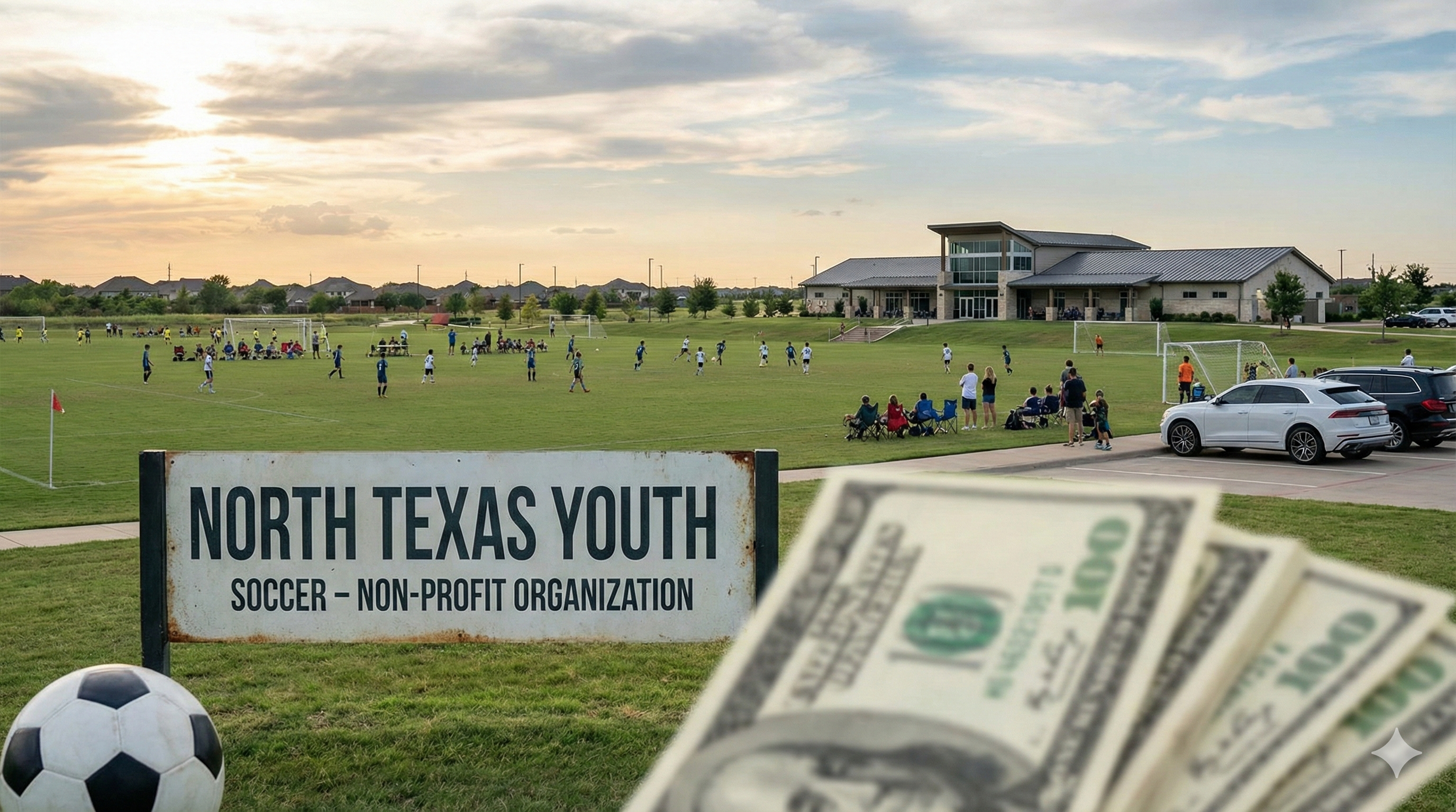
The Non-Profit Illusion: How North Texas Youth Soccer Clubs Enrich Executives and Fail Families
A deep forensic analysis of financial filings and court records reveals a stark disconnect between this charitable status and the commercial reality. While these clubs enjoy massive tax breaks intended to foster community access, the benefits rarely trickle down to the families writing the checks. Instead, the "non-profit" label has become a shield for a business model that facilitates executive enrichment, aggressive asset accumulation, and, in some cases, systemic fraud.
In the sprawling suburbs of North Texas, youth soccer is not just a pastime; it is a high-stakes industry. Every weekend, thousands of families flock to immaculately manicured fields in Plano, Frisco, and Allen, their SUVs loaded with gear that costs hundreds of dollars, paying club fees that rival college tuition. The organizations running these leagues—giants like Solar Soccer Club, the Dallas Texans, and Sting Soccer—often bear the 501(c)(3) tax-exempt designation. Legally, they are charities, existing in the same tax category as food banks and homeless shelters.
However, a deep forensic analysis of financial filings and court records reveals a stark disconnect between this charitable status and the commercial reality. While these clubs enjoy massive tax breaks intended to foster community access, the benefits rarely trickle down to the families writing the checks. Instead, the "non-profit" label has become a shield for a business model that facilitates executive enrichment, aggressive asset accumulation, and, in some cases, systemic fraud.
The Broken Promise: Why Tax Breaks Don't Lower Fees
The fundamental social contract of a non-profit is simple: the government waives taxes so the organization can use that surplus to serve the public. In youth soccer, this should translate to subsidized fees and broad access for low-income players. In North Texas, it largely does not.
The first misconception many parents have is that their thousands of dollars in "club dues" are tax-deductible. They are not. Because the IRS views these payments as a "quid pro quo"—money paid for services rendered—families pay with after-tax dollars.1 Meanwhile, the clubs themselves are exempt from federal income tax, state franchise tax, and, crucially, the 8.25% Texas sales tax.
For a club like Solar SC, which generates nearly $7 million in annual revenue, the sales tax exemption on equipment, field maintenance, and facilities saves hundreds of thousands of dollars annually.2 Yet, parent fees continue to rise. These savings are not passed on as fee reductions; they are absorbed into the operating budget, often to fund higher salaries and facility expansion. The tax burden is effectively shifted entirely to the families, who subsidize the club's tax-free existence while receiving no fiscal relief themselves.
The "Ghost" Salaries and Executive Enrichment
One of the most contentious aspects of this "charitable" ecosystem is how executive compensation is handled. While managing a multi-million dollar organization requires talent, the pay scales in North Texas youth soccer often eclipse those of the community workforce the clubs claim to serve.
The Transparent Excess
Analysis of IRS filings for Solar Soccer Club reveals a compensation structure that mirrors the corporate world rather than the charitable sector. Executive Director Adrian Solca has received reportable compensation packages reaching $300,000.4 To put this in perspective, the average annual salary for a worker in the Dallas-Fort Worth area is approximately $68,400. The leader of a youth sports charity is earning more than 4.4 times the average worker in his community.
The Shell Game
Other clubs appear to use more opaque methods. Organizations like the Dallas Texans and Sting Soccer have historically reported $0 compensation for their top principals on their non-profit Form 990s.5 This does not mean these leaders work for free. It often suggests the existence of parallel for-profit entities—such as "Sting Soccer Group, LP"—that charge the non-profit "management fees" or "licensing fees." This legal sleight-of-hand allows executives to extract tax-exempt revenue from the non-profit side and move it into a private business where salaries are hidden from public scrutiny, effectively bypassing the transparency required of 501(c)(3) organizations.
The Kickback Economy: Monetizing the Uniform
Perhaps the most egregious example of exploiting families is the mandatory uniform cycle. Clubs sign exclusive contracts with manufacturers like Nike, Adidas, or Capelli. In exchange for mandating that every player buy a specific kit—often costing between $300 and $500—the clubs receive "rebates."
These rebates are essentially legalized kickbacks. Instead of using their bulk purchasing power to negotiate lower prices for families (e.g., getting a $50 jersey for $30), non-profit clubs often agree to the full retail price for parents. In return, the manufacturer kicks back a percentage of that spend to the club as cash or credit.7 Families are effectively forced to make a hidden donation to the club every time they buy a pair of socks, while club leadership frames the exclusive gear deal as a mark of prestige.
A History of Fraud: When the System Breaks
The combination of high cash flow, volunteer governance, and a lack of rigorous external auditing has made North Texas youth soccer a fertile ground for financial malfeasance. The history of the region is dotted with cases where the "charitable" mission was hijacked for personal gain.
The Solar SC Embezzlement: In a scandal that shook the local soccer community, David Ringer, the long-time President of Solar Soccer Club, was indicted and pleaded guilty to misapplication of fiduciary property. He siphoned approximately $800,000 from the club over several years, using player fees to cover personal debts and fund his law firm. The fraud went undetected for years because Ringer held a position of absolute trust with little oversight.9
Sting Soccer’s "Fiscal Shortages": Brent Coralli, the owner of Sting Soccer, was involved in a massive illegal gambling ring for which he pleaded guilty. Separately, he faced a civil lawsuit alleging securities fraud, where an investor claimed that funds intended for a mobile lottery business in Peru were instead diverted to "fund fiscal shortages in the sports world of Sting." While the securities fraud claim was eventually dismissed, the allegations highlighted the dangerous commingling of youth sports funds with risky private ventures.11
The Wylie Youth Soccer Theft: As recently as May 2025, the treasurer of the Wylie Youth Soccer Association was arrested for stealing over $300,000. Like the Solar case, this involved a trusted insider treating the club's bank account as a personal piggy bank, exploiting the lack of third-party audits common in youth sports non-profits.
Conclusion: A Cycle Destined to Repeat
The "non-profit" status of elite youth soccer clubs in North Texas is, for all practical purposes, a tax shelter for commercial entertainment businesses. By utilizing 501(c)(3) designations, these clubs avoid taxes, gain priority access to municipal fields, and solicit donations, all while charging exorbitant fees that exclude the very public they are chartered to serve.
More disturbingly, the structural vulnerabilities that allowed David Ringer and others to embezzle millions remain largely unaddressed. As long as these organizations are run by self-perpetuating boards with minimal transparency and no requirement for independent forensic audits, the "pay-to-play" model will continue to be a target for fraud.
The parents of North Texas are not just paying for coaching and fields; they are unwittingly capitalizing an unregulated banking system for club executives. Until the IRS and governing bodies enforce stricter "public benefit" requirements and financial controls, the story of fraud in youth soccer is not a matter of history—it is a preview of the next scandal.
Works cited
Are soccer fees/expenses tax deductible if the club is registered as a ..., accessed on December 25, 2025, https://socalsoccer.com/threads/are-soccer-fees-expenses-tax-deductible-if-the-club-is-registered-as-a-non-profit.21593/
Solar Soccer Club - Nonprofit Explorer - ProPublica, accessed on December 25, 2025, https://projects.propublica.org/nonprofits/organizations/752542947
Solar Soccer Club | Allen, TX - Cause IQ, accessed on December 25, 2025, https://www.causeiq.com/organizations/solar-soccer-club,752542947/
Reviews of Solar Soccer Club, CEO Salary, Legit, Mission, 990 and ..., accessed on December 25, 2025, https://givefreely.com/charity-directory/nonprofit/ein-752542947/
Dallas Texans Soccer Club | Plano, TX - Cause IQ, accessed on December 25, 2025, https://www.causeiq.com/organizations/club-soccer,201652302/
Reviews of Sting Soccer Foundation, CEO Salary, Legit, Mission ..., accessed on December 25, 2025, https://givefreely.com/charity-directory/nonprofit/ein-261463492/
Parents are being robbed even for uniforms cost. : r/youthsoccer, accessed on December 25, 2025, https://www.reddit.com/r/youthsoccer/comments/1l7g3xf/parents_are_being_robbed_even_for_uniforms_cost/
The Cost Crisis in Youth Soccer: How Pay-to-Play is Reshaping ..., accessed on December 25, 2025, https://admiral-sports.com/shop/usa_en/journal/the-cost-crisis-in-youth-soccer-how-pay-to-play-is-reshaping-american-talent-development-and-limiting-participation/
Keep Thieves From Stealing From Your Nonprofit Youth Sports ..., accessed on December 25, 2025, https://www.mjcpa.com/keep-thieves-from-stealing-from-your-nonprofit-youth-sports-league/
Keep thieves from stealing from your nonprofit youth sports league, accessed on December 25, 2025, https://mordfin.com/blog/keep-thieves-from-stealing-from-your-nonprofit-youth-sports-league-2/
In Re: Sting Soccer Group, LP, and Brent Lee Coralli Appeal from ..., accessed on December 25, 2025, https://law.justia.com/cases/texas/fifth-court-of-appeals/2017/05-17-00317-cv.html
Texas Soccer Foundation v. Sting Soccer Foundation Appeal from ..., accessed on December 25, 2025, https://law.justia.com/cases/texas/fifth-court-of-appeals/2021/05-19-01228-cv.html

The Developmental Paradox:
A landmark analysis of nearly 35,000 top performers reveals that the most common path to elite status is not early specialization, but multidisciplinary 'sampling.' Discover why the '10,000-hour rule' fails to predict long-term success and how a winding developmental journey fosters the adaptability and durability required to reach the world-class level in sports, science, and the arts
A Comprehensive Analysis of Early Specialization versus Multidisciplinary Sampling in Elite Performance
Executive Summary
The prevailing cultural and systemic narrative regarding the acquisition of elite performance—whether in high-performance sport, the sciences, music, or other competitive domains—has long been anchored in the "early specialization" hypothesis. This model, popularized by mass-market interpretations of expertise research such as the "10,000-hour rule," posits that world-class status is primarily a function of accumulated deliberate practice starting in early childhood. Consequently, youth development systems globally have increasingly incentivized early selection, hyper-specialization, and the elimination of "distracting" activities.
However, a landmark synthesis of empirical research published in Science in December 2025 by Arne Güllich, Brooke Macnamara, and David Hambrick fundamentally destabilizes this orthodoxy. Analyzing data from nearly 35,000 adults across diverse fields, the researchers identified a profound disconnect between early childhood performance and adult elite status. The study reveals that most top-achieving adults were not elite specialists in childhood, and conversely, most child prodigies do not maintain their ascendancy into peak performance years.
This report provides an exhaustive examination of these findings, contrasting the "Early Specialization" model with the empirically supported "Early Sampling" pathway. It explores the physiological, psychological, and cognitive mechanisms that favor multidisciplinary engagement, analyzes the "two disparate populations" phenomenon in talent identification, and offers evidence-based recommendations for stakeholders in talent development. The analysis incorporates data from Olympic sports, Nobel Prize demographics, and longitudinal studies of musicians to construct a unified theory of sustainable high performance.
1. Introduction: The Cultural and Economic Context of Talent Development
The architecture of modern youth development is largely built upon a specific, compelling narrative: the prodigy. This archetype, fueled by high-profile anecdotes of athletes like Tiger Woods or musicians like Yo-Yo Ma, suggests a linear and reliable causal link between the age of initiation, the exclusivity of focus, and the ultimate level of achievement.1 This narrative has been industrialized into a youth sports and education economy that markets "elite" training programs to children as young as four or five, promising that early immersion is the only hedge against falling behind in an increasingly competitive global landscape.2
1.1 The "Early Start" Arms Race
The logic driving this "arms race" is intuitive: if expertise requires a massive volume of practice (often cited as 10,000 hours), then starting earlier provides an insurmountable temporal advantage. This view treats skill acquisition as a simple cumulative process, where time spent in other domains is viewed as "lost" time. Parents and coaches, guided by this zero-sum philosophy, often restrict children’s exposure to alternative activities to maximize domain-specific repetition.3
1.2 The Scientific Pivot
However, the scientific consensus has shifted dramatically. A new comprehensive analysis reported by Aylin Woodward in the Wall Street Journal (December 18, 2025) and published in Science challenges the foundational assumptions of the early specialization model. By examining the developmental histories of thousands of performers—from Olympic champions to Nobel laureates—researchers have demonstrated that the "early start" model is statistically the exception, not the rule.4
The data reveals a startling lack of continuity between high-performing children and high-performing adults. In fact, there is only a 10% overlap between the population of child stars and the population of adult elites. This statistic implies that 90% of the children identified as "elite" today will not be the elites of tomorrow, and conversely, the vast majority of tomorrow's elites are currently flying under the radar, engaging in a broader, less specialized range of activities.
2. Deconstructing the Expertise Myths: The 10,000-Hour Rule Revisited
To understand why the "sampling" pathway is effective, one must first rigorously deconstruct the "10,000-hour rule," which has served as the intellectual bedrock for early specialization.
2.1 Origin and Misinterpretation
The concept originated from a 1993 study by K. Anders Ericsson, Ralf Krampe, and Clemens Tesch-Römer, which examined violin students at a Berlin music academy. The study found that the "best" students (at age 20) had accumulated on average 10,000 hours of deliberate practice.5
The Average vs. The Threshold: Malcolm Gladwell’s popularization of this study in his book Outliers transformed a statistical average into a threshold or "magic number." Gladwell implied that 10,000 hours was a sufficient condition for mastery and that anyone could achieve it simply by putting in the time.6
Ericsson’s Rebuttal: Ericsson himself consistently argued that this was a simplification. He noted that 10,000 hours was merely the average of the top group at age 20—not the point at which they became "masters," but simply where they were in their development. Crucially, half of the top group had accumulated fewer than 10,000 hours, indicating that practice volume is not a uniform predictor of rank.5
2.2 Variance and Efficiency
Subsequent research has exposed massive variance in the time required to reach elite status. In chess, for example, the time to reach "master" level ranges from 728 hours to 16,120 hours—a differential of more than 2200%.5 This suggests that "practice efficiency" (how much skill an individual gains per hour of practice) varies wildly between individuals. The new research by Güllich and Macnamara suggests that a multidisciplinary background may be the key factor that enhances this efficiency, allowing late-starters to catch up rapidly.8
2.3 The Quality of Practice
The popular narrative also ignores the distinction between "practice" (repetition) and "deliberate practice" (highly structured, effortful activity designed to improve specific aspects of performance). Ericsson emphasized that deliberate practice is mentally exhausting and can typically be sustained for only 4-5 hours a day.10 Early specialization often leads to the accumulation of low-quality "mindless" hours rather than high-quality deliberate practice, potentially explaining why early volume does not strictly correlate with adult success.11
3. The "Two Disparate Populations" Phenomenon
The most significant contribution of the Güllich, Barth, Macnamara, and Hambrick research is the identification of a dichotomy between junior and senior success. Their meta-analyses, covering over 6,000 athletes and extending into academic domains, suggest that successful juniors and successful seniors are effectively "two disparate populations" with distinct developmental markers.12
3.1 The Reversal of Predictors
The attributes that predict success at the youth level are often negatively correlated with success at the adult level. This "reversal of predictors" creates a systemic trap where talent identification programs select for traits that act as false positives for long-term potential.2
3.2 The Efficiency of the Senior Elite
Adult world-class athletes, compared to their national-class peers (who are good but not elite), started their main sport significantly later. Furthermore, they accumulated less main-sport practice throughout their childhood and adolescence.8
The Implications: If adult elites practiced less but achieved more, their practice must have been more efficient. The hypothesis supported by the data is that their background in other activities (multidisciplinary sampling) provided a "scaffolding" of general physiological and cognitive capacities that accelerated their specific learning once they eventually specialized.3
3.3 Peak Performance Windows
The study clarifies that "peak performance" occurs at different ages across domains: 20–30 for sports and chess, and 40–50 for science and music. The lack of overlap between child stars and adult stars (the 10% figure) indicates that early dominance rarely survives the transition into these peak windows. As Macnamara notes, "Many top junior athletes peak early," effectively burning through their potential before reaching the biological and cognitive prime required for senior elite status.
4. The Multidisciplinary Advantage: Mechanisms of Sampling
The "sampling pathway"—defined as participating in multiple sports or activities during the ages of 6 to 12—is not merely a safeguard against boredom; it is an active mechanism of talent development. Güllich suggests a "sweet spot" of engaging in two additional areas alongside a main discipline.
4.1 Transfer of Learning and Pattern Recognition
The primary cognitive mechanism benefiting samplers is "transfer of learning."
Adaptive Learning: Exposure to diverse environments (e.g., the tactical geometry of soccer combined with the hand-eye coordination of tennis) creates a broader library of motor and cognitive patterns. This makes the individual a more "adaptable learner" in adulthood. When a sampler eventually specializes, they can draw upon solutions from other domains to solve novel problems in their main field.1
Conceptual Bridging: In cognitive domains, this manifests as the ability to apply frameworks from one discipline (e.g., physics) to another (e.g., biology). This cross-pollination is a hallmark of high-level innovation.16
4.2 Biological Sustainability: Injury Prevention
Early specialization imposes repetitive mechanical stress on specific anatomical structures during critical growth phases.
Overuse Injury: Research indicates that athletes who specialize early are at a significantly higher risk of overuse injuries (e.g., stress fractures, tendinopathies) compared to samplers.3 By diversifying activity, samplers distribute mechanical loads across different muscle groups and movement planes, preserving orthopedic health for the long term.
Long-Term Durability: Since senior elite status requires sustaining high training loads in the 20s and 30s, the "preservation" of the body during the teenage years is a competitive advantage. The specialist may be "better" at age 14, but the sampler is often "healthier" at age 24.17
4.3 Psychological Sustainability: The Prevention of Burnout
Specialization is frequently associated with "deliberate practice" (high effort, low inherent enjoyment), whereas sampling is associated with "deliberate play" (unstructured, intrinsically motivating activity).18
Intrinsic Motivation: The sampling years allow children to discover the activity that best suits their psychological profile ("match quality"). A child who chooses a sport after trying five others is statistically more likely to have a high affinity for that sport than a child who was placed in it by a parent at age 5.
Identity Complexity: Early specializers often develop a "foreclosed identity," where their self-worth is entirely contingent on their performance in a single domain. If they fail or get injured, they face a crisis of identity that often leads to dropout. Samplers, having a broader range of competencies, possess a more resilient psychological profile.18
5. Cross-Domain Validity: From the Stadium to the Laboratory
The findings of Güllich and Macnamara are robust because they are consistent across disparate domains. The pattern of "slow start, high finish" is visible not just in athletics, but in the highest echelons of intellectual achievement.
5.1 The Nobel Laureate Paradox
Research by Robert Root-Bernstein on Nobel laureates offers a striking parallel to the sports data. While one might assume that winning a Nobel Prize requires a monomaniacal focus on science from childhood, the data shows the opposite.20
Data sourced from Root-Bernstein et al..21
Functional Polymathy: Nobel laureates do not just have hobbies; they integrate these avocations into their scientific thinking. They often cite the visual-spatial skills learned in art or the structural logic of music as crucial to their scientific breakthroughs. This mirrors the "multisport" advantage, where skills transfer from one domain to another.
Career Trajectory: Much like adult elite athletes, Nobel laureates often had "slower" early careers compared to their less eminent peers (e.g., National Academy members). They took longer to win their first grants or professorships because they were spending time exploring diverse fields. However, this "inefficiency" in the short term resulted in the "efficiency" of breakthrough innovation in the long term.16
5.2 Music and Chess
Even in domains like music and chess, where the "child prodigy" myth is strongest, the data is nuanced.
Chess: While starting young is common, the variability in hours to mastery suggests that other factors—potentially general cognitive development fostered by schooling and other activities—play a massive role.5
Music: Güllich’s definition of peak performance in music as occurring between ages 40 and 50 challenges the obsession with the adolescent virtuoso. While technical proficiency can be acquired early, the interpretive depth required for world-class status often requires the emotional and intellectual maturity developed through a broader life experience.24
6. Critical Perspectives and Limitations
While the aggregate data strongly favors sampling, it is essential to acknowledge the limitations and the variability inherent in human development.
6.1 The Oswald Critique
Fred Oswald, an industrial-organizational psychologist at Rice University, cautions against over-interpreting these general trends for individual advice. "The implications for advising individuals are unclear," he notes.
General vs. Specific: While sampling is the probability play (it works for the majority), there are outliers. Figures like Tiger Woods or the Polgar sisters did specialize early and did succeed. The danger lies in treating the outliers as the model. The "Tiger Path" is a possible route, but it is a high-risk, high-attrition route compared to the "Roger Federer Path" (sampling).25
Context Matters: The "sweet spot" of two additional activities may vary by domain. Gymnastics and figure skating, for instance, rely on peak flexibility that diminishes post-puberty, potentially necessitating an earlier start than endurance sports like rowing or cycling.2
6.2 Methodological Considerations
The research by Güllich and Macnamara is meta-analytic, meaning it synthesizes data from dozens of previous studies.1 This provides high statistical power (N=35,000) but relies on the quality of the underlying studies. However, the consistency of the findings across "some two dozen previously published studies" and across different domains strengthens the validity of the conclusion.
7. Systemic Implications: The Failure of Talent Identification
The current youth sports infrastructure is largely designed to identify and select early specializers, creating a systemic inefficiency.
7.1 Selection Bias and the Relative Age Effect
Talent Identification (Talent ID) programs typically select children based on current performance.
The False Positive: A child who specializes in soccer at age 6 will almost always outperform a peer who is sampling soccer, swimming, and judo at age 10. The specialist has more domain-specific hours. Talent scouts interpret this performance gap as "talent" and select the specialist.
The Consequence: By cutting the sampler, the system removes the athlete who—according to the data—has the highest probability of becoming a senior elite. This explains the low retention rates in academy systems; they are selecting for precocity, not potential.2
7.2 The "Churn" of Youth Sports
The "Two Disparate Populations" finding suggests that most resources in youth academies are spent on athletes who will not make it. This high turnover (or "churn") is expensive for organizations and devastating for the deselected children. A system aligned with the evidence would keep the talent pool wide for as long as possible, delaying selection until post-puberty.2
8. Recommendations for Policy and Practice
Based on the comprehensive review of the evidence, the following recommendations are indicated for parents, coaches, and governing bodies.
8.1 For Parents: The "Sweet Spot" Strategy
Diversify: Encourage engagement in at least two additional areas outside the "main" interest. This does not mean frenetic activity; it means sustained, enjoyable engagement in complementary fields (e.g., a musician playing a sport, an athlete learning chess).
Ignore Early Rankings: Recognize that being the "best" at age 10 is a poor predictor of being the best at age 25. Do not sacrifice long-term development for short-term trophies.
Monitor for Burnout: Watch for signs of "identity foreclosure." Ensure the child sees themselves as a multifaceted person, not just a "performer".18
8.2 For Coaches and Academies: Structural Reform
Delay Specialization: Structure training programs to include "multisport" elements. A basketball academy might incorporate soccer for footwork or gymnastics for body control.
Value "Deliberate Play": Incorporate unstructured, athlete-led play into training sessions. This maintains intrinsic motivation and fosters creativity.19
Rethink Selection: Move away from early deselection. Create "development squads" that allow late bloomers (often the samplers) to remain in the ecosystem until their potential matures.2
9. Conclusion
The "Tiger Woods" narrative of early, singular focus is a compelling story, but it is a misleading map for talent development. The comprehensive analysis by Güllich, Macnamara, and Hambrick provides a rigorous, data-driven correction to this myth. By analyzing 35,000 performers, they have demonstrated that the road to the podium—or the Nobel Prize—is rarely a straight, narrow line starting in preschool.
Instead, the path to elite status is characterized by range, exploration, and a "slow burn." The "sampling period" is not a delay of development; it is the foundation of it. It builds the physiological durability to withstand adult training loads, the cognitive adaptability to solve complex problems, and the psychological resilience to sustain a career over decades.
The paradox of high performance is that the most efficient way to build a specialist is to start with a generalist. As Arne Güllich concludes, the "child prodigies" are the exception. The rule belongs to those who explore, sample, and mature into their excellence. For parents, coaches, and educators, the mandate is clear: to foster greatness, we must first foster variety.
Works cited
Brooke Macnamara Publications - Case Western Reserve University, accessed on December 20, 2025, https://caslabs.case.edu/macnamaralabs/brooke-macnamara-recent-publications/
(PDF) Effects of Early Talent Promotion on Junior and Senior ..., accessed on December 20, 2025, https://www.researchgate.net/publication/375283935_Effects_of_Early_Talent_Promotion_on_Junior_and_Senior_Performance_A_Systematic_Review_and_Meta-Analysis
What Makes a Champion? Early Multidisciplinary Practice, Not Early ..., accessed on December 20, 2025, https://www.researchgate.net/publication/353254295_What_Makes_a_Champion_Early_Multidisciplinary_Practice_Not_Early_Specialization_Predicts_World-Class_Performance
Recent discoveries on the acquisition of the highest levels of human ..., accessed on December 20, 2025, https://pubmed.ncbi.nlm.nih.gov/41411418/
The Great Practice Myth: Debunking the 10,000 Hour Rule • Six ..., accessed on December 20, 2025, https://www.6seconds.org/2022/06/20/10000-hour-rule/
Malcolm Gladwell's 10000 Hours Rule Explained, accessed on December 20, 2025, https://www.morethanaccountants.co.uk/malcolm-gladwells-10000-hours-rule-explained/
Blow to 10000-hour rule as study finds practice doesn't always make ..., accessed on December 20, 2025, https://www.theguardian.com/science/2019/aug/21/practice-does-not-always-make-perfect-violinists-10000-hour-rule
What Makes a Champion? Early Multidisciplinary Practice, Not Early ..., accessed on December 20, 2025, https://www.parentsinsport.co.uk/wp-content/uploads/2023/05/2021-gullich_230120_214251.pdf
Predictors of Junior Versus Senior Elite Performance are Opposite, accessed on December 20, 2025, https://pmc.ncbi.nlm.nih.gov/articles/PMC9124658/
The problem with: "Malcolm Gladwell's" "10000 hour" "rule", accessed on December 20, 2025, https://www.fixedinterval.com/aba/the-problem-with-malcolm-gladwells-10000-hour-rule-or-the-k-an
What Everyone Gets Wrong About the 10,000 Hour Rule, accessed on December 20, 2025, https://nextbigideaclub.com/magazine/conversation-what-everyone-gets-wrong-about-the-10000-hour-rule/16195/
Predictors of Junior Versus Senior Elite Performance are Opposite, accessed on December 20, 2025, https://www.researchgate.net/publication/357897021_Predictors_of_Junior_Versus_Senior_Elite_Performance_are_Opposite_A_Systematic_Review_and_Meta-Analysis_of_Participation_Patterns
Brooke Macnamara (0000-0003-1056-4996) - ORCID, accessed on December 20, 2025, https://orcid.org/0000-0003-1056-4996
Participation patterns in talent development in youth sports - PubMed, accessed on December 20, 2025, https://pubmed.ncbi.nlm.nih.gov/37274619/
Five Things to Know About Sport Specialization - USA Cheer, accessed on December 20, 2025, https://usacheer.org/five-things-to-know-about-sport-specialization
Returns to School | National Affairs, accessed on December 20, 2025, https://www.nationalaffairs.com/blog/detail/findings-a-daily-roundup/returns-to-school
The Benefits of Sampling Sports During Childhood - ResearchGate, accessed on December 20, 2025, https://www.researchgate.net/publication/320931606_The_Benefits_of_Sampling_Sports_During_Childhood
Early Sport Specialization and Sampling | Request PDF, accessed on December 20, 2025, https://www.researchgate.net/publication/341921075_Early_Sport_Specialization_and_Sampling
(PDF) “Specializers” Versus “Samplers” in Youth Sport - ResearchGate, accessed on December 20, 2025, https://www.researchgate.net/publication/261472347_Specializers_Versus_Samplers_in_Youth_Sport_Comparing_Experiences_and_Outcomes
(PDF) Arts Foster Scientific Success: Avocations of Nobel, National ..., accessed on December 20, 2025, https://www.researchgate.net/publication/247857346_Arts_Foster_Scientific_Success_Avocations_of_Nobel_National_Academy_Royal_Society_and_Sigma_Xi_Members
Polymathy Among Nobel Laureates As a Creative Strategy - Directory, accessed on December 20, 2025, https://directory.natsci.msu.edu/media/Directory/Profiles/RB%20&%20RB%20CR20230303094844.pdf
Polymathic interests of Nobel laureates. Note that percentages..., accessed on December 20, 2025, https://www.researchgate.net/figure/Polymathic-interests-of-Nobel-laureates-Note-that-percentages-forhumanities-social_fig2_341517921
What Makes a Champion? Early Multidisciplinary Practice ... - PubMed, accessed on December 20, 2025, https://pubmed.ncbi.nlm.nih.gov/34260336/
International medallists' and non-medallists' developmental sport ..., accessed on December 20, 2025, https://www.researchgate.net/publication/311503785_International_medallists'_and_non-medallists'_developmental_sport_activities_-_a_matched-pairs_analysis
(PDF) Revisiting predictor–criterion construct congruence, accessed on December 20, 2025, https://www.researchgate.net/publication/373561537_Revisiting_predictor-criterion_construct_congruence_Implications_for_designing_personnel_selection_systems

When Wall Street Buys The Soccer Fields
From Public Good to Asset Class
The landscape of youth athletics in the United States is currently undergoing a structural metamorphosis of a magnitude not seen since the post-war expansion of municipal recreation. Historically, the provision of youth sports was viewed primarily as a public good—a collaborative effort between municipal parks departments, school districts, and volunteer-led non-profit associations. However, over the last decade, and accelerating aggressively since 2020, this sector has been reclassified by global capital markets as a high-growth, recession-resilient asset class.
The industry, now valued between $40 billion and $64 billion annually, has become a primary target for institutional capital deployment. Private equity firms, seeking yield in a volatile macroeconomic environment, have identified parental anxiety regarding child development as a harvestable resource. By acquiring the physical infrastructure (fields, rinks, courts) and the digital infrastructure (registration platforms, streaming services) of youth sports, these firms have effectively positioned themselves as the toll collectors of childhood development.
Part I: The Structural Transformation of the Youth Sports Economy
1.1 Introduction: From Public Good to Asset Class
The landscape of youth athletics in the United States is currently undergoing a structural metamorphosis of a magnitude not seen since the post-war expansion of municipal recreation. Historically, the provision of youth sports was viewed primarily as a public good—a collaborative effort between municipal parks departments, school districts, and volunteer-led non-profit associations. This model prioritized accessibility, community cohesion, and broad-based participation. However, over the last decade, and accelerating aggressively since 2020, this sector has been reclassified by global capital markets as a high-growth, recession-resilient asset class. The industry, now valued between $40 billion and $64 billion annually, has become a primary target for institutional capital deployment.1
The catalyst for this shift lies in the fundamental economic behavior of the modern American family. Market analysis indicates that spending on youth enrichment—specifically athletics—demonstrates extreme inelasticity. Even in periods of economic contraction, parents are statistically likely to reduce discretionary spending on dining, travel, and luxury goods before they reduce investment in their children's development.1 Private equity (PE) firms, seeking yield in a volatile macroeconomic environment, have identified this parental anxiety as a harvestable resource. By acquiring the physical infrastructure (fields, rinks, courts) and the digital infrastructure (registration platforms, streaming services) of youth sports, these firms have effectively positioned themselves as the toll collectors of childhood development.2
This report provides an exhaustive analysis of this phenomenon, utilizing the City of McKinney, Texas, as a primary longitudinal case study. McKinney, a rapidly expanding suburb in the Dallas-Fort Worth (DFW) metroplex, represents the ideal demographic "petri dish" for this financial experiment: a high-income, family-oriented population with a cultural propensity for competitive athletics.6 By triangulating corporate acquisition data, municipal policy documents, and sociological research, this document details how firms like ZT Corporate, Black Bear Sports Group, and Steel Sports are reshaping the athletic, financial, and developmental realities of American youth.
1.2 The Macroeconomic Investment Thesis: The "Roll-Up" Strategy
The primary mechanism employed by private equity in this sector is the "roll-up" or consolidation strategy. The youth sports market has historically been highly fragmented, characterized by thousands of "mom-and-pop" facility operators, independent tournament directors, and localized coaching clubs. In the view of institutional investors, this fragmentation represents inefficiency. By acquiring these disparate entities and aggregating them under a single holding company, PE firms aim to achieve economies of scale, centralized procurement power, and, crucially, pricing power.1
The investment thesis rests on three pillars of value creation:
Vertical Integration: The goal is not merely to own a team, but to own the entire value chain. A fully integrated PE platform seeks to own the facility where the game is played, the league that organizes the schedule, the software that processes the registration fees, the streaming service that broadcasts the game, and even the hospitality agency that books the mandatory hotel stays.1
Digital Transformation and Data Monetization: The acquisition of technology platforms—such as the merger of Stack Sports and PlayMetrics backed by Genstar Capital—allows for the harvesting of granular data on millions of families. This data includes spending habits, travel patterns, and health metrics, which significantly increases the enterprise value of the holding company beyond the cash flow of the leagues themselves.1
Real Estate Appreciation: Many of these deals are fundamentally real estate plays. Facilities like the Baseball Nation complex in McKinney or the StarCenter ice rinks represent significant land holdings in high-growth suburban corridors. The operational cash flow of the sports leagues serves to service the debt on the real estate assets, while the long-term value is realized through land appreciation.7
1.3 The Post-COVID Acceleration
The timing of this consolidation is inextricably linked to the COVID-19 pandemic. The initial lockdowns of 2020 caused a severe contraction in the youth sports industry, forcing many small, independent facility owners and non-profit clubs to the brink of insolvency due to the cessation of play and revenue.1 This distress created a "buyer’s market" for private equity firms, who possessed significant "dry powder" (unallocated capital).
As the economy reopened, the "V-shaped" recovery in youth sports spending was steeper than in almost any other sector. Global spending on youth sports rebounded to record levels by 2023, with the U.S. market accounting for over $43 billion of the global $64 billion total.1 This rapid bounce-back validated the PE hypothesis regarding the sector's resilience. Furthermore, the pandemic accelerated the "professionalization" trend; parents, anxious about their children "falling behind" during lockdowns, became more willing to invest in premium, private coaching and high-cost travel leagues, further marginalizing low-cost recreational options.1
Part II: The McKinney Case Study – The Architecture of Privatization
McKinney, Texas, serves as a critical microcosm for understanding the operational realities of this financial shift. The city's demographics—affluent, suburban, and rapidly growing—align perfectly with the target profile for PE-backed sports platforms. The privatization of McKinney's youth sports infrastructure is not a singular event but a convergence of three distinct corporate strategies executed by ZT Corporate, Black Bear Sports Group, and Steel Sports.
2.1 ZT Corporate and the Industrialization of Baseball
In 2022, ZT Corporate, a Houston-based private equity firm, acquired Baseball Nation, a dominant local tournament and facility operator in the North Texas region.13 This acquisition was not merely a change in ownership; it represented a fundamental change in the operational logic of youth baseball in the region.
2.1.1 The "Perfect Game" Pipeline
Prior to the acquisition, Baseball Nation operated as a regional entity focused on local league play and tournaments. Post-acquisition, ZT Corporate integrated these assets into the Perfect Game ecosystem. Perfect Game is the preeminent scouting and showcase organization in amateur baseball, known for its high-cost, high-exposure events.13
The Shift in Usage: The facilities controlled by ZT Baseball Nation, which include Triple Creek Academy in McKinney and agreements for other municipal fields, have increasingly shifted focus toward hosting "Perfect Game" sanctioned events. These events are designed to attract teams from across the country rather than serve the local community.14
Economic Displacement: This shift creates a displacement effect. Local recreational teams, such as those organized by the McKinney Baseball Softball Association (MBSA), find themselves competing for field space against a national corporate entity. While the MBSA continues to offer affordable recreational leagues (approx. $130-$150 per season), the "prime" inventory is increasingly absorbed by the higher-yielding tournament model.20
2.1.2 Cost Structures and the "Select" Premium
The financial disparity between the PE-backed model and the traditional model is stark.
Recreational Cost: A season in the MBSA recreational league costs a family approximately $130 to $175, covering uniforms, umpire fees, and field use.20
PE-Backed "Select" Cost: Participation in the ZT Corporate/Perfect Game ecosystem involves a different order of magnitude in spending. "Select" or "Travel" team dues can range from $3,000 to $5,000 annually per player. This base fee is often just the entry price; families must also pay for "gate fees" at tournaments (often $10-$20 per person per day), mandatory merchandise packages, and travel expenses.22
The "Travel" Imperative: The ZT model relies on the "travel" component. By designating tournaments as "National Qualifiers" or "Showcases," the firm incentivizes teams to travel to McKinney, generating economic impact for the city but increasing the cost burden on families who must travel to other ZT/Perfect Game hubs to chase rankings.24
2.2 Black Bear Sports Group: The Monopolization of Ice
Perhaps the most aggressive example of PE consolidation in McKinney is evident at the Children’s Health StarCenter. While the facility bears the name of a non-profit hospital system (via a naming rights agreement), the operational control of ice rinks across the region has been heavily consolidated under entities like Black Bear Sports Group.26 Black Bear has become the largest owner-operator of ice rinks in the U.S., employing a strategy of acquiring distressed assets and maximizing revenue per square foot.3
2.2.1 The "Pay-to-Watch" Surveillance Model
One of the most contentious innovations introduced by PE firms in the ice sports sector is the monetization of spectator access via streaming technology. In McKinney and similar markets, parents have reported strict prohibitions on recording their own children's games.3
The Policy: Facilities implement contractual terms that ban personal recording devices, citing privacy or intellectual property concerns. Simultaneously, they install automated camera systems (such as LiveBarn or proprietary Black Bear systems).3
The Revenue Stream: To watch the game—or even to get a clip of a goal for a college recruiting reel—parents must subscribe to the facility's exclusive streaming partner. These subscriptions can cost more than professional entertainment packages (e.g., Netflix or ESPN+). This effectively privatizes the visual record of the child's development, turning a memory into a paid commodity.2
Enforcement: Reports indicate that enforcement is draconian, with threats of team penalties or expulsion from the league for parents caught livestreaming games on their phones.29 This represents a shift from a "service" model (providing a place to skate) to an "extraction" model (monetizing every aspect of the experience).
2.2.2 League Consolidation and Exclusion
Black Bear’s strategy involves vertical integration of the leagues themselves. By owning the rinks (the scarce resource), the firm can dictate which leagues are permitted to operate. In the Northeast and increasingly in other markets, Black Bear has launched its own leagues (e.g., the Atlantic Hockey Federation) and systematically evicted rival non-profit leagues that have operated for decades.30 This forces local clubs to join the PE-owned league—often at higher price points—or face extinction due to a lack of ice time. In McKinney, the StarCenter network's dominance creates a similar de facto monopoly, where the facility owner holds ultimate leverage over the pricing and structure of youth hockey.30
2.3 Steel Sports: The Corporate Conglomerate Model
Steel Sports, a subsidiary of the publicly traded conglomerate Steel Partners Holdings L.P. (NYSE: SPLP), operates Steel United, a major soccer club with a significant presence in McKinney.31 Unlike a local non-profit club, Steel Sports is part of a diversified portfolio that includes banking (WebBank), industrial manufacturing (Handy & Harman), and defense contracting (Aerojet Rocketdyne ties).31
2.3.1 The "Kids First" Branding Paradox
Steel Sports markets itself heavily on a philosophy of "Kids First" and character development, utilizing the legacy of baseball legend Tommy Lasorda to build a brand centered on trust and values.32 However, the financial structure suggests a more traditional corporate imperative.
Revenue Pressures: As a subsidiary of a publicly traded partnership, Steel Sports is ultimately accountable to unitholders expecting returns. This creates a structural pressure to maximize "share of wallet" from participating families.
Cost Escalation: In the McKinney area, competitive soccer fees under consolidated club models like Steel United have risen sharply. While recreational soccer through the McKinney Soccer Association (MSA) remains accessible at ~$115 per season, the transition to the "Club/Academy" level (managed by or partnered with Steel United) involves a quantum leap in cost.33
The Academy Funnel: Steel United utilizes a "loss leader" or low-cost entry strategy for very young children. Programs like the "Spring Futures" for 4-5 year olds are priced attractively at $80 for six sessions.35 This serves as a customer acquisition funnel, moving families into the competitive tier where annual costs—including club fees, uniforms, and travel—can exceed $3,000 to $5,000.36
2.3.2 The Uniform Industrial Complex
A critical, often overlooked revenue stream for firms like Steel Sports is the uniform cycle. Unlike recreational leagues where a t-shirt is provided, PE-backed clubs often mandate the purchase of extensive "kits" (home jersey, away jersey, practice gear, warm-ups, specialized bags) from exclusive partners (e.g., Puma).37
Forced Obsolescence: These kits are typically on a strict two-year cycle. Regardless of whether the old uniform fits or is in good condition, families must purchase the new design every cycle to remain eligible. This generates a consistent, predictable revenue stream for the club and its apparel partners, further increasing the cost of participation.36
Part III: The Economic Impact on Families – The "Share of Wallet"
The financialization of youth sports effectively transfers wealth from middle-class families to institutional investors. This transfer is achieved through a sophisticated "fee stack" that extends far beyond simple registration costs.
3.1 The Inflation of Participation Costs
Data indicates that the average family spending on youth sports has increased by 46% over the last five years.15 However, this average masks the extreme costs at the "competitive" level which PE firms target.
The $10,000 Reality: For a child involved in a PE-backed travel baseball or soccer organization, the annual financial commitment frequently reaches $10,000 when all ancillary costs are included. This includes:
Club Dues: $2,500 - $4,000 (Tuition, coaching salaries, facility fees).36
Tournament Fees: $500 - $1,500 (Gate fees, player participation fees).22
Private Training: $1,000 - $2,000 (Supplemental clinics often run by the same agency).7
Travel & Logistics: $3,000 - $5,000 (Hotels, gas, flights, meals).7
Equipment/Uniforms: $500 - $1,000 (Mandated kits, high-end bats/cleats).36
3.2 The "Stay-to-Play" Kickback Economy
A primary mechanism for extracting value from the "travel" component is the "Stay-to-Play" policy enforced by tournament operators like ZT Baseball and Unrivaled Sports.7
The Mechanism: To be eligible for a tournament, a team is contractually required to book their hotel accommodations through a specific third-party housing agency designated by the tournament organizer. Teams are prohibited from booking directly with hotels or using discount sites (e.g., Expedia).24
The Kickback: The housing agency negotiates a rate with the hotel that includes a significant rebate (often $10-$20 per room night) that is paid back to the tournament organizer.
The Consumer Cost: Families often pay above market rates for these rooms, effectively paying a hidden tax to the tournament operator. This transforms the youth sports tournament into a hospitality brokerage, where the "product" being sold to investors is not just the baseball game, but the hotel occupancy of the parents.7
3.3 The Subscription Trap
The introduction of SaaS (Software as a Service) platforms into youth sports adds another layer of cost. Platforms like TeamSnap, LeagueApps, and PlayMetrics charge transaction fees on every payment. Furthermore, the shift to subscription models for content (streaming games) creates a recurring monthly cost for grandparents and extended family members who wish to watch the child play, expanding the revenue base beyond the immediate nuclear family.2
Part IV: Municipal Complicity and the "Turf Trap"
The rise of private equity in youth sports is often facilitated by municipal governments. Cities like McKinney face pressure to maintain high-quality facilities while minimizing the tax burden on residents. This creates an alignment of interests between the city (seeking revenue/cost recovery) and PE firms (seeking assets).
4.1 The Revenue Imperative: McKinney's Strategic Goals
The City of McKinney’s strategic planning documents explicitly prioritize financial performance for its recreational assets.
Cost Recovery Goals: The city has set a target of achieving a "minimum of 85% cost recovery" for the Apex Centre, a major recreational facility.39 This creates a mandate to prioritize high-revenue activities (e.g., renting lanes to private clubs or hosting tournaments) over low-revenue open play for residents.
Sports Tourism: The city views its sports facilities as engines for economic development. The Visit McKinney and McKinney Community Development Corporation (MCDC) actively promote sports tourism to drive hotel tax revenue.6 This incentivizes the city to partner with large tournament operators (like ZT Baseball) that can guarantee "heads in beds," often giving them priority access to fields over local recreational leagues.
4.2 The Synthetic Turf Revolution
McKinney has allocated significant capital ($5.5 million in FY25) to upgrade facilities, specifically converting grass fields to synthetic turf at the Craig Ranch Soccer Complex.6
The "Turf Trap": While turf increases the durability of fields, allowing for more play, it fundamentally alters the economics of the facility. Turf fields are expensive to install and maintain, requiring the city to maximize their utilization to justify the bond debt. The most efficient way to maximize utilization is to rent the facility to large, PE-backed tournament operators who rent the entire complex for weekends at premium rates.
Displacement: This dynamic pushes local recreational play to the margins—either to inferior grass fields or to undesirable time slots (early mornings, late nights), while the prime "championship" fields are reserved for the lucrative travel circuit.40
4.3 Policy Shifts: Field Allocation Reviews
The McKinney City Council is actively reviewing its "Field Allocation Policy" in 2025.6 The debate centers on balancing the needs of "recognized local sports leagues" (like the non-profit MBSA) against the demands of "select" and commercial entities.
The Threat: If the policy shifts to a purely market-based allocation (highest bidder wins), PE-backed firms with deep capital reserves will inevitably outbid non-profit associations. This would effectively privatize the public commons, restricting access to municipal parks to those who can afford the fees of the private clubs that rent them.6
Part V: Sociological and Developmental Consequences
The transformation of youth sports from a community activity to a financial product has profound implications for the physical, psychological, and social development of children.
5.1 The "Gentrification of Play"
The most immediate consequence of the PE model is the exclusion of lower-income families. The "Pay-to-Play" barrier creates a segregated system.
Participation Data: A study referenced in the research indicates that 70% of children from families earning over $100,000 participate in sports, compared to just 43% of children from lower-income households.15
The Hollow Middle: As PE firms consolidate the market, the "middle tier" of sports—affordable but competitive local leagues—is disappearing. Families are forced to choose between low-level recreational play (often underfunded) or high-cost elite play. There is increasingly no middle ground for the "late bloomer" or the multi-sport athlete who cannot commit $5,000 and year-round travel.2
Public School Impact: This gentrification impacts public school teams. High school programs in affluent areas like McKinney become "all-star" teams composed of players developed in the private club system. Meanwhile, schools in lower-income areas, where students rely on the school for development, find themselves unable to compete, widening the opportunity gap.2
5.2 The Professionalization of Childhood
To maximize "Lifetime Customer Value" (LCV), PE-backed clubs aggressively market the concept of early specialization.
Year-Round Revenue: The traditional "seasonality" of sports (baseball in spring, soccer in fall) is detrimental to a business model that requires monthly recurring revenue. Therefore, clubs create "Fall Ball," "Winter Skills," and "Summer Showcases," convincing parents that their child will fall behind if they stop playing for even a month.8
Physical Toll: Medical experts, such as Dr. Troy Smurawa from Children's Health Andrews Institute (McKinney), warn that this single-sport specialization before age 12 significantly increases the risk of overuse injuries and burnout.6 The business model requires the child’s body to be utilized as a machine for revenue generation, often at the expense of long-term physical health.
5.3 The ROI Fallacy: The Scholarship Myth
The marketing of PE-backed clubs often implicitly or explicitly promises a return on investment in the form of college scholarships.
The Reality: The mathematical probability of a high school athlete obtaining a full Division I scholarship is statistically negligible (less than 2%). Even for those who do, the average scholarship amount often does not cover the cumulative cost of ten years of "select" club fees.2
The Professional Dream: The allure is further fueled by the visibility of professional contracts. However, MLS salary data shows that even professional players often earn modest salaries ($80,000 - $100,000 base for lower-tier roster spots), making the "lottery ticket" mentality of youth sports investment a financially irrational gamble for families.42
Psychological Impact: When parents invest tens of thousands of dollars, the parent-child relationship becomes transactional. The child feels immense pressure to perform to justify the "investment," leading to high levels of anxiety and dropout rates by age 13.43
Part VI: Future Outlook – Saturation or Regulation?
6.1 The "Greater Fool" Risk
Private equity operates on a cycle of buying, improving financial metrics (EBITDA), and selling at a higher multiple. The current frenzy of acquisitions suggests a "land grab" phase.
Market Saturation: The industry faces a ceiling. There is a finite number of families capable of sustaining $10,000 annual spending per child. As inflation squeezes household budgets, the industry risks hitting a saturation point where the "churn" of families leaving the system outpaces new acquisition.7
The Exit Strategy: The likely exit strategy for these PE firms is to sell these consolidated platforms to even larger conglomerates or to take them public. However, if the underlying asset—the participation of families—erodes due to cost fatigue, these valuations could prove to be a bubble, leaving communities with hollowed-out sports infrastructure.2
6.2 The Potential for "Municipal Socialism"
A counter-movement is emerging. Public figures and grassroots organizations are beginning to call for the "re-municipalization" of sports.
Legislative Scrutiny: Senators and policymakers are beginning to classify the hidden fees (junk fees) and exclusionary practices of these firms as anti-competitive. Senator Chris Murphy’s comments on the "ban on recording" highlight a growing political awareness of the issue.29
Community Pushback: In markets saturated by PE, some parents are returning to "sandlot" style play or forming independent cooperatives to bypass the PE gatekeepers. If cities like McKinney pivot their policy back toward resident access over tourism revenue, the PE model—which relies on subsidized access to public fields—could face a significant margin squeeze.6
Conclusion
The transformation of McKinney’s youth sports landscape is not an isolated local event but a symptom of a global capital trend. The entry of ZT Corporate, Black Bear Sports Group, and Steel Sports has successfully professionalized the delivery of youth athletics, providing state-of-the-art facilities and sophisticated digital tools. However, this efficiency has been purchased at the cost of accessibility, community, and the fundamental nature of childhood play.
By treating youth sports as an asset class, these firms have applied the logic of extraction to the development of human potential. They have created a system that is highly profitable for investors but increasingly unsustainable for families and exclusionary for the community at large. The "McKinney Model" demonstrates that when the public commons of play is privatized, the result is a high-quality, high-cost product that serves the few at the expense of the many. As the industry matures, the tension between the financial imperatives of private equity and the developmental needs of children will likely become one of the defining social conflicts of the suburban American experience.
Key Findings Recap
Cost Escalation: Youth sports costs have risen 46% since 2019, driven by the need to service PE debt and return expectations.15
Monopoly Tactics: Firms utilize "roll-up" strategies to control rinks and fields, enforcing "pay-to-watch" streaming bans and "stay-to-play" hotel mandates.3
Public Subsidy: Municipalities like McKinney unintentionally subsidize this model by prioritizing "cost recovery" and sports tourism, granting PE firms access to taxpayer-funded infrastructure.6
Inequality: The system creates a "pay-to-play" caste system, effectively barring lower-income children from the developmental pathways necessary for high school and college success.2
Sources
45 McKinney City Council meeting minutes August 26 2025 field allocation
45 McKinney City Council field allocation policy outcome 2025
7 Impact of private equity on youth sports development Dallas (Hacker News Discussion)
39 FY2025 City Council Goals - McKinney, Texas
41 McKinney Community Development Corporation - Capital Projects Funding
2 The Financial Engineering of Childhood - Substack
31 Steel Partners Holdings L.P. - 2017 Investor Letter
46 Owner of Children's Health StarCenter McKinney (Video)
25 Complaints about Steel United McKinney soccer costs
6 Youth sports soar: McKinney officials, business owners adapt to meet rising demand
5 Project Play: Costs to Play Trends
36 Reddit: Soccer Club Fees Discussion
36 Reddit: Complaints about Steel United McKinney soccer costs
43 Reddit: Youth Sports is Broken Discussion
3 TPR: When private equity invests in youth sports facilities
22 Jacobin: Private Equity's New Venture: Youth Sports (Reddit Discussion)
38 Project Play survey: Family spending on youth sports rises 46%
33 McKinney Soccer Association - Recreational Registration
10 Private Equity International: 7 private equity deals in the sports sector
4 Youth Sports Market Latest Trends - Industry Research
30 Reddit: Private Equity Youth Sports Dallas Fort Worth Acquisitions
42 MLS Player Salaries Guide 2025
47 Steel Partners Holdings L.P. - SEC Filing
9 PlayMetrics Blog: What's Next for Youth Sports
8 Stax Insights: Navigating the Evolving Landscape of Youth Sports Management
29 Jacobin: Private Equity's New Venture: Youth Sports
40 Community Impact: Youth Sports Soar - McKinney
36 Reddit: Steel United McKinney Player Contract Fees
26 McKinney's Dr Pepper StarCenter rebrands, changes name
24 USA Baseball: Arizona Championships - Hotel Information (Stay to Play)
40 Community Impact: McKinney Youth Sports Soar
15 Prep Network: 10 Big Takeaways from NYT Feature on Youth Sports
23 Elite Baseball: 16U National Team Fees
12 Youth Enrichment Brands Launches With Acquisition of i9 Sports
1 Stout: Youth Sports Became Magnet Private Equity
17 Dallas Innovates: Stack Sports Merges With PlayMetrics
44 YouTube: Youth Sports Are BROKEN - Hydration Situation
27 Black Bear Sports Group: Hockey Clubs
16 Unrivaled Sports Acquires Rocker B Ranch
32 Steel Sports: Kids First Philosophy
11 Black Bear Sports TV: Live Stream
18 Fundz: ZT Corporate Acquires Baseball Nation
20 McKinney Little League Fees & Refunds
14 BeBeez: ZT Corporate Acquires Baseball Nation
37 Steel Sports: FAQs (Uniforms)
20 McKinney Baseball Association Fees
13 Business Wire: ZT Corporate Acquires Baseball Nation
34 Steel United TX: Academy Team Fees
35 Steel United: Spring Futures Program
21 MBSA: Recreational vs Competitive Baseball Fees
35 Steel United: Spring Futures Cost
19 Perfect Game: ZT Baseball Nation Ballparks
28 Black Bear Sports Group Website
Works cited
How Youth Sports Became a Magnet for Private Equity - Stout, accessed on December 15, 2025, https://www.stout.com/en/insights/article/youth-sports-became-magnet-private-equity
The Financial Engineering of Childhood: How Private Equity is ..., accessed on December 15, 2025, https://nomoredrills.substack.com/p/the-financial-engineering-of-childhood
When private equity invests in youth sports facilities | TPR, accessed on December 15, 2025, https://www.tpr.org/2025-11-25/when-private-equity-invests-in-youth-sports-facilities
Youth Sports Market Size, Share | Industry Report [2034], accessed on December 15, 2025, https://www.industryresearch.biz/market-reports/youth-sports-market-101949
Costs to Play Trends - State of Play 2023, accessed on December 15, 2025, https://projectplay.org/state-of-play-2023/costs-to-play-trends
Youth sports soar: McKinney officials, business owners adapt to ..., accessed on December 15, 2025, https://communityimpact.com/dallas-fort-worth/mckinney/business/2025/01/31/youth-sports-soar-mckinney-officials-business-owners-adapt-to-meet-rising-demand-for-local-youth-sports/
Private Equity's New Venture: Youth Sports | Hacker News, accessed on December 15, 2025, https://news.ycombinator.com/item?id=46006183
Evolving Landscape of Youth Sports Management Platforms, accessed on December 15, 2025, https://www.stax.com/insights/navigating-the-evolving-landscape-of-youth-sports-management-platforms-insights-from-the-field
The Future of Youth Sports: Trends from Club Leaders Nationwide, accessed on December 15, 2025, https://home.playmetrics.com/blog/whats-next-for-youth-sports
Goal-orientated: 7 private equity deals in the sports sector, accessed on December 15, 2025, https://www.privateequityinternational.com/goal-oriented-7-private-equity-deals-in-the-sports-sector/
live Events - Black Bear TV, accessed on December 15, 2025, https://blackbearsports.tv/live
Youth Enrichment Brands Launches With Acquisition of i9 Sports, accessed on December 15, 2025, https://www.yeb.com/news/youth-enrichment-brands-launches-with-acquisition-of-i9-sports
ZT Corporate Acquires Baseball Nation to Bring Ultimate Player ..., accessed on December 15, 2025, https://www.businesswire.com/news/home/20220603005404/en/ZT-Corporate-Acquires-Baseball-Nation-to-Bring-Ultimate-Player-Experience-to-North-Texas
ZT Corporate Acquires Baseball Nation to Bring Ultimate Player ..., accessed on December 15, 2025, https://bebeez.it/en/private-capital-in-north-america/zt-corporate-acquires-baseball-nation-to-bring-ultimate-player-experience-to-north-texas/
10 Big Takeaways from NYT Feature on the $40B Youth Sports ..., accessed on December 15, 2025, https://prepnetwork.com/2025/07/18/10-big-takeaways-from-nyt-feature-on-youth-sports-industry/
Unrivaled Sports Acquires Rocker B Ranch, An Expansive Premier ..., accessed on December 15, 2025, https://www.prnewswire.com/news-releases/unrivaled-sports-acquires-rocker-b-ranch-an-expansive-premier-destination-for-youth-baseball-and-multi-sport-experiences-in-texas-302341208.html
North Texas' Stack Sports Merges With Youth Sports League ..., accessed on December 15, 2025, https://dallasinnovates.com/north-texas-stack-sports-merges-with-youth-sports-league-management-software-provider-playmetrics/
ZT Corporate acquires ZT Baseball - 2022-06-03 - Fundz, accessed on December 15, 2025, https://www.fundz.net/acquisitions/zt-corporate-acquires-zt-baseball-1525
2024 13U Crank it to the Creek (AA) - Perfect Game, accessed on December 15, 2025, https://www.perfectgame.org/Events/Default.aspx?event=86835
Fees & Refunds - McKinney Little League Baseball, accessed on December 15, 2025, https://www.mckinneyllb.com/Default.aspx?tabid=2662518
McKinney Baseball & Softball Assoc - Sports Connect, accessed on December 15, 2025, https://clubs.bluesombrero.com/Default.aspx?tabid=1179709
[Jacobin] Private Equity's New Venture: Youth Sports. PE bought up ..., accessed on December 15, 2025, https://www.reddit.com/r/baseball/comments/1p35r13/jacobin_private_equitys_new_venture_youth_sports/
2025 National Team - Elite Baseball, accessed on December 15, 2025, https://elitebaseball.co/16u-national-team/
About the National Team Championships - Arizona - USA Baseball, accessed on December 15, 2025, https://www.usabaseball.com/events/arizona-championships/about
People still don't get this… (Regarding U.S. Youth Soccer Costs ..., accessed on December 15, 2025, https://www.reddit.com/r/ussoccer/comments/1iiwh2a/people_still_dont_get_this_regarding_us_youth/
McKinney's Dr Pepper StarCenter rebrands, changes name, accessed on December 15, 2025, https://communityimpact.com/local-news/dallas-fort-worth/mckinney/features/business/2019/02/21/mckinneys-dr-pepper-starcenter-rebrands-changes-name/
Hockey Clubs - Black Bear Sports Group, accessed on December 15, 2025, https://blackbearsportsgroup.com/hockeyclubs/
Black Bear Sports Group: Home, accessed on December 15, 2025, https://blackbearsportsgroup.com/
Private Equity’s New Venture: Youth Sports, accessed on December 15, 2025, https://jacobin.com/2025/11/youth-sports-hockey-private-equity
[Jacobin] Private Equity's New Venture: Youth Sports. They bought ..., accessed on December 15, 2025, https://www.reddit.com/r/hockey/comments/1p35fo0/jacobin_private_equitys_new_venture_youth_sports/
March 16, 2017 To the Unitholders of Steel Partners Holdings L.P., accessed on December 15, 2025, https://warrenlichtenstein.com/media/letters/2017-Investor-Letter.pdf
Steel Sports - Building Character Through Youth Sports Nationwide, accessed on December 15, 2025, https://steelsports.com/
McKinney Soccer Association, accessed on December 15, 2025, https://mckinneysoccer.org/
2024/25 Steel United TX Academy Teams, accessed on December 15, 2025, https://steelunitedtx.leagueapps.com/clubteams/4290577-202425-steel-united-tx-academy-teams
Spring 2025 Spring Futures (February & March) - Steel United | Texas, accessed on December 15, 2025, https://tx.steelunited.com/programs/spring-2025-spring-futures-february-march/
Soccer Club fees : r/youthsoccer - Reddit, accessed on December 15, 2025, https://www.reddit.com/r/youthsoccer/comments/1ka055d/soccer_club_fees/
FAQs - Steel Sports, accessed on December 15, 2025, https://steelsports.com/resources/faqs/
Project Play survey: Family spending on youth sports rises 46% over ..., accessed on December 15, 2025, https://projectplay.org/news/2025/2/24/project-play-survey-family-spending-on-youth-sports-rises-46-over-five-years
FY25 Council Strategic Goals, accessed on December 15, 2025, https://www.mckinneytexas.org/DocumentCenter/View/32026/FY2025-City-Council-Goals?bidId=
McKinney | January 2025 - Community Impact, accessed on December 15, 2025, https://editions.communityimpact.com/view/377965038/28/
Allocate $5.5 million in capital projects funding for... - Envisio, accessed on December 15, 2025, https://performance.envisio.com/dashboard/mckinneytexas4118/Activity-266528
Salary Guide - MLS Players Association, accessed on December 15, 2025, https://mlsplayers.org/resources/salary-guide
Youth Sports is Broken!!! Do you agree? : r/Parenting - Reddit, accessed on December 15, 2025, https://www.reddit.com/r/Parenting/comments/183nh9u/youth_sports_is_broken_do_you_agree/
The DIRTY Truths About Youth Sports EXPOSED Kid$ & Parent ..., accessed on December 15, 2025, https://www.youtube.com/watch?v=ystBp0XrugQ
City of McKinney FY26 Strategic Goals, accessed on December 15, 2025, https://www.mckinneytexas.org/DocumentCenter/View/36574/FY2026-Department-Level-Objectives---Council-Strategic-Goals?bidId=
Christopher Durovich, FACHE, President and CEO, Children's Health, accessed on December 15, 2025, https://www.youtube.com/watch?v=hSqXOWd16DU
Letter to Stakeholders, dated March 11, 2025. - SEC.gov, accessed on December 15, 2025, https://www.sec.gov/Archives/edgar/data/1452857/000121390025022824/ea023392101ex99-1_steelpart.htm

Canteraz Soccer Academy Launches "Let's Grow" Initiative to Evolve Youth Talent Development
FOR IMMEDIATE RELEASE: Canteraz Soccer Academy (CSA) today announced the launch of its groundbreaking "Let's Grow" initiative, designed to identify, nurture, and financially support high-potential local youth soccer players in McKinney, TX. In critical partnership with the Bottlenoses Academy Foundation, "Let's Grow" commits to removing socio-economic barriers with a multi-year development path, mirroring successful international talent models. For the 2026-2027 season, CSA will immediately form two fully sponsored, highly competitive teams: an elite 2012 Girls’ Soccer Team (ECNL-RL-NTX) and a 2014 Boys’ Soccer Team (Boys Classic League), advancing CSA's vision of comprehensive human development.
Listen to this article -> Click HERE
McKinney, TX – October 2nd, 2025 – Canteraz Soccer Academy (CSA) today announced the launch of its groundbreaking "Let's Grow" initiative, designed to identify, nurture, and financially support high-potential local youth soccer players.
The program is being launched with the critical help and support of the Bottlenoses Academy Foundation and key local businesses, who are partnering with Canteraz to sponsor two Uber competitive youth teams.
The core goal of "Let's Grow" is to remove the majority of financial and logistical barriers that prevent talented youth from accessing top-tier development pathways.
The initiative will commit to a multi-year relationship with accepted players and their parents, mirroring the highly successful, long-term talent identification models used by globally recognized institutions in Europe and South America. This commitment is focused on developing players based purely on their potential and "hunger for growth."
We firmly believe that there is significant local youth talent that is currently overlooked or unsupported. 'Let's Grow' is not just about soccer; it’s another powerful step forward in realizing our vision of nurturing comprehensive human development within our community," said Oscar Yactayo, Founder at Canteraz Soccer Academy.
To begin this initiative, Canteraz will immediately form two highly competitive teams for the 2026-2027 season:
An elite 2012 Girls’ Soccer Team that will compete in the ECNL-RL-NTX league and multiple high-level tournaments.
A highly competitive 2014 Boys’ Soccer Team that will participate in the Boys Classic League.
The heavily discounted/sponsored status of these teams will enable a focus exclusively on human and player development, ensuring that talent can grow and thrive.
Interested players and parents ready to learn more about the selection process and program details are encouraged to follow the link below to request information.
Link to get more information -> HERE
About Canteraz Soccer Academy - Canteraz Soccer Academy is dedicated to the long-term development of youth athletes, focusing on both athletic skill and personal growth. The Academy aims to provide professional-grade training and competition opportunities to local communities.
About Bottlenoses Academy Foundation - The foundation aims to create opportunities for all youth athletes by actively removing common barriers, such as socio-economic barriers. Its vision is to enhance human development by nurturing youth athletes so they can achieve their potential and improve our local communities.
Media Contact: info@bottlenoses.com or text to (469) 489-0935

The Anxiety Behind the 'Like' Button: A Look at Youth Athletes and Social Media
In an age dominated by digital presence, social media has emerged as a significant source of anxiety for young athletes. The relentless pressure to perform flawlessly and maintain a perfect online image is overwhelming, a phenomenon often intensified by parental actions, both conscious and unconscious. This dynamic creates a complex challenge where the pursuit of online validation can unfortunately overshadow a young person's genuine development and mental well-being. From the "comparison trap" fueled by highlight reels to the mental burden of seeking perfection, young athletes face immense stress. Parents, by publicizing performance or even living vicariously, can inadvertently exacerbate these pressures. This article explores these hidden struggles and offers actionable tips for parents, like leading by example and creating tech-free zones, to help foster a healthier, more present environment for their children.
Listen to this article -> Click HERE
In today's digital world, social media has become a primary source of anxiety for young athletes. The pressure to perform and present a perfect image online is overwhelming. This phenomenon is often fueled, both intentionally and unintentionally, by parents. It's a complex issue where the pursuit of online validation can overshadow a young person's genuine development and mental health.
The Silent Struggles of Young Athletes
The digital landscape, while offering connection and community, also presents significant challenges for young athletes. The "comparison trap" is a major one. When athletes scroll through their feeds, they're often bombarded with the highlight reels of their peers—perfect shots, impressive stats, and carefully curated moments of victory. This can lead to a sense of inadequacy and a constant need for external validation. The pursuit of perfection online becomes a mental burden. The fear of being judged for a mistake, a loss, or even their physical appearance can lead to intense stress and anxiety. In fact, studies show that a majority of teens believe social media negatively affects their mental health, confidence, and sleep.
The Parental Role
Parents, often with the best intentions, can unknowingly intensify their child's social media anxiety. A key issue is publicizing performance. When parents over-share their child's achievements, losses, and even training progress, it can put immense pressure on the child. Every game, every goal, and every loss becomes a public event, making the child feel that their worth is tied to their performance. Some parents may also be living vicariously through their child's athletic career. The drive to get likes and followers for their child can shift the focus from the child's actual growth and well-being to online exposure. This modeling of unhealthy behavior—constantly checking phones and getting stressed over online comments—is also something children internalize, increasing their own anxiety.
Actionable Tips for Parents
To help your child navigate the pressures of social media, here are a couple of practical steps you can take:
Lead by Example: Your behavior is your child's most powerful lesson. Put your own phone down during family meals, before bed, and during dedicated family time. Show them that real-life connections and experiences are more valuable than what happens online.
Create Tech-Free Zones: Establish specific rules for the entire family. Make the dinner table a no-phone zone, or implement a "tech curfew" where all devices are put away an hour before bedtime. This helps everyone disconnect, fostering better sleep, communication, and emotional well-being. By setting clear boundaries, you're not just reducing screen time; you're cultivating a healthier, more present family environment.
Sources
https://pmc.ncbi.nlm.nih.gov/articles/PMC11804524/
https://www.voiceinsport.com/post/mind/social-media-squeeze-digital-trends-affect-young-athletes
https://www.usafieldhockey.com/news/2024/november/29/6-ways-social-media-impacts-athlete-identity

Shut Up and Let Them Play: The Silent Coach’s Secret Weapon
We’ve all seen it. A coach barking orders from the sideline, drowning out the roar of the crowd with a constant stream of instructions. But is this really the best way to help our players succeed? In the high-pressure cauldron of competition, the key to unlocking a player’s potential might just be to say less.
Listen to this article -> Click HERE
We’ve all seen it. A coach barking orders from the sideline, drowning out the roar of the crowd with a constant stream of instructions. But is this really the best way to help our players succeed? In the high-pressure cauldron of competition, the key to unlocking a player’s potential might just be to say less.
To truly support our athletes, we must understand the cognitive load they face during a game. Their minds are racing, trying to process information, make split-second decisions, and react to their opponents. Overloading them with instructions can be counterproductive. Instead, we should focus on building a strong foundation during training and then trusting our players to apply their knowledge in the heat of the moment.
Here are three tips for coaches to enhance player performance during games:
Create a supportive environment. Foster a culture of trust and encouragement where players feel empowered to make decisions.
Focus on reinforcement. During games, limit coaching to brief reminders of key points that have been thoroughly practiced in training.
Trust the process. Believe in the skills and abilities of your players. Let them experience the challenges and triumphs of competition.
Platforms like Bottlenoses Coach Verified are essential in ensuring that coaches have the necessary qualifications and expertise to create a supportive and effective learning environment. By verifying coach credentials, these platforms empower parents and administrators to make informed decisions about the quality of coaching their athletes receive.
By adopting a more player-centered approach, coaches can help their athletes thrive and reach their full potential. Remember, sometimes the best coaching is the coaching that goes unspoken.
Sources
https://learning.ussoccer.com/articles/coaching/article/effective-coaching-during-games

Creating a Player-Centered Environment for Youth Soccer Success
The cornerstone of youth soccer development lies in fostering an environment that empowers young athletes to thrive. This player-centric approach goes beyond simply teaching the game; it's about nurturing a love for soccer, building confidence, and cultivating essential life skills. Central to this success are educated and prepared coaches who understand the unique needs of their players.
Listen to this article -> Click HERE
The cornerstone of youth soccer development lies in fostering an environment that empowers young athletes to thrive. This player-centric approach goes beyond simply teaching the game; it's about nurturing a love for soccer, building confidence, and cultivating essential life skills. Central to this success are educated and prepared coaches who understand the unique needs of their players.
Understanding Player Motivation
To create an optimal learning environment, coaches must grasp what drives young players. Self-determination theory highlights three key motivators: autonomy, competence, and relatedness. Players thrive when they feel in control of their actions, experience a sense of accomplishment, and connect with their teammates. By understanding these fundamental needs, coaches can tailor their approach to inspire and engage players.
Learning Through Experience
Youth soccer players learn best through hands-on experience. Coaches should create opportunities for players to experiment, make mistakes, and learn from them. By providing challenging yet achievable tasks, coaches encourage players to develop problem-solving skills and build resilience.
The Coach's Role
Coaches act as mentors and guides, fostering a supportive and encouraging atmosphere. Positive reinforcement, constructive feedback, and celebrating effort over outcome are essential. By establishing clear expectations and building trust, coaches create a safe space for players to grow and develop.
Three Tips for Coaches:
Focus on the player: Prioritize individual needs and goals over team results. Create opportunities for players to take ownership of their development.
Create a positive culture: Emphasize teamwork, sportsmanship, and respect. Build a supportive community where players feel valued and encouraged.
Continuously learn: Stay up-to-date on coaching best practices and player development. Seek opportunities for professional growth to enhance your ability to serve young athletes.
The Power of Coach Education
Platforms like Bottlenoses Coach Verified play a crucial role in supporting a player-centered environment by providing transparency in coach education. By verifying a coach's qualifications and experience, parents and administrators can be confident that their players are receiving the best possible guidance.
In conclusion, creating a player-centered environment is essential for developing well-rounded young athletes. By understanding player motivation, emphasizing experiential learning, and providing supportive coaching, we can empower the next generation of soccer stars. The impact of educated and prepared coaches cannot be overstated; they are the architects of a thriving youth soccer culture.
Sources
https://learning.ussoccer.com/articles/coaching/article/creating-a-player-centered-environment
Standage, Martyn, and Richard M. Ryan. "Self‐determination theory in sport and exercise." Handbook of sport psychology (2020): 37-56.

Unlocking Potential: The Power of Individual Development Plans in Youth Soccer
The journey from aspiring athlete to soccer prodigy is a complex one, requiring a delicate balance of talent, dedication, and expert guidance. At the heart of this development lies the Individual Development Plan (IDP), a roadmap designed to unlock each player's unique potential. But, the effectiveness of an IDP hinges on the caliber of coaching it receives.
Listen to this article -> Click HERE
The journey from aspiring athlete to soccer prodigy is a complex one, requiring a delicate balance of talent, dedication, and expert guidance. At the heart of this development lies the Individual Development Plan (IDP), a roadmap designed to unlock each player's unique potential. But, the effectiveness of an IDP hinges on the caliber of coaching it receives.
Great coaches are architects of growth, inspiring players to experiment, learn from setbacks, and cultivate a deep-seated love for the game. Yet, to truly maximize a player's development, a strategic approach is essential. This is where the IDP shines.
By setting clear goals, establishing timelines, and outlining actionable steps, IDPs empower players to take ownership of their progress. Coaches act as mentors, offering guidance, feedback, and support. Together, they create a dynamic framework for growth.
However, the impact of an IDP can be significantly compromised by an ill-equipped coach. Without the necessary education and expertise, a coach may:
Misdiagnose Player Needs: A lack of understanding of player development stages can lead to inappropriate training methods or excessive pressure, hindering growth.
Set Unrealistic Goals: Without a solid foundation in soccer pedagogy, coaches may set unrealistic expectations, leading to frustration and burnout.
Fail to Create a Supportive Environment: A coach unfamiliar with effective communication and motivational techniques can create a negative atmosphere, stifling player development.
To address this challenge, platforms like Bottlenoses Coach Verified emerge as invaluable tools. By providing a centralized repository of coach credentials, these platforms enhance transparency and accountability within the soccer community. Parents and administrators can confidently entrust their young athletes to qualified coaches equipped to guide them through their IDPs.
Ultimately, the success of an IDP hinges on the coach's ability to create a nurturing environment where players can thrive. By investing in coach education and leveraging platforms like Bottlenoses Coach Verified, we can ensure that every young soccer player has the opportunity to reach their full potential.
Let's empower our coaches, equip our players, and build a brighter future for youth soccer.
To learn how to create an IDP, follow this link https://playerdevelopmentproject.com/qa-individual-learning-plans/
Sources
https://learning.ussoccer.com/articles/coaching/article/achieving-personal-excellence-through-individual-development-plans

Building Young Stars: Scaffolding and Coach Education in Youth Soccer
Young soccer players are brimming with potential, but their development hinges on effective coaching. Here's where the concept of scaffolding becomes crucial. Scaffolding refers to the support coaches provide to bridge the gap between a player's current skill level and the desired learning goal. Think of it as building blocks; coaches gradually add complexity as players master basic concepts.
Listen to this article -> Click HERE
Young soccer players are brimming with potential, but their development hinges on effective coaching. Here's where the concept of scaffolding becomes crucial. Scaffolding refers to the support coaches provide to bridge the gap between a player's current skill level and the desired learning goal. Think of it as building blocks; coaches gradually add complexity as players master basic concepts.
Why Scaffolding Matters?
Imagine throwing a complicated soccer strategy at a beginner. Cognitive overload! Scaffolding prevents this by tailoring tasks and instruction to match a player's specific needs. This leads to:
Reduced Frustration: Players avoid the discouragement of tasks too difficult and experience the joy of achievement.
Enhanced Learning: By gradually increasing complexity, skills are developed step-by-step, fostering deeper understanding.
Self-Reliance: As players progress, the coach's support fades, encouraging them to become independent learners.
Scaffolding in Action:
Coaches can employ various techniques:
Task Modifications: Adjusting practice drills (e.g., smaller spaces, fewer players) to make them more manageable.
Guiding Instruction: Providing clear demonstrations, explanations, and prompts alongside positive reinforcement.
Questioning Techniques: Encouraging players to think critically about their performance and decision-making.
The Role of Educated Coaches:
Scaffolding requires a well-trained coach who understands:
Player Development: Recognizing different skill levels and catering to individual needs.
Learning Theory: Utilizing techniques like scaffolding to optimize learning.
Communication Strategies: Delivering clear, concise instructions and fostering open communication with players.
Transparency Pays Off:
Platforms like Bottlenoses Coach Verified play a vital role by providing transparency in coach education. By verifying a coach's qualifications and experience, parents and administrators can be confident their players are receiving the best possible guidance. This transparency fosters trust and ensures young athletes are mentored by qualified coaches equipped with the knowledge to utilize scaffolding effectively.
Conclusion:
Youth soccer is about nurturing talent, and scaffolding is a vital tool for coaches. By combining effective scaffolding with well-trained, educated coaches, we can empower young players to develop their skills, gain confidence, and reach their full potential on the field.
If you are a soccer club, visit our website https://www.bottlenoses.com/coach-verified-enterprise-request
If you are a youth soccer league or association, visit our website https://www.bottlenoses.com/tournament-and-league-verified-request
——————————
Sources
Guadagnoli, M. A., & Lee, T. D. (2004). Challenge point: A framework for conceptualizing the effects of various practice conditions in motor learning. Journal of Motor Behavior, 36(2), 212–224. https://doi.org/10.3200/JMBR.36.2.212-224
Hodges, N. J., & Lohse, K. R. (2022). An extended challenge-based framework for practice design in sports coaching. Journal of Sports Sciences, 40(7), 754–768. https://doi.org/10.1080/02640414.2021.2015917
Mcneill, M. C., Fry, J. M., Wright, S. C., Tan, C. W. K., & Rossi, T. (2008). Structuring time and questioning to achieve tactical awareness in games lessons. Physical Education & Sport Pedagogy, 13(3), 231–249. https://doi.org/10.1080/17408980701345766
Myhill, D., & Warren, P. (2005). Scaffolds or straitjackets? Critical moments in classroom discourse. Educational Review, 57(1), 55–69. https://doi.org/10.1080/0013191042000274187
Pea, R. D. (2004). The social and technological dimensions of scaffolding and related theoretical concepts for learning, education, and human activity. Journal of the Learning Sciences, 13(3), 423–451. https://doi.org/10.1207/s15327809jls1303_6
Rovegno, I., Nevett, M., Brock, S., & Babiarz, M. (2001). Chapter 7: Teaching and learning basic invasion-game tactics in 4th grade: A descriptive study from situated and constraints theoretical perspectives. Journal of Teaching in Physical Education, 20(4), 370–388. https://doi.org/10.1123/jtpe.20.4.370
van Merrienboer, J. J. G., Kirschner, P. A., & Kester, L. (2003). Taking the load off a learner’s mind: Instructional design for complex learning. Educational Psychologist, 38(1), 5–13. https://doi.org/10.1207/S15326985EP3801_2
Vygotsky, L. S. (1978). Mind in society: The development of higher psychological processes. MA: Harvard University Press.

Coaching Through Adversity: The Importance of Coach Education
The world of youth soccer is filled with triumphs and challenges. While victories on the field are celebrated, it's the ability to navigate adversity that truly defines a coach's impact. From injuries and performance slumps to personal crises and parental conflicts, coaches often find themselves in uncharted waters. The ability to effectively manage these challenges is paramount for the holistic development of young athletes.
Listen to this article -> Click HERE
The world of youth soccer is filled with triumphs and challenges. While victories on the field are celebrated, it's the ability to navigate adversity that truly defines a coach's impact. From injuries and performance slumps to personal crises and parental conflicts, coaches often find themselves in uncharted waters. The ability to effectively manage these challenges is paramount for the holistic development of young athletes.
A staggering statistic highlights the issue: In the Dallas/Fort Worth metro area, over 50% of club coaches and a shocking 75% of volunteer coaches lack formal certification. This alarming statistic underscores a critical gap in the support system for our youth soccer community. Uneducated and unprepared coaches are ill-equipped to handle the complexities of modern-day coaching, potentially jeopardizing the growth and well-being of their players.
A coach armed with appropriate knowledge and tools can turn adversity into an opportunity for growth. They can provide emotional support, foster resilience, and create a safe space for players to develop both on and off the field. Conversely, coaches lacking the necessary education may struggle to empathize, offer constructive guidance, or create a positive team culture. This can lead to frustration, burnout, and even talent attrition.
Platforms like Bottlenoses Coach Verified are a step in the right direction. By providing complete coach education visibility, they empower parents and administrators to make informed decisions about the quality of coaching their children receive. This transparency is crucial for building trust and ensuring that young athletes have access to qualified mentors.
To navigate adversity effectively, coaches can implement the following strategies:
Build Strong Relationships: Cultivate open communication and trust with players, parents, and staff. This foundation will be invaluable during challenging times.
Create a Supportive Culture: Foster a team environment where players feel empowered to share their struggles and support one another.
Seek Professional Development: Continuously invest in your coaching education to enhance your ability to handle complex situations and provide comprehensive support.
In conclusion, coach education is not merely a professional requirement; it's a cornerstone of youth soccer development. By equipping coaches with the knowledge and skills to navigate adversity, we create a more nurturing and empowering environment for young athletes. When coaches are prepared, players thrive, and the entire soccer community benefits.
If you are a soccer club, visit our website https://www.bottlenoses.com/coach-verified-enterprise-request
If you are a youth soccer league or association, visit our website https://www.bottlenoses.com/tournament-and-league-verified-request
Sources

The Crucial Role of Social Emotional Learning (SEL) in Youth Soccer: A Call for Better Coach Preparation
The realm of youth soccer coaching is complex, demanding a multifaceted skill set that extends far beyond tactical knowledge. At its core lies the ability to foster a learning environment where young athletes can develop not only technically and physically but also mentally and emotionally. Self-Regulated Learning (SRL) emerges as a crucial component in this equation, empowering players to take ownership of their development.
Listen to this article -> Click HERE
The world of youth sports is often hyper-focused on physical skill development. However, a critical component often overlooked is the emotional and social growth of young athletes. Social Emotional Learning (SEL) is the process of acquiring and applying knowledge, skills, and attitudes to develop healthy identities, manage emotions, achieve personal and collective goals, feel and show empathy for others, establish and maintain supportive relationships, and make responsible and caring decisions.
While SEL is increasingly recognized as essential for overall well-being, its implementation in youth sports, particularly soccer, is lagging. This is especially problematic given the influential role coaches play in young athletes' lives.
The Impact of Unprepared Coaches
Uneducated or unprepared youth soccer coaches can inadvertently hinder player development by neglecting the SEL component. Without a solid foundation in SEL, coaches may:
Create a toxic environment: A lack of emotional intelligence can lead to harsh criticism, public humiliation, and favoritism, fostering a negative and stressful atmosphere.
Hinder teamwork and communication: Without strong relationship skills, coaches may struggle to build a cohesive team, leading to poor communication and conflict resolution.
Neglect character development: An emphasis solely on winning can overshadow the importance of developing qualities like integrity, sportsmanship, and empathy.
Contribute to mental health issues: A lack of emotional support and understanding can exacerbate anxiety, depression, and low self-esteem in young athletes.
The Role of SEL in Player Development
SEL-focused coaching can have a profound impact on young athletes, both on and off the field. By incorporating SEL into training and gameplay, coaches can:
Enhance performance: Emotion regulation, self-awareness, and goal setting can significantly improve athletic performance.
Build resilience: Developing coping mechanisms and problem-solving skills helps athletes overcome challenges and setbacks.
Foster leadership: Strong interpersonal skills and empathy are essential for developing future leaders.
Create a positive culture: A supportive and inclusive environment promotes a love for the game and encourages lifelong participation.
Bottlenoses Coach Verified: A Step in the Right Direction
Platforms like Bottlenoses Coach Verified are taking steps to address the issue of unprepared coaches. By verifying coach credentials and background checks, they help ensure that young athletes are in safe and supportive environments. While certification doesn't guarantee SEL expertise, it's a positive step towards raising standards in youth soccer coaching.
Ultimately, the success of youth soccer depends on holistic development. By prioritizing SEL alongside technical skills, coaches can empower young athletes to reach their full potential both on and off the field.
Sources
Dr. Liam McCarthy, Leeds Beckett University
https://learning.ussoccer.com/articles/coaching/article/social-emotional-learning
Humphrey, N. (2013). What do we mean by social and emotional learning? In Social and Emotional Learning: A Critical Appraisal (pp. 17-35). SAGE Publications Ltd, https://doi.org/10.4135/9781446288603

The Coach's Role in Developing Youth Soccer Players' Self-Awareness and Performance Mindset
In the dynamic world of youth soccer, coaches often find themselves juggling technical skills, tactical strategies, and the pressures of competition. However, the most impactful coaches recognize that their true business is not solely about the sport; it's about coaching people. Cultivating self-awareness and a strong performance mindset in young athletes is paramount to their overall development and success on and off the field.
Listen to this article -> Click HERE
In the dynamic world of youth soccer, coaches often find themselves juggling technical skills, tactical strategies, and the pressures of competition. However, the most impactful coaches recognize that their true business is not solely about the sport; it's about coaching people. Cultivating self-awareness and a strong performance mindset in young athletes is paramount to their overall development and success on and off the field.
The Importance of Self-Awareness
Self-awareness is the cornerstone of personal growth. It empowers individuals to understand their strengths, weaknesses, emotions, and thought patterns. For young soccer players, self-awareness is crucial for:
Building resilience: Understanding emotional responses helps players bounce back from setbacks.
Enhancing decision-making: Self-awareness enables players to make informed choices on and off the field.
Fostering leadership: Players with strong self-awareness can emerge as leaders and inspire their teammates.
Improving communication: Understanding one's own perspective facilitates effective communication with coaches and peers.
The Coach's Role
Coaches play a pivotal role in developing players' self-awareness. By creating a supportive and open environment, coaches can encourage players to explore their thoughts and feelings. Here are some key strategies:
Provide constructive feedback: Offer specific and actionable feedback that helps players understand their performance.
Encourage self-reflection: Ask players to reflect on their games and training sessions to identify areas for improvement.
Model self-awareness: Demonstrate vulnerability and openness by sharing your own experiences and challenges.
Promote emotional intelligence: Teach players to recognize and manage their emotions effectively.
The Importance of Coaching Education
Continuous learning is essential for coaches to stay ahead of the curve. Coaching education equips them with the knowledge and skills to develop well-rounded athletes. Bottlenoses Coach Verified plays a crucial role in this by setting high standards for coaches through a rigorous verification process. This platform ensures that parents and clubs can have confidence in the quality of coaching their children receive.
Conclusion
Developing self-awareness and a strong performance mindset in youth soccer players is a collaborative effort between coaches and athletes. When coaches focus on nurturing the whole person, they not only develop better soccer players but also create a lasting positive impact on their athletes' lives.
Source
https://learning.ussoccer.com/articles/coaching/article/performance-mindset-a-guide-for-soccer-coaches-by-jon-mcgraw

Self-Regulated Learning: A Cornerstone of Effective Youth Soccer Coaching
The realm of youth soccer coaching is complex, demanding a multifaceted skill set that extends far beyond tactical knowledge. At its core lies the ability to foster a learning environment where young athletes can develop not only technically and physically but also mentally and emotionally. Self-Regulated Learning (SRL) emerges as a crucial component in this equation, empowering players to take ownership of their development.
Listen to this article -> Click HERE
The realm of youth soccer coaching is complex, demanding a multifaceted skill set that extends far beyond tactical knowledge. At its core lies the ability to foster a learning environment where young athletes can develop not only technically and physically but also mentally and emotionally. Self-Regulated Learning (SRL) emerges as a crucial component in this equation, empowering players to take ownership of their development.
SRL is a process that equips individuals to manage their thoughts, behaviors, and emotions effectively to navigate learning experiences. It involves setting goals, planning strategies, monitoring progress, and reflecting on outcomes. In the context of youth soccer, SRL translates to players who can independently analyze their performance, set targets for improvement, and adapt their training accordingly.
To cultivate an environment conducive to SRL, coaches must first embrace the concept themselves. They serve as role models, demonstrating effective learning strategies and a growth mindset. By openly sharing their own learning journeys, coaches inspire players to become active participants in their development.
Key steps for coaches to foster Self-Regulated Learning:
Create a Growth Mindset Culture: Emphasize that mistakes are opportunities for learning and encourage players to view challenges as chances to grow.
Set Clear and Achievable Goals: Collaborate with players to establish individual goals that align with their aspirations and skill levels.
Promote Self-Assessment: Equip players with tools and frameworks to evaluate their performance and identify areas for improvement.
Encourage Reflection: Dedicate time for players to reflect on their training sessions and matches, fostering self-awareness and critical thinking.
Provide Supportive Feedback: Offer constructive feedback that focuses on effort, improvement, and process rather than solely on outcomes.
The complexity of youth soccer coaching underscores the importance of continuous learning. Coaches must stay updated on the latest training methodologies, player development principles, and psychological strategies. Platforms like Bottlenoses Coach Verified play a vital role in supporting this endeavor by providing access to verified coaches, educational resources, and a community of like-minded professionals. By fostering a culture of lifelong learning, such platforms contribute to enhancing coaches' capacity to facilitate SRL in their players.
Ultimately, Self-Regulated Learning is a cornerstone of player development. By empowering young athletes to take control of their learning journeys, coaches can cultivate not only skilled soccer players but also resilient, independent individuals. To achieve this, coaches must prioritize their own SRL, seek continuous education, and create environments where players feel supported and challenged to reach their full potential.
If you are a soccer club, visit our website https://www.bottlenoses.com/coach-verified-enterprise-request
If you are a youth soccer league or association, visit our website https://www.bottlenoses.com/tournament-and-league-verified-request
————————
Sources
The Global Metacognition Institute - https://www.youtube.com/watch?v=6YkAiXdl0EE

Better Soccer Coaches, Better Players: How Coaching Education Benefits Your Child's Soccer Experience
Imagine a soccer coach who not only knows the game but creates a positive environment that fosters your child's love for the sport and helps them grow as a player and a person. This is the power of coaching education, and research shows it makes a big difference for young athletes.
Listen to this article -> Click HERE
Imagine a soccer coach who not only knows the game but creates a positive environment that fosters your child's love for the sport and helps them grow as a player and a person. This is the power of coaching education, and research shows it makes a big difference for young athletes.
Why Coaching Education Matters
Many youth soccer coaches have limited formal training. Studies show that a whopping 75% may only have basic first aid/CPR skills! This lack of training can lead to challenges, including limited practice time, negative interactions with parents, and frustration for both coaches and players.
The Positive Coaching Effect
The good news is that coaching education can dramatically improve the experience for everyone. Studies show that coaches trained in positive coaching techniques have happier players who are more satisfied with their teammates and the season. These players are also more motivated and experience a greater boost in self-esteem, regardless of the team's win-loss record.
How Your Child Benefits
Here's what coaching education means for your child:
A More Positive Environment: Trained coaches create a supportive and encouraging atmosphere, which is key to fostering a love for the sport and promoting healthy development.
Improved Skills and Confidence: Coaches who understand skill development and age-appropriate training methods can help your child learn new techniques and build confidence.
Enhanced Social Skills: Positive coaches create a team environment where communication and sportsmanship are valued, helping your child develop positive social skills.
Greater Self-Esteem: Studies show that players with trained coaches experience a significant increase in self-esteem, even those who started the season with lower confidence.
Finding a Coach Verified Program
Platforms like Bottlenoses Coach Verified can help ensure your child has a positive experience. Through a rigorous verification process, they ensure coaches have the necessary credentials and background checks, giving parents peace of mind.
Investing in Your Child's Future
Coaching education is an investment in your child's future. By prioritizing well-trained coaches, we can create a thriving youth soccer environment that fosters a love for the game, builds self-esteem, and helps young players reach their full potential.
Sources

The Importance of Soccer Coaching Education: What skills do sport coaches need?
The world of sports is undergoing a transformation, with a growing emphasis on the role of coaches in shaping young athletes. Soccer, as one of the most popular sports globally, is no exception. The quality of coaching can significantly impact a player's development, enjoyment of the game, and overall experience. This is where the importance of soccer coaching education comes into play.
Listen to this article -> Click HERE
The world of sports is undergoing a transformation, with a growing emphasis on the role of coaches in shaping young athletes. Soccer, as one of the most popular sports globally, is no exception. The quality of coaching can significantly impact a player's development, enjoyment of the game, and overall experience. This is where the importance of soccer coaching education comes into play.
The Evolution of Coaching
Traditionally, coaching was often associated with former players who transitioned into the role based on their on-field experience. While this approach can provide valuable insights, it is increasingly recognized that effective coaching requires a deeper understanding of athlete psychology, physiology, and technical skills.
Research has consistently shown that coaches who possess formal education and ongoing professional development tend to be more successful in creating positive environments, developing player skills, and achieving long-term results.
The Bottlenoses Coach Verified Advantage
In the realm of youth soccer, ensuring the quality of coaching is paramount. Bottlenoses Coach Verified emerges as a valuable tool in addressing this challenge. By implementing a rigorous verification process, including credential checks and background screenings, Bottlenoses empowers parents and clubs to make informed decisions about the coaches entrusted with their children's development.
The platform's commitment to promoting ongoing education aligns perfectly with the evolving landscape of coaching. By encouraging coaches to pursue additional qualifications and stay updated with the latest best practices, Bottlenoses contributes to elevating the overall standard of youth soccer coaching.
Key Coaching Skills for Success
Beyond formal education, effective soccer coaches possess a range of essential skills:
Technical Expertise: A solid understanding of the game's fundamentals, including passing, shooting, dribbling, and tactical awareness, is crucial for imparting knowledge to players.
Communication Skills: The ability to effectively communicate with players, parents, and fellow coaches is essential for building relationships, providing feedback, and creating a positive team environment.
Leadership: Inspiring and motivating players, fostering teamwork, and setting clear expectations are vital for creating a successful team culture.
Player Development: Understanding the stages of player development and tailoring training sessions accordingly is key to maximizing individual growth.
Game Management: Making strategic decisions during matches, adapting to different game situations, and effectively managing substitutions are essential for achieving positive results.
Emotional Intelligence: Building rapport with players, understanding their motivations, and providing emotional support are crucial for creating a positive and supportive environment.
The Future of Soccer Coaching
As the sport continues to evolve, the demand for highly qualified coaches will only increase. Initiatives like Bottlenoses Coach Verified play a crucial role in ensuring that young players have access to quality coaching that fosters their development and love for the game.
By prioritizing coaching education, investing in professional development, and implementing robust verification systems, the soccer community can work towards creating a brighter future for the sport.
If you are a soccer club, visit our website https://www.bottlenoses.com/coach-verified-enterprise-request
If you are a youth soccer league or association, visit our website https://www.bottlenoses.com/tournament-and-league-verified-request
Sources
https://www.du.edu/sport-sense/news/what-skills-do-sport-coaches-need

The Crucial Role of Youth Soccer Coach Education
The impact of a coach on a young athlete is immeasurable. Beyond teaching skills and tactics, coaches shape character, instill values, and foster a lifelong love of sport. Given this profound influence, it's imperative that those entrusted with such responsibility are equipped with the necessary knowledge and skills. This is where youth coach education becomes paramount.
Listen to this article -> Click HERE
The impact of a coach on a young athlete is immeasurable. Beyond teaching skills and tactics, coaches shape character, instill values, and foster a lifelong love of sport. Given this profound influence, it's imperative that those entrusted with such responsibility are equipped with the necessary knowledge and skills. This is where youth coach education becomes paramount.
As Denver University highlights, "If we believe in the importance of coaching, we should believe in the importance of coach-education." Just as athletes rely on coaches to guide their development, coaches benefit immensely from the expertise of coach-educators. While self-education might seem appealing, it often lacks the structure, depth, and credibility of formal programs.
Investing in coach education demonstrates a commitment to professional growth. Beyond the obvious financial outlay, there's an often-overlooked cost in time and energy. Sifting through countless resources to find reliable information can be overwhelming. Formal education provides a curated learning experience, ensuring coaches receive accurate and relevant knowledge.
Athletes today demand more from their coaches than simply technical instruction. They seek mentors who understand their physical, emotional, and psychological needs. Formal coach education equips coaches to address these holistic requirements, fostering a positive and supportive environment. Research consistently demonstrates that athletes coached by trained professionals exhibit lower anxiety, higher self-esteem, and greater motivation.
Conversely, the consequences of poor coaching can be detrimental. High injury rates, increased dropout rates, and toxic team dynamics are just some of the potential outcomes. The Aspen Institute's findings underscore the urgency of the issue: a significant number of young athletes quit sports due to negative experiences, including poor coaching.
Bottlenoses Coach Verified is a valuable tool in addressing the challenge of unqualified coaches. By verifying credentials, conducting background checks, and promoting ongoing education, Bottlenoses empowers parents and clubs to make informed decisions. The platform's focus on player development, transparency, and creating a positive environment aligns perfectly with the core principles of effective youth coaching.
Ultimately, the success of youth sports hinges on the quality of coaching. Formal and continuous coach education is not merely an option but a necessity. By investing in their own development, coaches empower themselves to create a lasting positive impact on the lives of young athletes.
If you are a soccer club, visit our website https://www.bottlenoses.com/coach-verified-enterprise-request
If you are a youth soccer league or association, visit our website https://www.bottlenoses.com/tournament-and-league-verified-request
Sources
Gearity, B., & Murray, M. (2011). The effects of poor coaching on athletes: A qualitative study. Journal of Sport and Exercise Psychology, 33(1), 109-127.
Aspen Institute of Sports. (2019). State of Youth Sports.
https://www.du.edu/sport-sense/news/why-sport-coaching-education-important

The Impact of Prepared and Educated Coaches on Youth Soccer Players
Soccer, a sport loved by millions worldwide, is more than just a game for young players. It's a journey of passion, dedication, and growth. At the heart of this journey are the coaches who shape these young talents into well-rounded athletes and individuals.
Listen to this article -> Click HERE
Soccer, a sport loved by millions worldwide, is more than just a game for young players. It's a journey of passion, dedication, and growth. At the heart of this journey are the coaches who shape these young talents into well-rounded athletes and individuals.
The Role of Coaches in Youth Development
Coaches play a pivotal role in nurturing young players' potential. They identify and develop talent, providing guidance and support to cultivate a love for the game. Recognizing each player's unique strengths and weaknesses, coaches tailor their approach to maximize individual growth.
Building Technical and Tactical Foundations
Technical proficiency is essential in soccer. Coaches at Barça Academy emphasize fundamental skills like passing, shooting, dribbling, and ball control through progressive exercises. They also integrate tactical training, teaching players to read the game, understand positioning, and make quick decisions.
Instilling Values and Character Development
Beyond technical skills, coaches at Barça Academy focus on character development. They instill values like respect, effort, ambition, teamwork, and humility, which are integral to the FC Barcelona ethos. Coaches lead by example, promoting integrity and sportsmanship.
Fostering Mental Strength and Resilience
Soccer can be mentally challenging. Coaches help young players develop mental strength and resilience to cope with the pressures of competition. They teach techniques to stay focused, handle setbacks, and learn from failures.
Creating a Positive and Inclusive Environment
A positive and inclusive environment is essential for player development. Coaches at Barça Academy foster a safe space where players feel valued and supported. They encourage open communication, teamwork, and camaraderie.
Bottlenoses Coach Verified: Empowering Youth Soccer
Bottlenoses Coach Verified is a platform that addresses the issue of unqualified coaches in youth soccer. By verifying credentials, conducting background checks, and supporting ongoing coach education, Bottlenoses empowers parents and clubs to make informed decisions.
Benefits of Bottlenoses Coach Verified
Player Development: Verified coaches create developmentally appropriate training plans, maximizing each player's potential.
Information Transparency: Parents and clubs have access to verified credentials and background check information, ensuring they choose coaches who align with their values.
Positive Environment: Verified coaches create a positive and supportive atmosphere, leading to increased enjoyment, improved teamwork, and a stronger sense of community.
In conclusion, prepared and educated coaches are the cornerstone of youth soccer development. They not only teach skills and tactics but also instill values, foster mental strength, and create a positive environment for young players to thrive. Bottlenoses Coach Verified further strengthens this foundation by ensuring that coaches are qualified and committed to the well-being of their players.
If you are a soccer club, visit our website https://www.bottlenoses.com/coach-verified-enterprise-request
If you are a youth soccer league or association, visit our website https://www.bottlenoses.com/tournament-and-league-verified-request
———————————-
Source
https://fcbarcelona.us/the-role-of-the-soccer-coaches-from-barca-academy/

The Unseen Risk: Unqualified Youth Soccer Coaches and Player Development
The world of youth soccer is often a whirlwind of energy, enthusiasm, and dreams of future stardom. However, beneath the surface lies a concerning issue – the prevalence of unqualified and uncertified coaches who may not possess the appropriate education to create a nurturing and supportive environment for young athletes. While their intentions may be good, the lack of proper training can hinder player development and create a negative experience.
Listen to this article -> Click HERE
The world of youth soccer is often a whirlwind of energy, enthusiasm, and dreams of future stardom. However, beneath the surface lies a concerning issue – the prevalence of unqualified and uncertified coaches who may not possess the appropriate education to create a nurturing and supportive environment for young athletes. While their intentions may be good, the lack of proper training can hinder player development and create a negative experience.
The Importance of Qualified Coaches
Thelma Horn, a Miami University professor, emphasizes the profound impact coaches have on young athletes' physical and psychosocial development. During the formative years of 8 to 18, coaches often become the primary figures in a child's sporting life, even surpassing parents in influence. Their feedback and expectations can shape an athlete's confidence, character, and overall trajectory.
In the absence of qualified coaching, young players may be subjected to environments lacking positive reinforcement and constructive criticism. Uncertified coaches might inadvertently create a culture of negativity, favoritism, or unrealistic expectations. This can lead to a loss of motivation, decreased self-esteem, and even a complete abandonment of the sport.
The Power of Bottlenoses Coach Verified
Bottlenoses Coach Verified emerges as a beacon of hope, addressing the issue of unqualified coaches head-on. By creating a platform for verifying credentials, conducting background checks, and supporting ongoing coach education, Bottlenoses empowers parents and clubs to make informed decisions.
1. Player Development: Verified coaches possess the knowledge and skills to create developmentally appropriate training plans. They understand the nuances of different age groups and can tailor their coaching methods to suit individual needs, maximizing each player's potential.
2. Information Transparency: Bottlenoses Coach Verified fosters transparency by providing parents and clubs with access to a coach's verified credentials and background check information. This empowers them to choose coaches who align with their values and priorities.
3. Positive Environment: Verified coaches are equipped to create a positive and supportive environment where players feel valued and encouraged. This leads to increased enjoyment of the sport, improved teamwork, and a stronger sense of community.
Conclusion
The issue of unqualified coaches in youth soccer is a concern that needs addressing. By choosing coaches verified through Bottlenoses, parents can ensure that their child receives the quality coaching they deserve. As Professor Horn suggests, a good coach can have a profound effect on a young athlete's development, both on and off the field. By prioritizing qualified coaches, we can create a positive and supportive environment where every child has the opportunity to thrive.
If you are a soccer club, visit our website https://www.bottlenoses.com/coach-verified-enterprise-request
If you are a youth soccer league or association, visit our website https://www.bottlenoses.com/tournament-and-league-verified-request
——————————————————————-
Source

The Silent Crisis in Youth Soccer: 50% Dropout Rate by Age 12-13
Youth soccer faces a silent crisis: a staggering 50% of players quit the sport by age 12-13. While various factors contribute to this alarming trend, the role of unprepared and uncertified coaches cannot be underestimated. These coaches, often lacking the necessary training and qualifications, inadvertently create an environment that fosters burnout and hinders player development.
Listen to this article -> Click HERE
Youth soccer faces a silent crisis: a staggering 50% of players quit the sport by age 12-13. While various factors contribute to this alarming trend, the role of unprepared and uncertified coaches cannot be underestimated. These coaches, often lacking the necessary training and qualifications, inadvertently create an environment that fosters burnout and hinders player development.
The Unprepared Coach's Impact
Unprepared coaches may unknowingly implement training methods that are developmentally inappropriate for young athletes. This can lead to overuse injuries, frustration, and ultimately, a loss of interest in the sport. Furthermore, these coaches may struggle to create a positive and supportive team culture, essential for nurturing a love for the game. When young players are not given the tools to succeed, they are more likely to experience burnout and disengage from soccer altogether.
The Importance of Certified Coaches
Certified coaches, on the other hand, are equipped with the knowledge and skills to create a positive and developmentally appropriate environment for young players. They understand the nuances of child development and can tailor their coaching methods to meet the unique needs of each age group. Moreover, certified coaches are trained in recognizing and addressing early signs of burnout, ensuring that players remain engaged and motivated.
Bottlenoses Coach Verified: A Solution for Change
Bottlenoses Coach Verified is committed to addressing this crisis by raising the bar for youth soccer coaching. Through rigorous verification and transparency, the platform ensures that coaches meet the highest standards for their role. Comprehensive background checks prioritize the safety and well-being of young athletes, while ongoing education empowers coaches to continuously improve their knowledge and skills.
By making coaches accountable for their continuous preparation and education, Bottlenoses Coach Verified is fostering a new generation of qualified coaches who are dedicated to creating a positive and nurturing environment for young soccer players. This commitment to excellence is not only crucial for retaining players but also for cultivating a lifelong love for the beautiful game.
Conclusion
The 50% dropout rate in youth soccer is a wake-up call. It's time to recognize the pivotal role coaches play in shaping the experiences of young athletes. By investing in the development and certification of coaches, we can create a sustainable and thriving youth soccer ecosystem where players flourish and the sport continues to grow.
Search your coach now!
Search Now! HERE
——————————————————
Sources
https://projectplay.org/state-of-play-2023/participation
https://usafacts.org/articles/are-fewer-kids-playing-sports/
https://projectplay.org/news/provide-coaching-education-for-positive-youth-development